Austell Sewer and Drain Guide for Homeowners
Sewer provider: City of Austell Public Works, Sanitary Sewer Division · Cobb, Douglas counties
At a glance
The City of Austell collects sewage in its own water and sewer service area and sends it into Cobb County's system for treatment at the South Cobb plant. City code puts the building sewer from the house to the municipal property line on the owner, and the Sanitary Sewer Division looks after the city's lines and investigates complaints.
On this page
Austell is a small Cobb County city that keeps its own water and sewer crews. It doesn't treat sewage itself: the city collects wastewater in its service area and feeds it into Cobb County's system, where it is treated at the South Cobb plant (Austell Water Division). So inside Austell's service area, the street sewers and the crews who answer a sewer complaint are the city's, even though the treatment plant is the county's.
Who provides sewer service here
Austell's Sanitary Sewer Division maintains and repairs more than 51 miles of sanitary sewers, more than 700 manholes and two sewage pump stations, and it says roughly one million gallons of wastewater move through those lines each day. Its work is both preventive and corrective (Austell Sanitary Sewer).
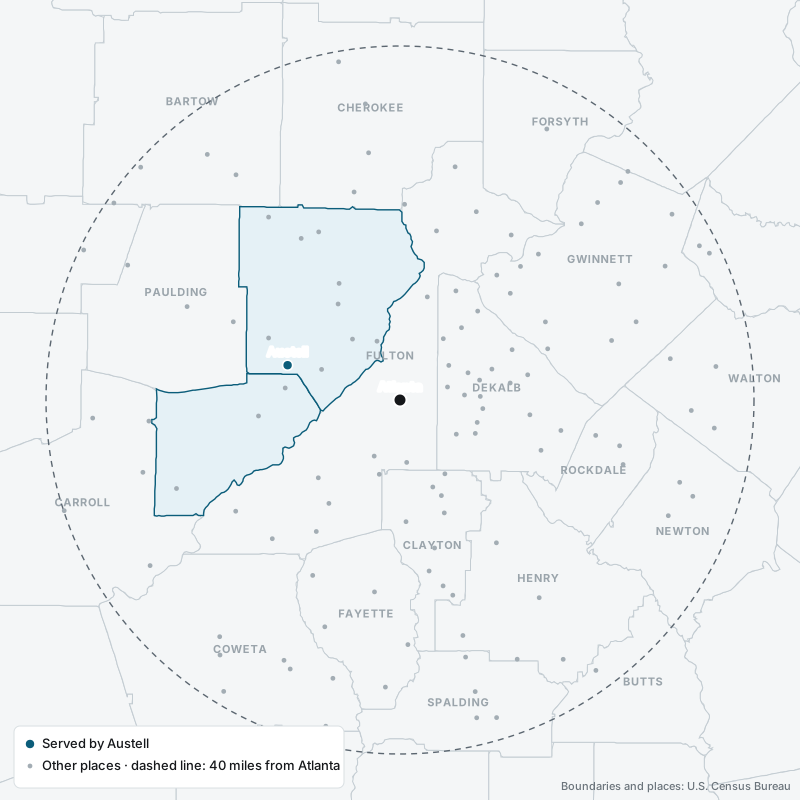
The city's service area doesn't match the city limits. Austell's Water Division page explains that the service areas for both water distribution and wastewater collection are set by contracts between the county water system and the six municipalities. Austell's area is bounded by Clay Road to the north, the Douglas County line to the south, Noses Creek to the west and Buttermilk Creek to the east, and about 63 percent of the system's water customers are inside the city limits (Austell Water Division). The city installs and maintains the water and wastewater lines along major streets, and in new subdivisions the developer builds the lines and then hands them over to the city to maintain (same page).
To be sure you're an Austell sewer customer, look at your utility bill; for account or billing questions the city sends you to City Hall (Austell Sanitary Sewer). If your bill comes from Cobb County Water System instead, see the Cobb County page.
Where your responsibility ends
Austell's code splits the cost of a sewer connection at the property line. The owner pays all costs of connecting the building sewer from the house to the municipal property line and must cover the city for any loss or damage the connection causes. The connection from the property line into the public sewer is made by the city, for a standard tap fee (Austell Code § 46-140(c)).
That section is about building and paying for the connection; it doesn't say in so many words who repairs an old lateral later. Before you pay for work near the street, ask the Sanitary Sewer Division where the city's part begins at your address. Who is responsible for the sewer line compares Austell's property-line split with other Georgia providers. This page is general information, not legal advice; the Sanitary Sewer Division can tell you how the code applies at your address.
The code also sets material rules that matter for repairs. Any part of a building sewer within ten feet of a water service line must be cast iron with leaded joints, and the public works director may require cast iron where tree roots threaten the line (Austell Code § 46-140(f)). If roots are your problem, tree roots in sewer lines explains the repair options.
If sewage backs up
The Sanitary Sewer Division cleans lines with high-pressure water, mechanical rodding and root saws. It uses closed-circuit TV inspection and dye or smoke testing to respond to complaints from citizens, find places where rain and groundwater get into the system, and inspect new construction (Austell Sanitary Sewer).
The city's July 2026 notice on water and sewer emergencies sets out who to call. During business hours, emergency water or sewer breaks go to the Public Works customer service line. Sewer overflows, a sewer smell in the neighborhood, sewage in a public roadway or damaged sewer infrastructure that creates a safety concern go to the city's emergency response crews, and a life-threatening emergency goes to 911. Both city numbers are printed on the notice (Austell emergency notice).
For what to do inside the house while you wait, see what to do in a sewer backup; for coverage questions, see sewer backup insurance in Georgia.
Repairs, permits and inspections
The City of Austell requires a plumbing permit to install, remove, alter or replace any plumbing, gas or drainage pipe work, or any fixture or water heater, and its permits page links the city's online application portal (Austell Permits).
Work on the public side has its own rules. No one may uncover, connect to, alter or disturb a public sewer without a written permit from the public works director, and the trench for a building sewer may not be backfilled until the work has been inspected (Austell Code § 46-140).
Any trench toward the property line, where Austell's tap connection is made, needs a Georgia 811 ticket first: Georgia 811 asks everyone for a free request at least three business days ahead, and state law requires one before digging with machines (Georgia 811; Georgia dig law). Austell's own locating help under that law stops at the right-of-way line.
Grease, wipes and rainwater
Austell's code forbids discharging stormwater, surface water, groundwater, roof runoff, subsurface drainage or cooling water into any sanitary sewer; that water belongs in a storm sewer or another outlet the public works director approves. The same section limits fat, oil and grease in wastewater sent to the public sewer (Austell Code § 46-141). A downspout or yard drain piped into your sewer line is exactly the kind of connection the city's dye and smoke tests are designed to find.
For kitchen grease, wipes and other household habits, see what not to flush or pour.
Septic homes in this area
Inside Austell, a home within 250 feet of a public sanitary sewer that it can drain into by gravity must connect within 60 days of an official notice to do so. Where public sewer isn't available, the building sewer goes to a private system that meets county health department rules, and once sewer becomes available the owner must connect and fill in the old septic tank (Austell Code §§ 46-138 and 46-139).
Georgia's Department of Public Health sends septic record requests and inspections to county environmental health offices (Georgia DPH); for the Cobb side of Austell that is Cobb & Douglas Public Health, which also covers Douglas County (Cobb & Douglas Public Health).
Cities and communities served
The city's sewer serves Austell's service area, which stops at the Douglas County line and also reaches addresses outside the city limits, so the table marks Austell as partly served.
| City or community | Sewer service | Plumbing permits | Local note |
|---|---|---|---|
| Austell | Part of the area | City of Austell Community Development | Austell's water and sewer service area is set by agreement with Cobb County's water system and ends at the Douglas County line; sewage is treated at Cobb's South Cobb plant. |
Next step
Check that your bill comes from the City of Austell. If it does and you're planning sewer work near the street, call the Sanitary Sewer Division first and ask where the city's part of your connection begins.
Provider rules change. Every statement above links to the provider's own page or ordinance as checked in October 2026 — if a source and this page disagree, the source wins. All places within 40 miles of Atlanta and their providers are listed in the metro Atlanta sewer directory.
Sources
- City of Austell Public Works: Sanitary Sewer
- City of Austell Public Works: Water Division
- City of Austell: Emergency Water and Sewer Breaks
- City of Austell: Permits
- Austell Code of Ordinances (Municode): Chapter 46, Article III, Sewers, Division 1, Generally (Secs. 46-136 to 46-145)
- Cobb & Douglas Public Health: Septic Systems
- Georgia Department of Public Health: Onsite Sewage / Septic Systems
- Georgia 811: The 811 Process
- Georgia 811: Georgia Underground Facility Protection Act (O.C.G.A. Title 25, Chapter 9)