Clayton County Sewer and Drain Guide for Homeowners
Sewer provider: Clayton County Water Authority · Clayton County
At a glance
The Clayton County Water Authority (CCWA) runs public sewer for unincorporated Clayton County and all six of its cities. You own and maintain the 4-inch lateral from your house to CCWA's 6-inch line in the right-of-way, and CCWA takes sewer backup reports by phone during and after business hours.
On this page
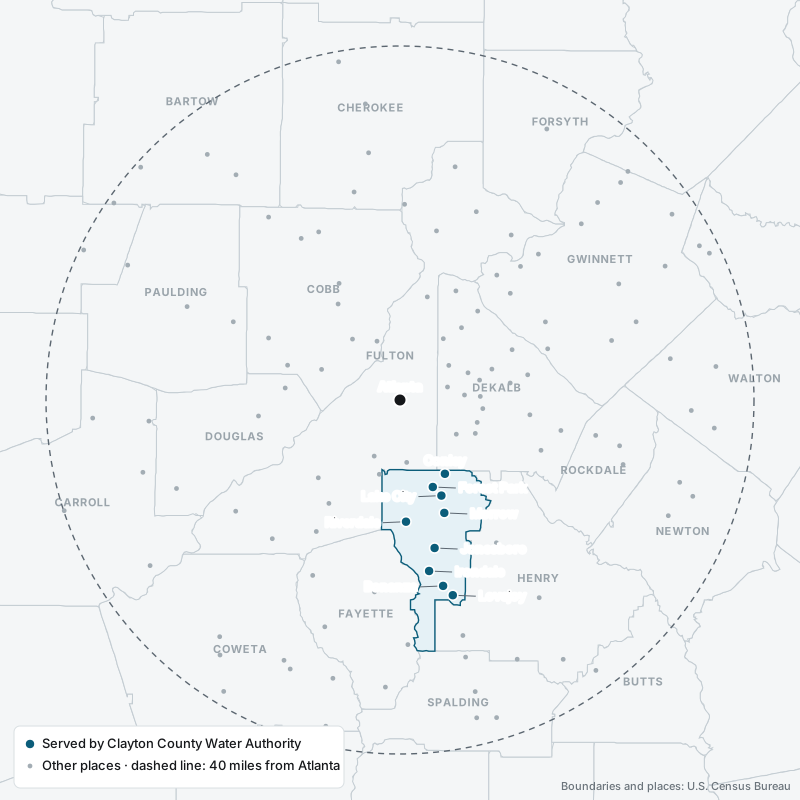
In Clayton County, one authority provides water, sewer and stormwater service throughout the county and its six cities (CCWA). A homeowner in Riverdale and one in Lovejoy deal with the same sewer rules, the same split of responsibility for the pipe under the yard, and the same number to call when a drain backs up.
What does change from town to town is the office that issues your plumbing permit. This page covers the Clayton County Water Authority's own rules and lists the permit office for each city and community below.
Who provides sewer service here
The Clayton County Water Authority (CCWA) was created by the Georgia General Assembly in 1955. It now provides water, sewer and stormwater service to more than 250,000 people throughout the county and its six cities: Forest Park, Jonesboro, Lake City, Lovejoy, Morrow and Riverdale. Clayton County's code puts the construction, operation and maintenance of the sanitary sewer lines under the county's jurisdiction in CCWA's hands (Sec. 98-2), and city pages confirm the arrangement: Lovejoy says its water and sewer service is with CCWA, and Jonesboro sends residents with water or sewer problems to the authority.
Not every home is connected. CCWA's FAQ explains that homes on septic systems are billed for water only, while homes tied into the system are billed for both water and sewer. If your monthly bill shows a sewer charge, you are a CCWA sewer customer.
Where your responsibility ends
CCWA draws the line at the joint between two pipes. According to its sewer backup page, the 4-inch line that carries wastewater from your house is a private lateral: you own it up to the point where it connects to CCWA's system and are responsible for all of its maintenance. The 6-inch line beyond that joint, inside the public right-of-way or an easement issued to CCWA, belongs to the authority, which maintains it. The same page shows a backup that started exactly at that 4-inch-to-6-inch connection.
The county code says the same thing from the owner's side: building sewers and their connections are the landowner's property and responsibility, and CCWA has no duty to maintain them (Sec. 98-5).
CCWA requires a cleanout on every lateral near the right-of-way and may require a second one at the building. Keep it reachable and capped: the authority warns that broken caps let stormwater into the line and can cause an overflow, and replacement caps are sold at home improvement stores (CCWA). The guide to finding your sewer cleanout shows what to look for.
Basement plumbing carries an extra rule. If your lowest fixture, such as a basement toilet or sink, sits below the next upstream manhole, CCWA says you must have a sanitary backflow device on your lateral, and without one you are responsible for damage and cleanup when sewage backs up (CCWA). Backwater valves explained covers how these devices work. This is general information; CCWA or a licensed plumber can tell you how the rules apply at your address.
If sewage backs up
CCWA treats a sewer backup as an emergency to report by phone. Its incident reporting page lists sewer backups alongside main breaks and storm drainage problems, and its contact page says those reports go to the same customer service line after business hours.
Know the limits of the visit. CCWA field staff inspect only from the lateral cleanout to the main and cannot work on private property (CCWA). If the trouble is in your 4-inch lateral, repair or replacement is yours to arrange, and CCWA says cleanup and restoration costs from a private-lateral failure fall on the property owner. For what to do inside the house while you wait, follow the sewer backup procedure.
Repairs, permits and inspections
Plumbing permits come from your city, or from the county if you live outside city limits:
- Forest Park: the city requires permits for plumbing work, and homeowners doing their own work may apply with an affidavit (Forest Park).
- Lake City: since June 2025, building, plumbing and land disturbance permits are applied for through an online portal (Lake City).
- Morrow: the Planning & Economic Development Department takes applications online, and trade submissions need a copy of a current state license (Morrow).
- Riverdale: the Building and Permitting Division permits plumbing, electrical and mechanical work (Riverdale).
- Jonesboro: the city's building permit form says plumbing needs its own separate permit (Jonesboro).
- Lovejoy: permits go through City Hall or the Community Development Department, and plans need CCWA approval before the city issues them (Lovejoy).
- Conley, Irondale, Bonanza and other unincorporated areas: the county's building permit section issues plumbing permits for remodels, repairs and new construction (Clayton County).
New connections also involve CCWA. Under Sec. 98-5, connecting a building sewer takes a CCWA permit, the connection and testing happen under the county building inspector's supervision, and service does not start until fees are paid and the inspector approves the work. Before anyone digs, Georgia 811 asks everyone to call at least three business days ahead (Georgia 811); the law requires it before digging with machines (dig law).
Grease, wipes and rainwater
CCWA's grease page says fats, oils and grease stick to pipes both on your property and in the street, and that a garbage disposal only shreds solids without keeping grease out. Its advice is to let cooking grease cool, pour it into a metal can and put the can in the trash. For leftover turkey-fryer oil, it suggests reusing or recycling it, or soaking it up with sawdust, sand or unscented cat litter, never a scented or disinfectant litter, which can react with the oil and start a fire.
On flushing, CCWA's list is short: human waste and toilet paper only. It warns that many products labeled flushable do not break down, and it names baby wipes, cotton swabs, latex gloves and cleaning sponges among the items to keep out.
Rainwater has to stay out too. Sec. 98-5 bars connecting roof downspouts, foundation drains, areaway drains or any other source of surface runoff or groundwater to a building sewer that drains to the public sewer unless CCWA approves it. A cracked cleanout cap does the same damage, so replace one as soon as you notice it.
Septic homes in this area
Septic systems remain in parts of the county, and CCWA bills those homes for water only (FAQ). Clayton's code requires a health officer's permit to build, repair or enlarge a septic tank, an inspection before the system is covered, and at least 25,000 square feet of lot for a system that uses a soil absorption field. When public sewer becomes reasonably available, the owner must connect within 30 days of notice and clean out and fill the old tank (Sec. 98-2).
Septic permits and records are kept by the county environmental health office, which the Department of Public Health lists at 1117 Battle Creek Road in Jonesboro (DPH). If you are unsure which system you have, see septic or sewer: how to tell.
Claims and reimbursement
CCWA's incident reporting form is for property damage caused during CCWA work, such as broken pipes, landscaping or driveway damage, and for injuries involving CCWA vehicles or equipment. CCWA does not publish a reimbursement process for backups, and its backup page places the cost of damage from a private-lateral failure, or from a backup into a home that lacked a required backflow device, on the owner. For coverage questions, see sewer backup insurance in Georgia.
Cities and communities served
CCWA serves all six Clayton County cities and the unincorporated communities of Conley, Irondale and Bonanza. Septic homes in any of them are water-only customers; the table lists the permit office for each place.
| City or community | Sewer service | Plumbing permits | Local note |
|---|---|---|---|
| Forest Park | Yes | City of Forest Park Planning and Community Development | Plumbing work needs a city permit; homeowners doing their own work can apply with an affidavit. |
| Lake City | Yes | City of Lake City (online permit portal) | Since June 2025, building, plumbing and land disturbance permits are applied for online. |
| Morrow | Yes | City of Morrow Planning & Economic Development | Trade permit submissions need a copy of a current state license; CCWA's headquarters is in Morrow. |
| Riverdale | Yes | City of Riverdale Building and Permitting Division | Plumbing, electrical and mechanical work need city permits, applied for online. |
| Jonesboro | Yes | City of Jonesboro (City Hall building permits) | The city refers water and sewer problems to CCWA; plumbing needs its own city permit. |
| Lovejoy | Yes | City of Lovejoy Community Development | Building plans need CCWA approval before the city issues its permit. |
| Conley | Yes | Clayton County Building Permits (Community & Economic Development) | Unincorporated; the 2020 Census places the whole Conley CDP in Clayton County. |
| Irondale | Yes | Clayton County Building Permits (Community & Economic Development) | Unincorporated; homes on septic get water-only CCWA bills. |
| Bonanza | Yes | Clayton County Building Permits (Community & Economic Development) | Unincorporated; septic permits and records are with the county environmental health office. |
Next step
Find your lateral cleanout near the street and check that its cap is intact. If your lowest drain sits below the next manhole uphill on your street, ask a licensed plumber whether your lateral has the backflow device CCWA requires.
Provider rules change. Every statement above links to the provider's own page or ordinance as checked in October 2026 — if a source and this page disagree, the source wins. All places within 40 miles of Atlanta and their providers are listed in the metro Atlanta sewer directory.
Sources
- Clayton County Water Authority: Preventing Costly Sewer Backups
- Clayton County Water Authority: Who We Are
- Clayton County Water Authority: Frequently Asked Questions
- Clayton County Water Authority: Contact Us
- Clayton County Water Authority: Incident Reporting Request
- Clayton County Water Authority: Proper Disposal of F.O.G. (Fats, Oils, and Grease)
- Clayton County Water Authority: It's A Toilet, Not A Trash Can (What Not to Flush)
- Clayton County Code of Ordinances (Municode): Sec. 98-5. Building sewers and connections
- Clayton County Code of Ordinances (Municode): Sec. 98-2. Sewer construction and service
- Clayton County Community & Economic Development: Building Permits
- Georgia Department of Public Health: County Environmental Health Offices
- Georgia 811: The 811 Process