DeKalb County Sewer and Drain Guide for Homeowners
Sewer provider: DeKalb County Department of Watershed Management · DeKalb County
At a glance
DeKalb County's Department of Watershed Management owns the public sewer in unincorporated DeKalb and in its cities, including Decatur, Brookhaven and Dunwoody. County code makes you responsible for the sewer connection on your property, while the county maintains the part in county street rights-of-way and sewer easements. Report a backup to the department's 24-hour emergency line or its online form.
On this page
In the DeKalb cities and unincorporated communities on this page, the sewer under your street belongs to the county, not to your city. That means DeKalb's code and crews, not your city hall, decide where your part of the line ends and who clears a blockage near the street. Your city still issues the plumbing permit for work on your own pipes.
What follows comes from county and city sources checked in October 2026.
Who provides sewer service here
The DeKalb County Department of Watershed Management (DWM) provides water and sewer service to more than 775,000 residents, maintains about 5,200 miles of water and sewer pipe, and treats wastewater at its Pole Bridge and Snapfinger plants. Decatur tells residents its water and sewer issues are handled by DeKalb County (City of Decatur). Brookhaven and Avondale Estates both say the county owns the sewer pipes and the service laterals under their streets, and that city crews have no authority to repair them (Brookhaven; Avondale Estates).
To confirm you are a DWM sewer customer, check your county water and sewer bill. DWM applies no sewer charges to customers who have septic tanks, so a bill without a sewer charge suggests your home is on septic (Services & Billing); the guide to telling septic from sewer lists other checks. The county's sewer work runs under a Clean Water Act consent decree with the U.S. EPA and Georgia EPD (Consent Decree).
Where your responsibility ends
DeKalb's code splits the connection at the edge of public space. The property owner maintains and repairs the building sewer connection on private property, and the county maintains and repairs it within county street rights-of-way and sanitary sewer easements (Code § 25-220). The county's sewer article also has its own definition of the building drain, which runs to a point 10 feet outside the inner face of the building before the building sewer begins (Code § 25-146).
In practice, the property-line cleanout marks the split. The county's sewer overflow response plan (October 2018 revision, posted with its consent decree documents) defines a private sewer line as the pipe from the property-line cleanout to the building, and says that if no property-line cleanout exists, the entire line from the building to the county main is treated as private (response plan).
The same plan covers the lower lateral, the stretch from the right-of-way cleanout to the main. If that pipe or its cleanout is 4 inches or smaller, the owner must bring it up to the county's 6-inch minimum. If there is no right-of-way cleanout or other access, the owner is told to have a plumber install one to code and stays responsible for clearing the private lateral. The plan's template notice to owners adds that when a backup into a building came from a blockage that originated in that building, between the property-line cleanout and the main, the owner pays the related repairs unless a defect turns up in a county-maintained line (response plan, sections 2.3.1.4 and 3.1.5).
Every building needs its own building sewer, with a narrow exception for a rear building on the same lot (Code § 25-212). For what cleanouts look like, see where to find your sewer cleanout; for how DeKalb compares with other Georgia providers, see who is responsible for your sewer line. This page is general information, not legal advice; DWM, a licensed plumber or an attorney can tell you how the rules apply to your property.
If sewage backs up
DWM lists its hours as 24 hours a day, seven days a week (DWM), and its Services & Billing page lists a 24-hour emergency line and an email address for reporting sewer backups, water main breaks and outages (Services & Billing). For problems that can wait, the department has an online form for water and sewer repairs; Brookhaven, which recommends it, says DWM replies by email with a work order number you can use to track the repair (Brookhaven).
The 2018 response plan describes what happens next. A first-response crew decides whether the overflow comes from county pipes or private property, inspects the nearby county main and, where a cleanout is available, may rod the service line to the main. If a county line is blocked, the county handles it. If nothing is wrong in the county system, the problem is classed as private, the owner is advised to hire a plumber, and an owner without a property-line cleanout gets a letter about the code requirement. When a county maintenance problem in the lower lateral causes a building backup that needs professional cleaning, dispatch coordinates the county's contracted cleanup vendors (response plan, section 2.3).
For what to do inside the house while you wait, see what to do when sewage backs up.
Repairs, permits and inspections
In unincorporated DeKalb, the county's Planning & Sustainability Department issues permits and inspects the work, and a plumbing permit must be submitted by a licensed plumbing contractor (permits page). The county's owner-occupant affidavit, which lets homeowners act as their own builder, says plumbing permits still require a state-licensed contractor (affidavit). Inspections are requested through the county's e-permitting portal (permits page).
Inside a city, the county says primary permitting is handled by the city's own permitting office, not the county (permits page). Decatur requires a separate trade permit for any sewer, drainage or plumbing work regardless of cost, plus a pre-application meeting with the city arborist if the work would disturb a protected tree's root zone (Decatur). Tucker lists sewer line replacement among jobs that need a plumbing permit (Tucker), and Brookhaven requires permits for emergency work within 24 hours after it starts (Brookhaven). The table below links each city's office.
Work on the county's own pipes needs DWM's permission: no unauthorized person may uncover, connect to or disturb a public sanitary sewer without a written permit from the department (Code § 25-252). Before anyone digs, Georgia 811 asks for a dig ticket at least three business days ahead, and state law requires one before digging with mechanized equipment; the sewer utility must help mark laterals up to the edge of the public right-of-way (Georgia 811; O.C.G.A. Title 25, Ch. 9). To vet a plumber, see how to hire a drain cleaning company in Georgia.
Grease, wipes and rainwater
DWM's household grease advice: pour cooled fats, oils and grease into a sealed container for the trash, scrape plates and cookware before washing, and wipe greasy pans with a paper towel (Customer Outreach Programs). Its commercial program inspects restaurant grease interceptors (Commercial FOG Program), and its 2025 consent decree report says staff handed out grease education at apartment complexes and neighborhoods near sewer spills (2025 annual report). After an overflow from an apartment complex's private sewer line, county code can require the owner to get a grease permit, clean the lines with camera verification and educate residents (Code § 25-265.22).
County code bars connecting roof downspouts, exterior foundation drains, area drains or other surface runoff to a building drain or building sewer, and existing connections must be removed when the building sewer joins the public system (Code § 25-218). Rain is a real strain here: the county's 2025 report attributes 2024's jump in overflows to more heavy rain events and the inflow and infiltration they caused, and traces many wet-weather overflows to capacity limits in large trunk sewers (2025 annual report). For household habits, see what not to flush or pour and why drains back up when it rains.
Septic homes in this area
DeKalb Public Health's septic program must permit a new septic system, a new drain line or a repair before a contractor does the work, requires DPH-certified contractors for installing, repairing and pumping systems, and may hold a copy of your system's installation inspection report (DeKalb Public Health).
County code requires owners on a street with a public sewer to connect, at their own expense, within 24 months of official notice when the sewer is within 100 feet of the property line (Code § 25-154). Neighborhoods that want sewer have a cost-sharing route: five or more owners in the same drainage basin and within a quarter mile can ask DWM for a feasibility study, and if owners of at least 51 percent of the property in the designated area petition, the county can create a special tax district to build the line (Code § 25-187).
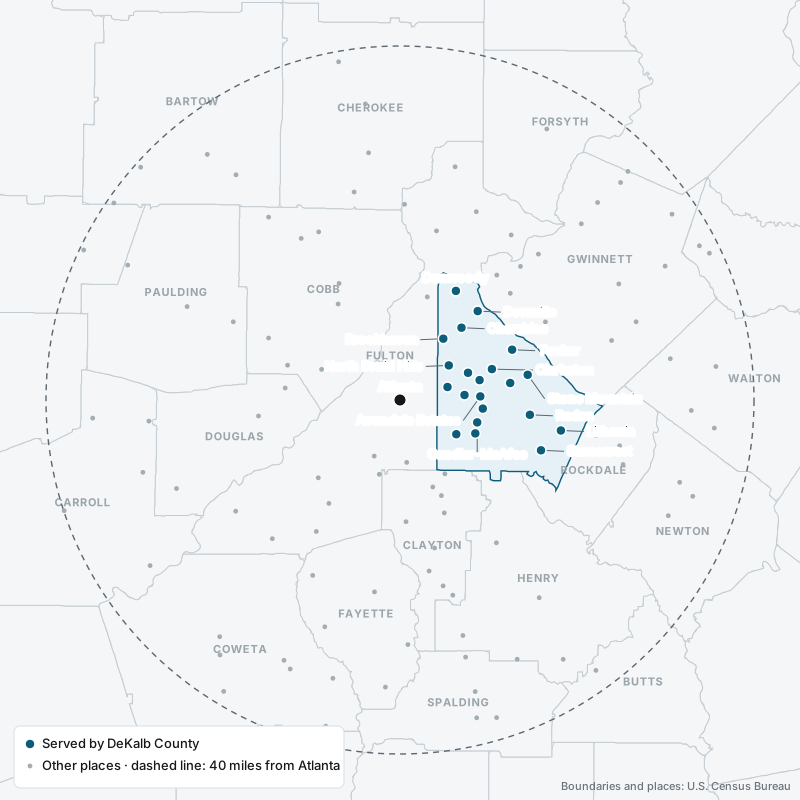
Cities and communities served
The table lists the places in this guide's coverage area that rely on DWM for public sewer, with each one's permit office. Other areas are in the local directory.
| City or community | Sewer service | Plumbing permits | Local note |
|---|---|---|---|
| Decatur | Yes | City of Decatur Design, Environment and Construction Division | City says DeKalb County handles its water and sewer issues; separate trade permits are required for any sewer, drainage or plumbing work regardless of value. |
| Brookhaven | Yes | City of Brookhaven Community Development (Building Permits) | City says DeKalb Watershed owns the sewer lines and service laterals under its streets; city permits for emergency work are due within 24 hours after work starts. |
| Avondale Estates | Yes | City of Avondale Estates Planning & Permitting | City says DeKalb Watershed owns the water and sewer lines, including service laterals, under nearly every city street, and the city cannot repair them. |
| Chamblee | Yes | City of Chamblee Planning and Development Department | City code follows DeKalb County standards for new sewer construction; plumbing work is filed as a component permit through the city's online portal. |
| Clarkston | Yes | City of Clarkston Community Development (Permits and Inspections) | City says its water and sewer are managed by DeKalb County; plumbing repairs that alter piping need a city permit. |
| Pine Lake | Yes | City of Pine Lake | City public works coordinates with DeKalb Watershed, and building plan review can require a DeKalb Watershed capacity approval letter. |
| Doraville | Yes | City of Doraville Community Development | City says water service is set up directly with DeKalb Watershed, using the county's water and sewer service application; city permits require an owner affidavit. |
| Dunwoody | Yes | City of Dunwoody Community Development (Permits & Inspections) | City's trouble-call guide sends sewer spills to DeKalb's water and sewer emergency line; stand-alone plumbing repairs use a single trade component permit. |
| Tucker | Yes | City of Tucker Building and Permitting Division | City lists sewer line replacement among jobs needing a plumbing permit; its code has plats show easements for county-maintained sewer lines. |
| Stone Mountain | Yes | City of Stone Mountain Building Department | City directs water and sewer emergencies and questions to DeKalb Watershed Management; contact City Hall before starting work that needs trade permits. |
| Stonecrest | Yes | City of Stonecrest Building and Permitting Division | City says DeKalb owns and maintains sewer lines in public rights-of-way and dedicated easements, and homeowners maintain service lines on their property. |
| Lithonia | Yes | City of Lithonia Building and Permitting Division | City's utilities page names DeKalb County for all water service; confirm sewer service at your address with DeKalb Watershed. |
| Druid Hills | Yes | DeKalb County Planning & Sustainability Department | — |
| North Druid Hills | Yes | DeKalb County Planning & Sustainability Department | — |
| Gresham Park | Yes | DeKalb County Planning & Sustainability Department | — |
| North Decatur | Yes | DeKalb County Planning & Sustainability Department | — |
| Candler-McAfee | Yes | DeKalb County Planning & Sustainability Department | — |
| Panthersville | Yes | DeKalb County Planning & Sustainability Department | — |
| Scottdale | Yes | DeKalb County Planning & Sustainability Department | — |
| Belvedere Park | Yes | DeKalb County Planning & Sustainability Department | — |
| Redan | Yes | DeKalb County Planning & Sustainability Department | — |
Next step
Find your property-line cleanout now, before you need it. If you can't find one, ask DWM where your responsibility ends at your address, and ask a licensed plumber about adding a cleanout, since the county's response plan uses that cleanout to divide your pipe from the public one.
Provider rules change. Every statement above links to the provider's own page or ordinance as checked in October 2026 — if a source and this page disagree, the source wins. All places within 40 miles of Atlanta and their providers are listed in the metro Atlanta sewer directory.
Sources
- DeKalb County Department of Watershed Management: Watershed Management
- DeKalb County Department of Watershed Management: Services & Billing
- DeKalb County Code of Ordinances (Municode): Sec. 25-220. Maintenance and repair responsibility for building sewer service connections to public sanitary sewer system
- DeKalb County Code of Ordinances (Municode): Sec. 25-218. Connection of surface runoff and groundwater sources to public sewer
- DeKalb County Department of Watershed Management: Sanitary Sewer Overflow Contingency and Emergency Response Plan (October 2018)
- DeKalb County: Consent Decree Annual Report No. 14 (2025)
- DeKalb County Department of Watershed Management: Customer Outreach Programs
- DeKalb County Department of Planning & Sustainability: Permits, Plan Review & Inspections
- DeKalb Public Health: Septic Systems
- DeKalb County Code of Ordinances (Municode): Sec. 25-187. Submission of pre-petition request; submission of petition; creation of a special tax district
- City of Brookhaven: DMW Water & Sewer in Brookhaven
- City of Decatur: Public Works FAQs