Gwinnett County Sewer and Drain Guide for Homeowners
Sewer provider: Gwinnett County Department of Water Resources · Gwinnett County
At a glance
Gwinnett County's Department of Water Resources runs the public sewer in unincorporated Gwinnett and most of its cities, though Buford and Loganville run their own systems. You maintain your private lateral up to the edge of the right-of-way or sewer easement, and the county maintains the short stub from there to the main. In a backup, call the department's 24-hour dispatch center before paying anyone to dig near the street.
On this page
Gwinnett County's Department of Water Resources (DWR) publishes more detail than most Georgia sewer providers: a written procedure for backups, a rule for who maintains which part of the lateral, and a claim process for plumber bills. If your home is on the county sewer, those documents decide who pays when the line near the street fails.
This page sums them up for homeowners and renters and lists the permit office for each city. The statewide picture is in the guide to who is responsible for the sewer line in Georgia.
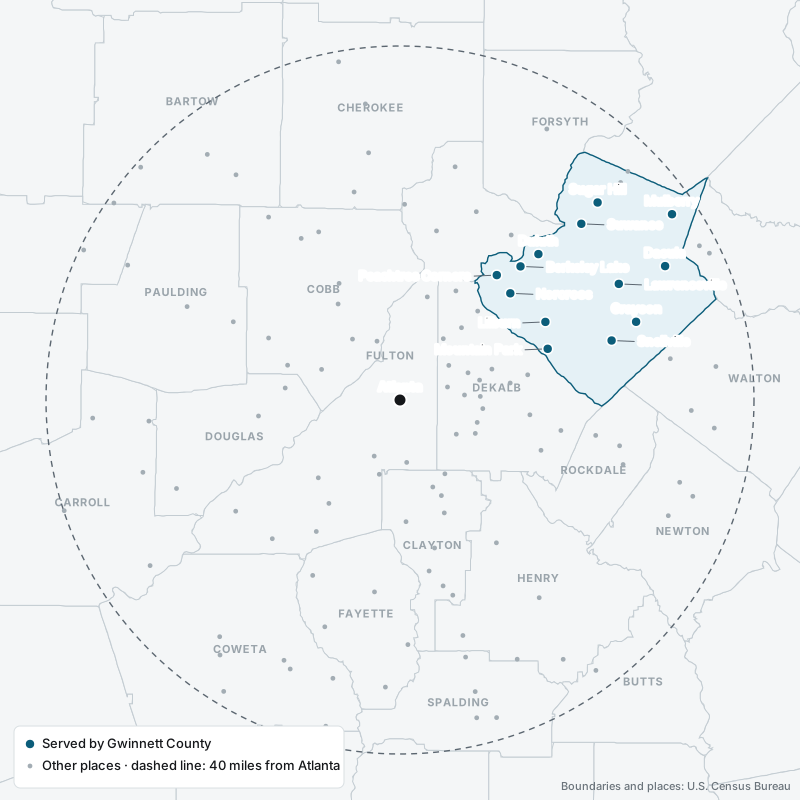
Who provides sewer service here
DWR's sewer system carries wastewater from more than 180,000 homes and businesses through about 3,000 miles of pipe and roughly 200 pump stations to three county treatment plants (DWR wastewater page). The department maintains the sewer mains and the short "service stubs" that connect each main to a customer's own pipe (DWR standard procedure).
Not every Gwinnett address uses this system. The City of Buford runs its own sewer department (see the Buford page), Loganville's city sewer serves areas inside its limits (see the Loganville page), and Auburn's sewer comes through Barrow County (see the Barrow County page). DWR also notes that, according to the Georgia Department of Public Health, about 30 percent of Gwinnett residents use septic systems (DWR septic page).
The quickest check is your county water bill. DWR says a sewer-use charge on the bill means you are on the public sewer, while a sewer amount of zero most likely means a septic system (DWR septic page).
Where your responsibility ends
DWR's homeowner page says the private lateral runs to the edge of the right-of-way and that owners maintain the whole lateral, including its connection to the public sewer (Sewer Lateral page). The written procedure is more precise: you maintain all plumbing inside the house and the lateral to the limits of the right-of-way or sewer easement, and if the joint between your 4-inch pipe and the county's 6-inch stub lies outside that line, the joint is yours too (DWR standard procedure).
County standards call for a capped cleanout on the lateral at the right-of-way. DWR maintains that cleanout, while any cleanout closer to the house belongs to the owner (Sewer Lateral page), and county crews can work only through a cleanout in the right-of-way or an easement (DWR standard procedure). The guide to finding your sewer cleanout shows what to look for.
The county code requires every sewer user to keep building sewers and laterals in good repair so groundwater and rainwater stay out, and failure can bring enforcement, including fines. The same section bars permanent structures in county sewer easements and says the county won't replace landscaping it removes to reach its pipes (Gwinnett Code § 106-96).
If your lowest fixture, such as a basement toilet, sits below the next upstream manhole, DWR says Georgia's plumbing code requires a backwater valve that the homeowner maintains, and the county won't pay for backup damage from the main where a required valve is missing (Sewer Lateral page). See backwater valves explained.
If sewage backs up
DWR's dispatch center takes reports of sewer backups, spills and overflowing manholes 24 hours a day, 365 days a year, and asks residents to call right away (Report a Problem). The procedure treats every report as an emergency and recommends stopping heavy water use, such as the washing machine, dishwasher and showers, until the line is clear (DWR standard procedure). Cleanup and safety steps inside the house are in the sewer backup guide.
Under the same procedure, the investigator:
- Checks the flow in the manholes upstream and downstream of the property. A blocked main is cleared with a hydrojet, and a camera inspection of the main may follow within a few days.
- Looks into the right-of-way cleanout. A dry stub with sewage still backing up indoors puts the blockage on the owner's side, and county staff do no further work. A backed-up stub is jetted, or dug up and repaired if jetting fails.
- If there is no right-of-way cleanout and the cause can't be found another way, installs one at county expense at the owner's request, usually within two to five business days. DWR restores only grass cover and doesn't replace trees, shrubs or landscaping.
DWR says more than 70 percent of reported backups have historically been in the private part of the lateral, most often roots at the joint between the 4-inch and 6-inch pipes. It doesn't recommend plumbers, and plumbers hired by owners may not dig into the right-of-way (DWR standard procedure).
Repairs, permits and inspections
In unincorporated Gwinnett, the Department of Planning and Development issues plumbing and other trade permits and schedules inspections through its online ZIP Portal. A homeowner can get a permit for work on their own property with proof of ownership and a signed property-owner-as-contractor affidavit (Building Services). That includes unincorporated communities such as Mountain Park; each city in the table below runs its own permit office.
Mulberry is a special case. Since January 1, 2025, and pending litigation over the city's charter, the city handles building and trade permits, while the county still provides plan review and inspections for water and sewer work (Planning and Development notice).
Before anyone digs, Georgia 811 asks for a locate ticket at least three business days ahead (Georgia 811), and the state dig law requires one before excavating with mechanized equipment. Under the same law, the sewer utility helps locate laterals only up to the edge of the public right-of-way (Georgia Dig Law). For repair methods and choosing a contractor, see sewer line repair options and how to hire a drain cleaning company.
Grease, wipes and rainwater
DWR says most grease-related overflows happen on residential lines, that a clog on your property is yours to clear, and that a large spill can also bring a fine (DWR grease page). It tells residents to put fats and cooled grease in the trash and notes that a garbage disposal doesn't make grease safe for the drain. Restaurants and other food businesses fall under a separate county grease program.
The county code bans stormwater, groundwater, roof runoff, swimming pool drainage and condensate from the sanitary sewer unless DWR's director authorizes it (Gwinnett Code § 106-126). DWR treats a roof drain tied into a lateral as a source of inflow, uses cameras and smoke testing to find defects, and notifies owners when a test finds one on their property (Sewer Lateral page). Everyday habits are covered in what not to flush or pour.
Septic homes in this area
DWR sends septic owners to the county's environmental health office, which keeps records for systems installed since 1959, and the county's GIS Data Browser may show a septic sketch and past repair permits. Owners who have their tank pumped can earn a 10 percent stormwater utility fee credit each year for five years (DWR septic page). If a public sewer is within 200 feet of the home, the county code requires connection within 90 days of official notice (Gwinnett Code § 106-96). For upkeep, see septic tank pumping in Georgia.
Claims and reimbursement
If your plumber finds that the blockage was entirely in the county-maintained stub, DWR will submit a claim for the plumber's charges on your behalf to the county's Risk Management office, which decides responsibility. DWR staff must see the excavated lateral before it is repaired, so call DWR and allow at least two to three hours for staff to arrive (DWR standard procedure). The procedure lists what a claim needs: the incident address, owner and resident contact details, date and time, a short statement, a description of the damage, copies of bills and any photos.
The procedure also sets limits. A plumber-installed right-of-way cleanout isn't reimbursed unless DWR agreed in advance, payment may be capped at customary local costs, and if the home's lowest finished floor is below the upstream manhole rim, a damage claim must show a working backflow device. This is general information, not legal advice; insurance questions are covered in sewer backup insurance in Georgia.
Cities and communities served
The table lists the places in this area whose public sewer is the county system and who issues plumbing permits in each. Rest Haven's provider couldn't be confirmed; the local directory lists it with the other nearby cities and communities.
| City or community | Sewer service | Plumbing permits | Local note |
|---|---|---|---|
| Norcross | Yes | City of Norcross Building Official (Community Development) | Norcross provides electric service and contracts for trash pickup; its service-setup page links residents to Gwinnett County Water Resources. |
| Peachtree Corners | Yes | City of Peachtree Corners Building Division | The city names Gwinnett DWR as its water and sewer provider; its Building Division applies the 2024 codes, including plumbing, to applications submitted since January 1, 2026. |
| Lilburn | Yes | City of Lilburn Business Services Department | Lilburn says Gwinnett County supports its sewer, water and stormwater services; plumbing subcontractors file an affidavit before work and at least 24 hours before requesting an inspection. |
| Berkeley Lake | Part of the area | City of Berkeley Lake (City Hall; contracted building inspector) | Many homes use septic; a city ordinance requires owners to have septic systems inspected and pumped at least every five years and send proof to the city. |
| Duluth | Yes | City of Duluth Community Development & Engineering Department | Duluth's FAQ sends water and sewer emergencies to Gwinnett DWR and septic questions to Gwinnett County Environmental Health; the county inspects water and sewer work. |
| Snellville | Yes | City of Snellville Planning & Development (City Building Inspector) | Snellville asks for Gwinnett DWR water and sewer tap receipts with commercial building permits; plumbing subcontractors file affidavits with copies of their business and state licenses. |
| Lawrenceville | Yes | City of Lawrenceville Planning & Development Department | Lawrenceville agreed in 2020 to sell its water system to Gwinnett County and adopted the county's water and sewer ordinances; connecting to a public sewer needs a Gwinnett permit. |
| Grayson | Yes | City of Grayson (City Hall online permit portal) | Grayson lists Gwinnett County as its water utility; HVAC, electrical and plumbing permits are filed through the city's online permit portal. |
| Suwanee | Yes | City of Suwanee Planning Services, Inspections & Zoning | Suwanee requires permits for plumbing changes, including water heater replacement, and lists the 2024 plumbing code with Georgia amendments among its adopted codes. |
| Sugar Hill | Yes | City of Sugar Hill Building Services (Planning & Development) | Sugar Hill's code describes the sanitary sewer as operated by Gwinnett County; city inspection requests received by 2 p.m. are scheduled for the next business day. |
| Dacula | Yes | City of Dacula Planning and Development Department | Dacula lists Gwinnett County Public Utilities for water and sewer and issues permits, including for plumbing work, only inside the city limits. |
| Mulberry | Yes | City of Mulberry Planning & Development Department | Since January 1, 2025, Mulberry issues building and trade permits, while Gwinnett County reviews and inspects water and sewer work; the county cites pending charter litigation. |
| Mountain Park | Yes | Gwinnett County Department of Planning and Development | Unincorporated Gwinnett community, not the Fulton County city of the same name; the county issues permits, and a zero sewer charge on the county water bill likely means septic. |
Next step
Find your right-of-way cleanout now, near the street or the edge of the yard, and make sure its cap is intact. If your lateral has none, write that down: in a backup, DWR can install one at county expense when it needs one to locate the blockage.
Provider rules change. Every statement above links to the provider's own page or ordinance as checked in October 2026 — if a source and this page disagree, the source wins. All places within 40 miles of Atlanta and their providers are listed in the metro Atlanta sewer directory.
Sources
- Gwinnett County Department of Water Resources: Standard Procedure for Clearing Sanitary Sewer Back-ups and Overflows
- Gwinnett County Department of Water Resources: Sewer Lateral
- Gwinnett County Department of Water Resources: Report a Problem
- Gwinnett County Department of Water Resources: Wastewater
- Gwinnett County Department of Water Resources: Septic Tanks
- Gwinnett County Department of Water Resources: Fats, Oil, and Grease (FOG)
- Gwinnett County Code of Ordinances (Municode): Sec. 106-96. Use of public sewers and maintenance of private sewer lines
- Gwinnett County Code of Ordinances (Municode): Sec. 106-126. General sewer use requirements
- Gwinnett County Department of Planning and Development: Building Services
- Gwinnett County Department of Planning and Development: News and Notices (City of Mulberry Letter of Intent)
- Georgia 811: The 811 Process
- Georgia 811: Georgia Dig Law