Cherokee County Sewer and Drain Guide for Homeowners
Sewer provider: Cherokee County Water and Sewerage Authority (CCWSA) · Cherokee County
At a glance
The Cherokee County Water and Sewerage Authority (CCWSA) provides public sewer in parts of Cherokee County, including Holly Springs and areas next to Woodstock, while Canton and Woodstock run their own systems. Its specifications have it maintain laterals up to the right-of-way, but a CCWSA customer article treats the whole service line as private, so ask CCWSA before anyone digs.
On this page
In Cherokee County, public sewer can come from the Cherokee County Water and Sewerage Authority (CCWSA) or, in and around Canton and Woodstock, from city systems. CCWSA supplies drinking water across much of the county, but its sewer reaches far fewer people. It says it provides drinking water to more than 190,000 residents and wastewater service to more than 27,000 (CCWSA), so a CCWSA water bill doesn't by itself mean your home is on CCWSA sewer.
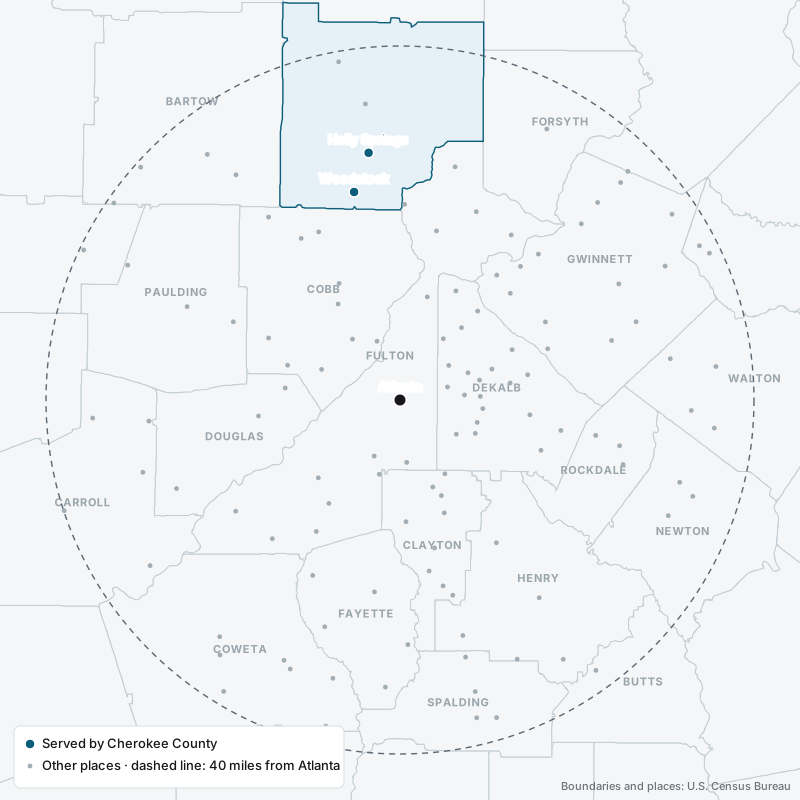
Who provides sewer service here
CCWSA was created by the Georgia Legislature in 1955 to provide drinking water and sanitary sewer service in Cherokee County. It is a not-for-profit public authority that is not part of county government and receives no tax money from the county or its cities; customer charges pay for operations. Its wastewater goes to three plants: Rose Creek off Wyngate Parkway in the south of the county, Fitzgerald Creek off West Wiley Bridge Road in the southeast, and Riverbend off East Cherokee Drive in the north (CCWSA).
CCWSA's sewer reaches into Holly Springs. The environmental reports CCWSA gives its board record overflows on its lines there, such as one at Holly Drive off Palm Street in 2019 (CCWSA board minutes, October 2019). Around Woodstock, the city and CCWSA divide service by map: the City of Woodstock signed a service delivery agreement with CCWSA in January 2000 that adopted a water and sewer service area boundaries map, and the two have revised it several times since (CCWSA board minutes, December 2019). Homes on the city's side are covered on the Woodstock page, and Canton's system has its own Canton page.
To confirm your provider, check whether your monthly bill from CCWSA includes sewer charges or only water.
Where your responsibility ends
CCWSA's sewer specifications, revised May 18, 2026, say the authority maintains sewer mains and sewer laterals up to the county, city or state right-of-way, or to the edge of an easement dedicated to CCWSA. Where a main runs through a private ingress-egress easement or a blanket utility easement, or where a building sits right at the right-of-way line, CCWSA maintains mains and laterals from back of curb to back of curb (CCWSA Sewer Specifications, S317).
The same section has each new service end in a 6-inch cleanout at the right-of-way or easement line and bars any structure, including porches, fences, retaining walls and signs, within five feet of a sewer cleanout. Plumbers may connect only to the end of the service stub provided for the lot (S317).
A customer article on CCWSA's website, "Water & Sewer Boundaries," describes the line differently. It calls the connection of the service line to the sewer main the boundary, and says the service line from the house to that connection is private property that the owner must fix (CCWSA). Because the two documents don't say the same thing, ask CCWSA which rule it applies at your address before you pay anyone to dig toward the street. The same article warns against opening a cleanout to let sewage drain onto the ground and calls a private-line problem "definitely a plumber call."
For how other Georgia providers split the line, see who is responsible for the sewer line. This page is general information, not legal advice, and only CCWSA can confirm where its maintenance ends at your address.
If sewage backs up
CCWSA's FAQ gives its customer service number for calls between 8 a.m. and 5 p.m. and a separate number for after-hours calls (CCWSA FAQs). The same FAQ says full-time crews maintain and inspect the sewer collection system, that CCWSA has a portable sewer camera to look inside a main and a water-jet unit for clearing stoppages such as grease, and that it reports every spill, whatever the volume, to Georgia's Environmental Protection Division.
If the problem turns out to be in the private part of your line, the boundaries article above says that is the owner's job. While you sort out whose side the problem is on, what to do in a sewer backup covers safety inside the house, and sewer backup insurance in Georgia covers who pays for damage.
Repairs, permits and inspections
In unincorporated Cherokee County, the county's Development Service Center issues trade "service permits" for plumbing, electrical and HVAC work, and only to state-licensed technicians. A permit must be issued before work starts; in an emergency, such as a water heater failing at night, the work may be done first, but a permit must be obtained as soon as possible and the job must pass a final inspection (Cherokee County Service Permits). Holly Springs, Canton and Woodstock issue their own permits; the table below names the office.
Because CCWSA's maintenance edge is the right-of-way or easement line, digging near it starts with Georgia 811, which asks for a free locate request at least three business days ahead; state law requires the request before digging with mechanized equipment, and it limits CCWSA's locating help to laterals up to the edge of the public right-of-way (Georgia 811; Georgia dig law). How to hire a drain cleaning company in Georgia covers license checks for the plumber you bring in.
Grease, wipes and rainwater
CCWSA's sewer use regulations prohibit sending stormwater, surface water, groundwater, roof runoff, subsurface drainage, swimming pool drainage or condensate into its system unless the authority specifically allows it (CCWSA Sewer Use Regulations, § 2.A.2). Its design rules likewise require separate sanitary sewers that exclude rainwater from roofs and groundwater from foundation drains (S302).
On grease, CCWSA's FAQ says its grease management program targets restaurants and other businesses that use a lot of grease, while homeowners pouring cooking oil down the drain are harder to regulate, so it relies on public education (CCWSA FAQs). What not to flush or pour covers grease disposal and why "flushable" wipes clog lines.
Septic homes in this area
Homes outside the sewer service areas rely on septic systems. The North Georgia Health District's county environmental health offices evaluate properties for septic permits and advise homeowners on their systems (NGHD Environmental Health); Cherokee County Environmental Health is on Bluffs Parkway in Canton (NGHD locations). To find out which system your home has, see septic or sewer: how to tell; for upkeep, see septic tank pumping in Georgia.
Cities and communities served
Two places in this directory get CCWSA sewer in at least part of their area: Holly Springs, and the parts of the Woodstock area on CCWSA's side of the boundary map. Canton and the rest of Woodstock are served by city systems, and for Waleska a public sewer provider couldn't be confirmed.
| City or community | Sewer service | Plumbing permits | Local note |
|---|---|---|---|
| Holly Springs | Part of the area | City of Holly Springs Community Development | CCWSA operates sewer lines in Holly Springs; its board minutes record overflows there. Check your bill to confirm your home is on CCWSA sewer. |
| Woodstock | Part of the area | City of Woodstock Building & Safety Division | Woodstock and CCWSA split water and sewer service areas under a boundary map first adopted in 2000; check which one bills you for sewer. |
Next step
If your sewer bill comes from CCWSA and a plumber says the problem is near the street, ask CCWSA in writing where its maintenance ends at your address: at the right-of-way or easement line, as its specifications say, or at the main.
Provider rules change. Every statement above links to the provider's own page or ordinance as checked in October 2026 — if a source and this page disagree, the source wins. All places within 40 miles of Atlanta and their providers are listed in the metro Atlanta sewer directory.
Sources
- Cherokee County Water and Sewerage Authority: Our Mission
- Cherokee County Water and Sewerage Authority: Sewer Specifications (revised May 18, 2026)
- Cherokee County Water and Sewerage Authority: Water & Sewer Boundaries
- Cherokee County Water and Sewerage Authority: FAQs
- Cherokee County Water and Sewerage Authority: Sewer Use Regulations and Grease Trap Program (revised April 30, 2018)
- Cherokee County Water and Sewerage Authority: Board Meeting Minutes, December 12, 2019
- Cherokee County Water and Sewerage Authority: Board Meeting Minutes, October 28, 2019
- Cherokee County Development Service Center: Service Permits
- North Georgia Health District: Environmental Health Services
- North Georgia Health District: Cherokee County locations (Cherokee County Environmental Health)
- Georgia 811: The 811 Process
- Georgia 811: Georgia Underground Facility Protection Act (O.C.G.A. Title 25, Chapter 9)