Douglas County Sewer and Drain Guide for Homeowners
Sewer provider: Douglasville-Douglas County Water and Sewer Authority · Douglas County
At a glance
The Douglasville-Douglas County Water and Sewer Authority (WSA) provides public sewer in Douglasville and unincorporated Douglas County, though many homes it supplies with water use septic tanks. Its rules make you responsible for your entire sewer lateral, even under the street. In a backup, WSA will check the public main free of charge, at any hour.
On this page
In most of Douglas County, the sewer pipe between your house and the street is yours to repair wherever it runs, and many homes aren't on the public sewer at all (WSA rules; WSA 2025 report).
Who provides sewer service here
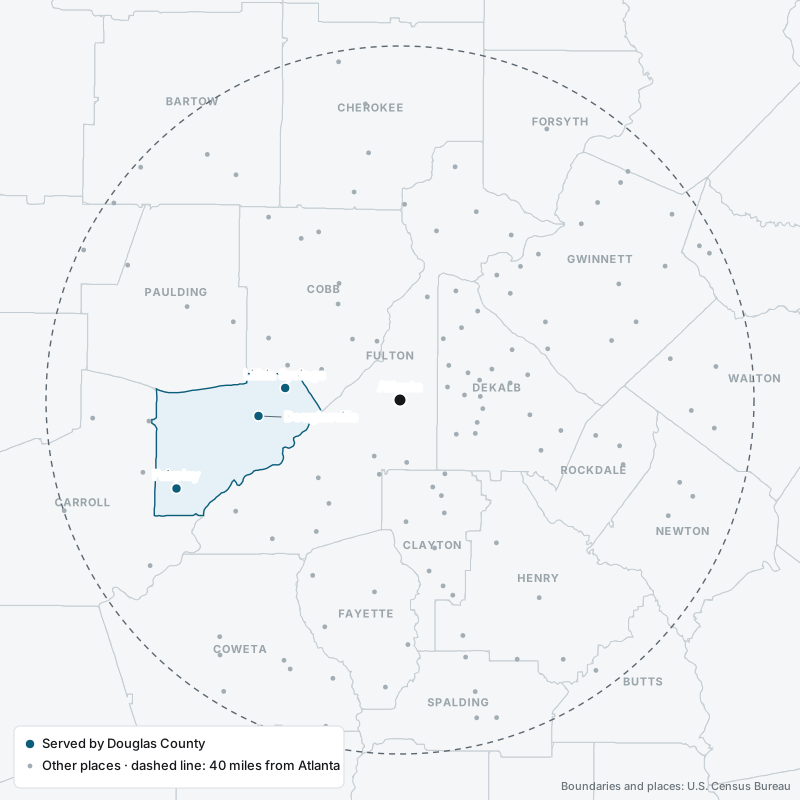
The Douglasville-Douglas County Water and Sewer Authority (WSA) defines its service area to include all property in the City of Douglasville and the unincorporated county, which takes in Lithia Springs and Fairplay (WSA Rule 3-2). Its 2025 annual financial report says it provides water, sewer and stormwater services to the county except the cities of Villa Rica and Austell (WSA 2025 report).
Being a WSA water customer doesn't mean you're on WSA sewer. The same report counts 20,165 residential sewer connections against 43,789 residential water connections in fiscal 2025, and WSA's new-service packet describes homes with water service only as homes on septic (new-service packet).
To check, look at your bill: sewer customers pay a monthly sewer base rate plus a treatment charge per thousand gallons (WSA FAQ). If you're thinking of connecting, WSA's Engineering Department gives written verification of whether sewer is available at your address (WSA).
Where your responsibility ends
WSA's rules put the dividing line at the public main. The authority repairs mains in public streets, dedicated rights-of-way and its own easements, while repairs to all private service laterals, regardless of location, are made by and at the expense of the owner (Rule 3-12). WSA's handout on sewer repairs spells it out: your lateral runs from the house to its connection with the public main, including the part beneath the sidewalk and street (WSA handout). The same rule bills the owner or tenant for WSA's costs when a private line is poorly maintained or not promptly repaired.
A few other rules shape the boundary:
- The building drain ends three feet outside the building's outside wall, where the private lateral begins (Rule 3-2).
- A new service is installed by WSA or its approved agent, at the applicant's expense, from the main to the edge of the property line (Rule 3-10).
- Lines installed before April 1, 1986 that serve separately owned properties outside a public right-of-way or easement may be treated as private (Rules 1-9 and 3-9).
- Each service lateral may serve only one dwelling, sewer cleanouts must sit outside driveways, and laterals at the right-of-way or easement line must be at least two feet below the finished floor they serve (Design and Construction Standards).
WSA's rate rules include a charge, $50 as of October 2026, to repair or replace a customer's sewer cleanout cap, which may be added to the sewer bill (Rule 4-2).
If sewage backs up
When it isn't obvious whether a backup comes from your lateral or the public main, WSA's handout tells you to call WSA, which takes these calls 24 hours a day and will inspect the public main free of charge (WSA handout). If the main is blocked, WSA repairs it as soon as possible; if it's clear, WSA tells you the blockage is probably in your lateral, which is then yours to fix. Never open manholes or other WSA structures yourself; the handout reserves that to WSA staff.
WSA's Report a Problem page adds that a plumber should be able to tell whether a backup's cause is on your side or WSA's (WSA). During business hours, Monday through Friday from 7:30 a.m. to 5:30 p.m., problems go to customer service; after hours and on weekends, WSA's Dispatch Office takes emergencies only, and problems can also be reported by email (Customer Services).
If your plumber finds the problem under the street and can't clear it, WSA decides whether the line must be dug up there, and it makes that repair only under certain circumstances (WSA handout). WSA's rules also limit its liability: it isn't liable for damage from causes outside its direct control, including sewer backflow (Rule 1-5), or for sewage that enters a building through the lateral when the floor sits lower than WSA's minimum elevation standards (Rule 3-15) (rules). The sewer backup guide covers the steps inside the house; sewer backup insurance in Georgia explains what a policy may pay.
Repairs, permits and inspections
Plumbing permits come from your local government, not WSA. Inside Douglasville, the city's Community Development Building Division inspects building and development throughout the city (City of Douglasville) and takes plumbing permit applications for plumbing installations or alterations (plumbing permit application). In unincorporated areas such as Lithia Springs and Fairplay, Douglas County's Building Permits and Inspections office, part of Development Services, requires plumbing permits for any new or renovation work (Douglas County). County code issues plumbing permits only to state-licensed master plumbers, except that a homeowner may get permits for work on their own primary single-family home (Sec. 6-12).
WSA has its own requirements. Connecting a building to a public sewer takes a WSA sewer permit (Rule 3-17), WSA inspects and approves connections to its system (Rule 1-17), private laterals must meet state and local building and plumbing codes (Rule 3-14), and an old lateral can serve a new building only after examination and testing (Rule 3-13) (rules). Contractors working on WSA infrastructure must be on its approved contractor list (WSA), and Douglas County's utility engineer handles permits for utility construction in county right-of-way (Douglas County).
Before anyone digs, Georgia 811 asks for a free locate request at least three business days ahead, and state law requires one before digging with powered equipment (Georgia 811; law). Georgia 811 treats the sewer line between a house and the public system as a private line that needs a private locator (Georgia 811).
Grease, wipes and rainwater
WSA bans clear water from the sewer. Its rules prohibit discharging stormwater, surface water, groundwater, roof runoff or subsurface drainage to a public sewer (Rule 3-19), and a property with a foundation drain, downspout drain or yard drain tied into the sewer gets written notice and 30 days to fix it, followed by penalties that rise each month and can be added to the water bill, with water service subject to shutoff (Rule 4-11) (rules). WSA looks for such connections with smoke testing, and each property gets a door hanger or letter at least 24 hours ahead (smoke testing notice).
Grease traps are required for kitchens in food establishments but not in single-family homes (Rule 3-22). For households, a regional flyer linked from WSA's Story of Water page calls fats, oils and grease the number one cause of sewer blockages in metro Atlanta and warns that residents may be held liable for damage and cleanup from a backup they cause (FOG Facts). WSA's 2026 water quality report says not to flush any wipes or sanitary products (2026 report). The what not to flush guide has the longer list.
Septic homes in this area
Septic permits in Douglas County come from Cobb & Douglas Public Health, which requires a permit before any installation, repair or change to a septic system (Cobb & Douglas Public Health). A repair permit application needs a letter from the water and sewer provider stating that public sewer isn't available (repair requirements), and septic records are requested through the district's online form (records request). Douglas County's permit guide says interior remodels and basement finishes start with the Building Department alone unless the home is on septic and the project adds a bedroom (permit guide).
WSA's rules tie septic to the public system. A water customer on septic agrees to connect within six months of notice once the tank needs repair and public sewer is available (Rule 1-19), and buildings built after October 1, 1988 within 500 feet of a public sewer must connect at the owner's expense (Rule 3-19). In the Dog River drainage basin, WSA may inspect septic systems, order repairs within 60 days and bill for them or shut off water (Rule 3-16), and homes built there since October 1, 1991 must have tanks pumped at least every five years (Rule 2-20) (rules).
The county's 2023 Lithia Springs plan says that community lacks sewer in a number of places, especially north of Veterans Memorial Highway and in the western part just north of I-20 (Lithia Springs Small Area Plan). See septic or sewer: how to tell.
Cities and communities served
WSA's sewer area covers Douglasville and unincorporated Douglas County, including Lithia Springs and Fairplay. Villa Rica, which straddles the Douglas-Carroll county line, has its own utilities department; see the Villa Rica guide.
| City or community | Sewer service | Plumbing permits | Local note |
|---|---|---|---|
| Douglasville | Yes | City of Douglasville Community Development, Building Division | The water and sewer authority makes owners responsible for the whole lateral, even under the street, and checks the public main free of charge, 24 hours a day. |
| Lithia Springs | Part of the area | Douglas County Development Services, Building Permits and Inspections | Douglas County's 2023 small area plan says Lithia Springs lacks sewer in a number of areas, especially north of Veterans Memorial Highway and the western part just north of I-20. |
| Fairplay | Part of the area | Douglas County Development Services, Building Permits and Inspections | Inside the water and sewer authority's service area, but sewer may not reach every street; ask its Engineering Department for written confirmation that sewer is available. |
Next step
Before paying anyone to dig near the street, call WSA and ask it to check the public main. The check is free, and the answer tells you whose side the blockage is on.
Provider rules change. Every statement above links to the provider's own page or ordinance as checked in October 2026 — if a source and this page disagree, the source wins. All places within 40 miles of Atlanta and their providers are listed in the metro Atlanta sewer directory.
Sources
- Douglasville-Douglas County Water and Sewer Authority: Rules and Regulations, effective January 1, 2026
- Douglasville-Douglas County Water and Sewer Authority: Sanitary Sewer Repairs - Information for the property owner
- Douglasville-Douglas County Water and Sewer Authority: Report a Problem
- Douglasville-Douglas County Water and Sewer Authority: Customer Services
- Douglasville-Douglas County Water and Sewer Authority: Annual Comprehensive Financial Report, fiscal year 2025
- Douglasville-Douglas County Water and Sewer Authority: Design and Construction Standards, effective January 1, 2026
- Douglas County, Georgia: Building Permits & Inspections
- Douglas County Code of Ordinances (Municode): Sec. 6-12. Construction industry board license required for issuance of certain permits
- Cobb & Douglas Public Health: Information for Homeowners (septic systems)
- Cobb & Douglas Public Health: Douglas County Onsite Sewage Repair or Modification Requirements
- Douglas County, Georgia: Lithia Springs Small Area Plan (2023)
- Georgia 811: Have My Lines Been Marked?