Griffin Sewer and Drain Guide for Homeowners
Sewer provider: City of Griffin Water & Wastewater · Spalding County
At a glance
The City of Griffin owns three wastewater treatment plants and the sewer system serving Griffin and some neighboring parts of Spalding County. City code makes owners maintain the building sewer up to the point of acceptance and requires a backwater valve in all new construction; most of the county outside Griffin is on septic.
On this page
Griffin treats its wastewater at three city plants, and its sewers have been extended past the city limits into some neighboring parts of Spalding County. Most of the county outside the city, though, still relies on septic tanks, according to the city-county wastewater plan cited below.
Griffin's code also has a rule worth knowing before you build or remodel: every new building must have a backwater valve, and the city does not accept liability for backup damage where a valve was required. The city web pages cited here are archived copies from May 2026, so confirm current contacts with the city.
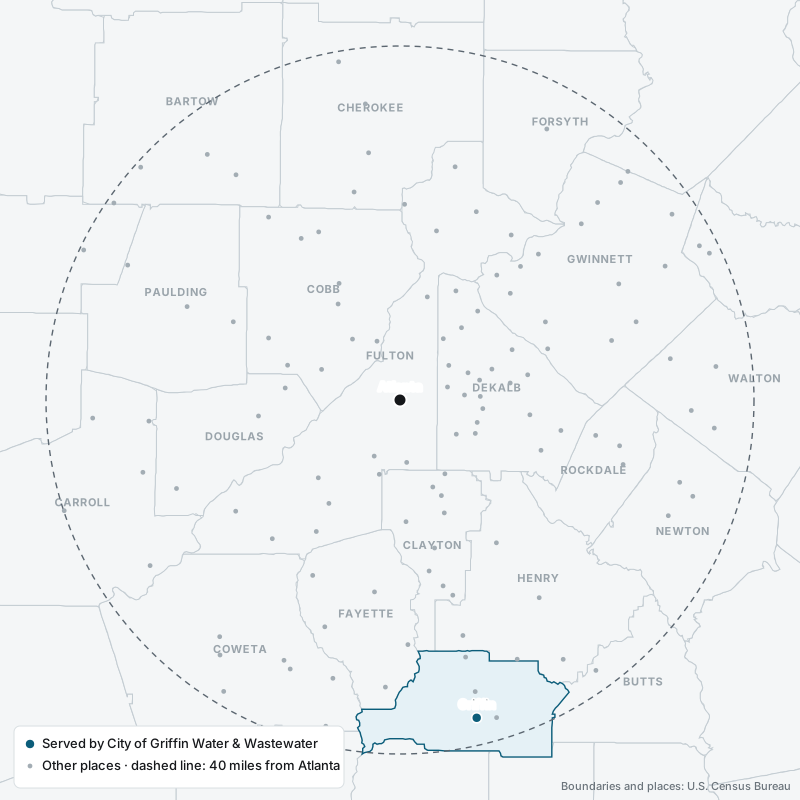
Who provides sewer service here
The City of Griffin owns and operates two drinking water plants, two reservoirs and three water pollution control plants, along with pump stations and the water distribution and wastewater collection systems (Water & Wastewater). The Wastewater page divides the city by plant: Cabin Creek serves north Griffin, Potato Creek the south side, and Shoal Creek, working with the Blanton Mill land application site, the west side of Griffin and parts of Spalding County.
The city-county wastewater plan describes the reach of those pipes. Areas inside Griffin are already sewered with only a few exceptions where lines were not economically feasible, the system has been extended outside the city where there was no other viable option, and most areas outside Griffin have no sewer access and rely on septic systems (Wastewater Management Plan).
Griffin bills as a combined utility, so the whole bill must be paid to keep any one service (Customer Service FAQ). Outside the city, your water may belong to the Spalding County Water Authority even though maintenance and billing are handled by Griffin under contract (SCWA); a sewer charge on the bill is what shows a sewer connection.
Where your responsibility ends
Griffin's code defines the boundary in its definition of a building sewer: proper maintenance of the service line is the owner's responsibility from the building drain to the "point of acceptance," and from that point the lateral becomes the city's responsibility as it continues to the sewer trunk line (Sec. 94-32). Another section adds that owners must keep the service lateral in working order, and if it lets in groundwater or rainwater, the director can order a repair or replacement, add a surcharge for treating that extra water, or require disconnection (Sec. 94-39).
Read together, those sections make the exact point of acceptance the key question at your address, so ask the city's water and wastewater office where it is before paying for digging. The same section requires a backwater valve in all new construction, lets the director order one for an existing home after a backup, and says the city does not accept legal responsibility for backup damage where a valve was required or ordered; owners maintain their valves, and any lift pumps. For how these valves work and how to maintain one, see backwater valves explained. None of this is legal advice; it is general information to check against the city's answer for your property.
If sewage backs up
The city's water and wastewater office lists a separate line for reporting leaks alongside its main number, with weekday office hours (Water & Wastewater). If only your house is affected, the problem may be on your side of the point of acceptance, so a licensed plumber is the next call; if neighbors share the problem or a manhole is overflowing, report it to the city. The sewer backup procedure covers what to do inside the house.
Repairs, permits and inspections
Griffin's Permits & Inspections office issues construction permits on weekdays. Trade permits for all plumbing work must be obtained by licensed contractors, and the city specifies that repairing or installing water lines and sewer tie-ins or repairs also require a trade permit by a licensed contractor. Homeowners may pull building permits for work they do themselves, with an affidavit, but sewer work falls under the trade permit rule. The city's inspectors coordinate with utility providers to clear connections.
Connections to the public sewer need the director's written approval, based on a permit application and fees, and no work may be covered until it is inspected (Sec. 94-39). Before any digging, Georgia 811 asks everyone to allow at least three business days for a locate request (Georgia 811); state law requires the request before excavation with machines (dig law).
Grease, wipes and rainwater
Roof downspouts, foundation drains, yard drains and other sources of surface runoff may not be connected to the building sewer or service lateral (Sec. 94-39). Griffin's list of prohibited discharges also names swimming pool drainage and condensate alongside stormwater, groundwater and roof runoff, unless the director authorizes them (Sec. 94-56).
The same list bars wastewater hotter than 104 degrees Fahrenheit, wastewater heavy with fats, oils or grease, and solids that can obstruct the flow. For draining a pool or keeping grease and wipes out of the line at home, ask the city first and see what not to flush or pour.
Septic homes in this area
Inside the city sewer service area, buildings that can reach public sewer must connect before a certificate of occupancy is issued; where they cannot, the city issues no permit or certificate until the county board of health has issued a septic permit (Sec. 94-35). Once sewer becomes accessible, a failed septic system cannot be repaired and the home must connect (Sec. 94-37). Septic permits and records for Spalding County are kept by the county environmental health office in Griffin (DPH).
Cities and communities served
The city system serves Griffin and some adjacent unincorporated areas. For East Griffin, Experiment and Sunny Side, check your bill or ask Spalding County; the directory lists what is known for each.
| City or community | Sewer service | Plumbing permits | Local note |
|---|---|---|---|
| Griffin | Yes | City of Griffin Permits & Inspections (Planning & Development) | Sewer tie-ins and sewer repairs need a trade permit pulled by a licensed contractor. |
Next step
If you are building or remodeling in Griffin, put a backwater valve on the plumber's checklist and ask the city where the point of acceptance is for your lot.
Provider rules change. Every statement above links to the provider's own page or ordinance as checked in October 2026 — if a source and this page disagree, the source wins. All places within 40 miles of Atlanta and their providers are listed in the metro Atlanta sewer directory.
Sources
- City of Griffin (archived May 15, 2026): Water & Wastewater
- City of Griffin (archived May 15, 2026): Wastewater
- City of Griffin (archived May 15, 2026): Permits & Inspections
- City of Griffin (archived May 15, 2026): Customer Service FAQ
- City of Griffin (archived May 15, 2026): Griffin/Spalding County Wastewater Management Plan 2020-2040 (proposed)
- Griffin Code of Ordinances (Municode): Sec. 94-32. Definitions
- Griffin Code of Ordinances (Municode): Sec. 94-39. Technical specifications for sewer connections
- Griffin Code of Ordinances (Municode): Sec. 94-35. Connection to public water and wastewater systems required
- Griffin Code of Ordinances (Municode): Sec. 94-56. Prohibited discharges
- Spalding County Water Authority: FAQs
- Georgia Department of Public Health: County Environmental Health Offices
- Georgia 811: The 811 Process