Jackson, GA Sewer Line and Drain Guide for Homeowners
Sewer provider: City of Jackson Water & Sewer Department · Butts County
At a glance
The City of Jackson provides water and sewer service to about 2,175 customers and runs three state-permitted wastewater plants. Its code makes building sewers and their connections, up to the city's collector line, the property and responsibility of the landowner, with no city maintenance. All plumbing is subject to city inspection, and plumbers' self-inspection does not apply in Jackson.
On this page
Jackson, in Butts County, runs its own water and sewer system and its own wastewater plants. Its sewer code is short on customer-service detail but very direct on the question homeowners care about most: whose pipe is it?
This page covers what the City of Jackson publishes for households: the size of the system, the landowner rule, permits and inspections, extending sewer to a property, what the sewer can't take, and septic.
Who provides sewer service here
The City of Jackson's Water & Sewer department provides water and sewer service to 2,175 customers and maintains 26 miles of water lines, three storage tanks and 36 miles of sewer lines (Water & Sewer). A separate wastewater treatment division operates three state-permitted treatment plants and tests daily so the discharged water is safe for aquatic life downstream (Wastewater Treatment).
If your city utility bill includes sewer, you are on this system. Bringing sewer to a property that lacks it follows the city's process for obtaining service, described in the septic section below.
Where your responsibility ends
Jackson's code is clear: all building sewers and connections, up to the city's collector line, are the responsibility and property of the landowner. The city owns neither the building sewer nor the connection and is not responsible for maintaining them (Jackson code, Sec. 66-91).
As written, that covers the whole run from your house to the collector line, wherever that line sits. The owner also bears the costs and expenses of installing the building sewer and indemnifies the city (Sec. 66-78). Other Georgia providers draw that line in other places; who is responsible for the sewer line lays out the differences.
If sewage backs up
Because the city's maintenance starts at its collector line, a blockage in your building sewer is your plumber's job under Sec. 66-91. If sewage is coming out of a manhole, or several homes on the street back up at once, the collector line may be the cause; the city's Water & Sewer page links to its staff directory for contacting the department (Water & Sewer).
Main sewer line clog signs helps tell a house-line clog from a main-line problem, and what to do in a sewer backup covers safety and cleanup.
Repairs, permits and inspections
Jackson's permit documents, including a building permit and a trade permit, are submitted by email to the city (Licenses / Permits). The Building Department's trade permit form covers electrical, mechanical, plumbing and gas, and HVAC work; it states that separate permits are required for electrical, plumbing and mechanical work and that a permit becomes void if work doesn't start within six months or stops for six months (Trade Permit Application). The Building Division takes inspection requests online, weekdays from 8 a.m. to 5 p.m., and requests made by 4:30 p.m. are scheduled for the next business day (Building Division).
The code adds three sewer-specific rules. State law's option for master plumbers and utility contractors to self-inspect water and sewer projects does not apply in Jackson (Sec. 66-1). Anyone installing sewer connections for hire must get a city permit before cutting a street, sidewalk or other public property, and plumbers must post a bond holding the city harmless for right-of-way work. And all building sewers and connections must be inspected and approved, with fees paid, before wastewater can flow to a city sewer (Secs. 66-90, 66-92 and 66-94).
Georgia 811 asks for a free locate ticket at least three business days ahead of any digging (Georgia 811); the dig law requires the ticket before excavating with machinery, and a sewer owner's locating help covers laterals only up to the edge of the public right-of-way (Georgia dig law).
Grease, wipes and rainwater
No stormwater, groundwater, roof runoff or subsurface drainage may go into Jackson's sewer, and roof downspouts, exterior foundation drains and area drains may not be connected to a building drain or building sewer; existing connections must be removed, at no cost to the city, when a building sewer is hooked up (Sec. 66-136).
The code also bans solids that can block sewers, from rags and plastics to paper cups, whether whole or ground, and limits ground garbage to pieces no larger than half an inch (Sec. 66-138). Under Sec. 66-144, the city may require businesses to install grease, oil and sand interceptors, but homes are exempt. The everyday habits behind those rules are listed in what not to flush or pour.
Septic homes in this area
Septic tank and portable toilet contents may not be dumped into Jackson's wastewater system (Sec. 66-151). An owner who wants sewer brought to a property must give the city a survey plat and a letter describing the property's intended use, then hire a contractor, at the owner's expense, to build the needed sewer lines to the nearest city facility with capacity, to city specifications and with city inspection before the lines are covered (Secs. 66-171 to 66-173).
Butts County Environmental Health is at 463 Ernest Biles Drive, Suite A, in Jackson, open weekdays from 8 a.m. to 5 p.m. with a lunch closing, and its forms include residential septic and septic repair permit applications (District 4 Public Health). Pumping schedules and warning signs are covered in septic tank pumping in Georgia.
Cities and communities served
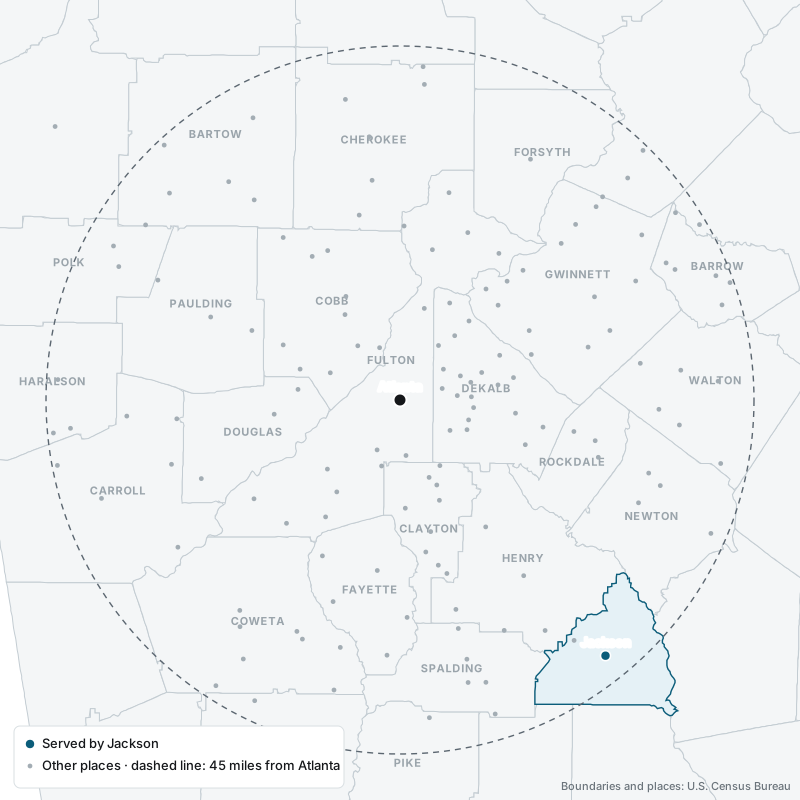
Among the places in this directory, only Jackson is on this system; other Butts County entries are in the local directory.
| City or community | Sewer service | Plumbing permits | Local note |
|---|---|---|---|
| Jackson | Yes | City of Jackson Building Department | City code makes building sewers and their connections, up to the city's collector line, the landowner's property and responsibility. |
Next step
Before buying or renovating a home in Jackson, have a plumber camera the building sewer all the way to the city's collector line, since the code makes that entire run the landowner's to maintain.
Provider rules change. Every statement above links to the provider's own page or ordinance as checked in October 2026 — if a source and this page disagree, the source wins. All places within 45 miles of Atlanta, plus Rome and their providers are listed in the metro Atlanta sewer directory.
Sources
- City of Jackson: Water & Sewer
- City of Jackson: Wastewater Treatment
- City of Jackson: Building Division
- City of Jackson: Licenses / Permits
- City of Jackson Building Department: Trade Permit Application
- City of Jackson (Municode): Code of Ordinances, Chapter 66, Article I: Utilities in General (Sec. 66-1)
- City of Jackson (Municode): Code of Ordinances, Chapter 66, Article II: Sewer Use
- District 4 Public Health, Georgia Department of Public Health: Butts County Health Department and Environmental Health
- Georgia 811: The 811 Process
- Georgia 811: Georgia Dig Law (O.C.G.A. Title 25, Chapter 9)