Woodstock Sewer and Drain Guide for Homeowners
Sewer provider: City of Woodstock Water and Sewer Utility · Cherokee County
At a glance
The City of Woodstock's Water and Sewer Utility serves about 8,700 customers and treats sewage at its own Rubes Creek plant; some areas around the city are in CCWSA's service area instead. City code puts the cost of building and connecting the building sewer on the owner, and sewer emergencies go to the utility's business-hours or after-hours line.
On this page
Woodstock is one of the Cherokee County cities that collect and treat their own sewage. Its Water and Sewer Utility runs the pipes, the billing office and the Rubes Creek treatment plant, while the Cherokee County Water and Sewerage Authority (CCWSA) serves areas on the other side of an agreed boundary. Which side of that line your home sits on decides whose rules apply.
Who provides sewer service here
Woodstock combined its water and sewer crews and its billing office into a single Water and Sewer Utility in 2012, overseen by the Public Works Department. Its maintenance division keeps up the pump stations, water lines and sewer lines (Woodstock Water & Sewer). The Utility Billing Office provides water and sewer customer service and billing for about 8,700 residential and commercial customers (Woodstock Utility Billing).
Sewage goes to the city's Rubes Creek Water Reclamation Facility, which runs around the clock and uses membrane filtration. The plant treats about 1 million gallons a day on average and is designed for up to 2.5 million, and a 2025 membrane upgrade raised its nitrogen removal above 99 percent (Woodstock Wastewater Treatment Plant).
The city's sewer stops at defined edges. City code says it is not Woodstock's policy to provide sewer to unincorporated areas, even ones next to the city limits (Woodstock Code § 44-124(h)). Woodstock and CCWSA also adopted a water and sewer service area boundaries map with their January 2000 service delivery agreement and have revised it several times since (CCWSA board minutes, December 2019). The utility's page links a "Do I live in the city" map; your bill shows which provider you actually have. If it's CCWSA, see the Cherokee County page.
Where your responsibility ends
On the water side, Woodstock spells out the split: the city maintains the water mains, meters and service lines from the main to the meter, and the owner is responsible for the line from the meter to the building and for any leaks inside (Woodstock Troubleshooting).
The sewer side is less explicit. City code defines the building sewer, the owner's pipe, as the extension from the building drain to the public sewer, and it puts all costs of installing and connecting the building sewer on the owner, who must also cover the city for any loss or damage the installation causes (Woodstock Code §§ 44-121, 44-126(c)). The code doesn't say who repairs the stretch under the street, so ask the Water and Sewer Utility before you hire anyone to dig there. Who is responsible for the sewer line shows how other Georgia providers handle that stretch. This page is general information, not legal advice; the utility can tell you how the code applies to your connection.
If sewage backs up
The Water and Sewer Utility page lists one number to call during business hours and another after hours for a water outage, a leak or a sewer-related emergency (Woodstock Water & Sewer). City utility and permit offices close at 4 p.m. on weekdays, so use the after-hours line in the evening.
Until a crew arrives, what to do in a sewer backup explains how to protect people and pets inside, and sewer backup insurance in Georgia covers damage questions.
Repairs, permits and inspections
Woodstock's Building & Safety Division, part of Community Development, handles plan review, building safety and code enforcement in the city. It issues electrical, mechanical, plumbing and gas permits the same day the application comes in, as long as the required documents are attached, and each application includes a unit count schedule used to calculate the fee (Woodstock Building & Safety).
Sewer connections need city sign-off. No one may uncover, connect to, alter or disturb a public sewer without a written permit from the city, and a building sewer trench may not be backfilled until the work has been inspected and approved. The permit holder must tell the city when the building sewer is ready, and the connection and testing take place under the inspection of a city representative (Woodstock Code § 44-126).
Because the city inspects building sewer trenches before backfill, plan the dig ticket as well: Georgia 811 asks for a free locate request at least three business days ahead, and state law requires one before mechanized digging (Georgia 811; Georgia dig law). Woodstock's locating duty under that law ends at the edge of the public right-of-way.
Grease, wipes and rainwater
Woodstock's code bars connecting roof downspouts, foundation drains, areaway drains or other surface runoff or groundwater to a building sewer that drains to a public sanitary sewer, and it forbids sending stormwater, groundwater, roof runoff, subsurface drainage or cooling water into any sanitary sewer. If a house sewer lets groundwater or rainwater in, the city may require the owner to repair it, charge a higher sewer rate that reflects the extra treatment cost, or require the house to disconnect from the city system (Woodstock Code §§ 44-126, 44-127).
The city's grease control program is aimed at food service businesses; the code says grease interceptors aren't required for private living quarters or dwelling units (Woodstock Code § 44-128). At home, keep grease and wipes out of the drain; what not to flush or pour explains why.
Septic homes in this area
Woodstock's code makes septic tanks the exception. Owners of buildings on a street with a city sewer must connect within 120 days of official notice when the sewer is within 100 feet of the property line and reachable by gravity, unless an agreement to defer has been reached. Where no sewer is available, a septic system approved by the health officer may be used, and a home already on city water that has been told to connect is billed for sewer whether or not the connection is made (Woodstock Code § 44-124).
For septic permits, site evaluations and homeowner questions, the North Georgia Health District runs county environmental health offices (NGHD Environmental Health); Cherokee County's office is on Bluffs Parkway in Canton (NGHD locations).
Cities and communities served
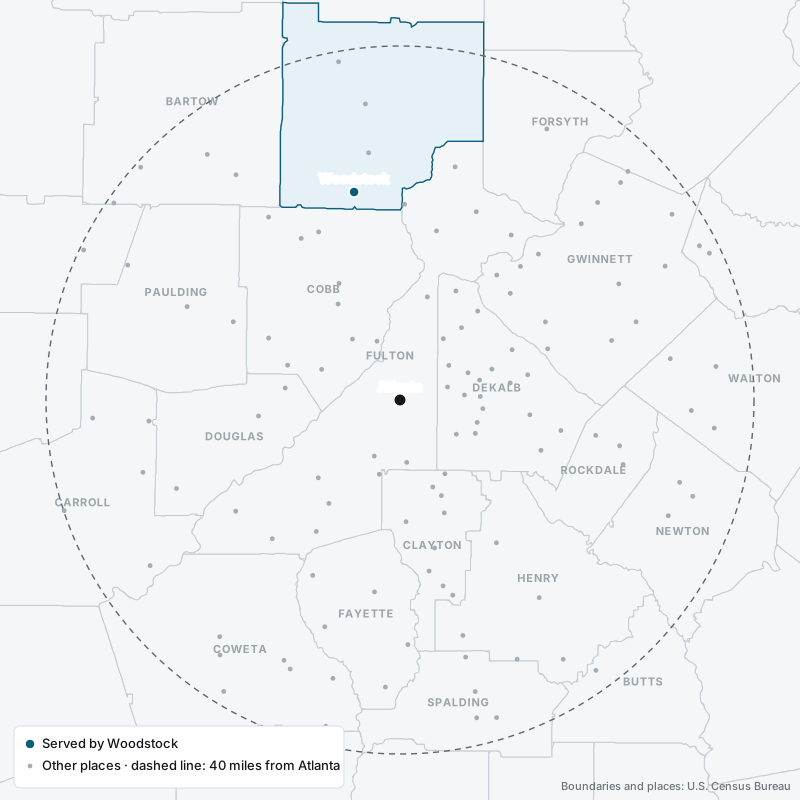
Woodstock's Water and Sewer Utility serves the parts of Woodstock on the city's side of the CCWSA boundary map, so the table marks Woodstock as partly served.
| City or community | Sewer service | Plumbing permits | Local note |
|---|---|---|---|
| Woodstock | Part of the area | City of Woodstock Building & Safety Division | Woodstock and CCWSA split water and sewer service areas under a boundary map first adopted in 2000; city code says Woodstock doesn't extend sewer to unincorporated areas. |
Next step
Before a plumber digs toward the street, call the Water and Sewer Utility and ask where the city's sewer begins at your address and who repairs the part under the street. City code covers the cost of building the connection but not that later repair.
Provider rules change. Every statement above links to the provider's own page or ordinance as checked in October 2026 — if a source and this page disagree, the source wins. All places within 40 miles of Atlanta and their providers are listed in the metro Atlanta sewer directory.
Sources
- City of Woodstock Public Works: Water & Sewer Utility
- City of Woodstock Utility Billing: Establish/Disconnect Service
- City of Woodstock Water & Sewer Utility: Wastewater Treatment Plant
- City of Woodstock Water & Sewer Utility: Troubleshooting
- City of Woodstock Community Development: Building & Safety Division
- Woodstock Code of Ordinances (Municode): Chapter 44, Article V, Sewer System (Secs. 44-121 to 44-140)
- Cherokee County Water and Sewerage Authority: Board Meeting Minutes, December 12, 2019
- North Georgia Health District: Environmental Health Services
- North Georgia Health District: Cherokee County locations (Cherokee County Environmental Health)
- Georgia 811: The 811 Process
- Georgia 811: Georgia Underground Facility Protection Act (O.C.G.A. Title 25, Chapter 9)