Bremen, GA Sewer Line and Drain Guide for Homeowners
Sewer provider: City of Bremen Public Works (wastewater) · Carroll, Haralson counties
At a glance
The City of Bremen treats sewage at three of its own plants, and its Public Works department makes water and sewer taps. Bremen's code treats the building sewer, also called the house connection, as the owner's cost and requires two cleanouts on it: one within five feet of the foundation and one in the public right-of-way. The city can order repairs to a leaky house sewer.
On this page
Bremen sits on the line between Haralson and Carroll counties, and it handles sewer itself: the city has three wastewater treatment plants of its own, and its Public Works department makes the taps. For homeowners, the useful details are in Chapter 26 of the city code, which spells out where cleanouts go and what the city can demand when a house line leaks.
This page gathers what the City of Bremen publishes for households: the system, the owner's house connection, how backups are handled, permits, what the sewer can't take, and septic.
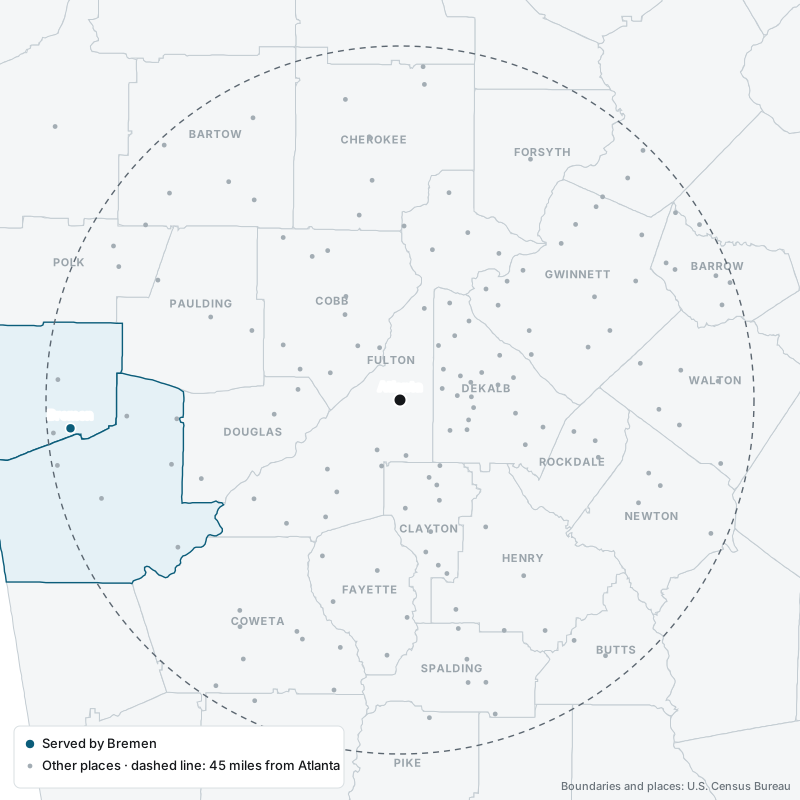
Who provides sewer service here
The City of Bremen treats sewage at three separate plants, the Baxter Creek, Buck Creek and Turkey Creek wastewater plants (Waste Water). Public Works is responsible for building maintenance, street and right-of-way upkeep, and water and sewer taps; it works out of City Hall at 232 Main Street, which is open until 5:30 p.m. on Mondays, Tuesdays and Thursdays, until noon on Wednesdays and until 5 p.m. on Fridays (Public Works).
The city lies in both Haralson and Carroll counties (Census Bureau place list). The code leaves it to the city to define where sewer is available and the costs tied to sewer permits or construction (Bremen code, Sec. 26-92), so ask City Hall if you aren't sure your street is served.
Where your responsibility ends
Bremen's code defines the building sewer as the extension from the building drain to the public sewer and notes that it is also called the "house connection" or "service connection" (Bremen code, Sec. 26-45). Paying for that line, and answering for any loss its installation causes the city, falls entirely on the owner (Sec. 26-84). Where a rear building shares the front building's line, the city disclaims responsibility for damage resulting from that shared connection (Sec. 26-85).
Two cleanouts are required. One must be installed within five feet of the outer foundation wall where the service line leaves the house, and another on the public right-of-way before the line enters the public sewer (Sec. 26-93). If a house sewer lets in groundwater or rainwater, the city may require the owner to repair it, charge a sewer rate that reflects the extra treatment cost, or require disconnection from the city system (Sec. 26-94).
The code doesn't state who maintains the short run between the right-of-way cleanout and the main, so ask Public Works before paying for work there. Who is responsible for the sewer line compares other Georgia providers, and finding your sewer cleanout explains what those cleanouts look like.
If sewage backs up
Bremen's Public Works page lists its phone line and City Hall hours; call there if sewage is rising from a manhole or from the cleanout in the right-of-way (Public Works). If the trouble is inside your own house connection, a licensed plumber is the usual call; main sewer line clog signs helps tell the two situations apart.
Do not open a cleanout cap on a line that may be full of sewage without reading the cautions in what to do in a sewer backup, which also covers cleanup safety.
Repairs, permits and inspections
Bremen's Building Department schedules and conducts all residential and commercial building inspections and handles nearly all city permitting, with applications sent by email (Building Department).
A written city permit is required before anyone uncovers, connects to or alters a public sewer; the owner or an agent applies on the city's form; and the superintendent supervises the connection and testing once the building sewer is ready (Secs. 26-82, 26-83 and 26-90). Pipe must be ductile iron or PVC sewer pipe, at least four inches across, with a fall of at least one-eighth inch per foot, and an inspection must approve the work before the trench is backfilled; where no suitable wye exists on a small public sewer, the city cuts in the connection at the owner's expense (Sec. 26-87). Disturbed streets, sidewalks and parkways must be restored to the city's satisfaction (Sec. 26-91).
Georgia 811 asks for a free locate request at least three business days before digging (Georgia 811). For mechanized digging, state law makes that request mandatory, and the sewer owner's duty is to help mark laterals only up to the edge of the public right-of-way (Georgia dig law).
Grease, wipes and rainwater
Roof downspouts, foundation drains, areaway drains and other runoff may not be connected to a building sewer or building drain tied to the public sewer unless the city approves it for polluted drainage (Sec. 26-89). The code also bans solids such as rags, plastics, paper cups and unground garbage, and it restricts wastewater with more than 100 milligrams per liter of oil, fat, grease or wax; household garbage grinders are allowed (Secs. 26-118 and 26-119).
Section 26-121 lets the city demand grease, oil and sand interceptors from businesses, while exempting houses and apartments. Household dos and don'ts are in what not to flush or pour.
Septic homes in this area
Septic tanks in Bremen are built, repaired and enlarged only under a health officer's permit, with an inspection before the tank is covered, and no soil absorption system is permitted on a lot under 15,000 square feet. No new septic tank may be installed where public sewer is accessible, and when sewer becomes available an existing system must be connected within 30 days of notice; pit privies are prohibited in the city (Secs. 26-154 to 26-161). A system that stops working in a sanitary manner must be corrected within the time the health officer sets in writing (Sec. 26-163).
On the Haralson County side, environmental health is at 133 Buchanan Bypass in Buchanan (Haralson County Environmental Health); on the Carroll County side, it is at 423 College Street in Carrollton (District 4 Public Health).
Cities and communities served
No other place in this directory uses Bremen's plants. Nearby Buchanan runs its own system; see the Buchanan page, the Carrollton page and the local directory.
| City or community | Sewer service | Plumbing permits | Local note |
|---|---|---|---|
| Bremen | Yes | City of Bremen Building Department | Bremen's code calls for one sewer cleanout within five feet of the foundation and another in the public right-of-way before the line enters the city sewer. |
Next step
Find both of your cleanouts, the one near the foundation and the one at the right-of-way, and keep them uncovered and reachable, so a plumber or city crew can get into the line quickly during a backup.
Provider rules change. Every statement above links to the provider's own page or ordinance as checked in October 2026 — if a source and this page disagree, the source wins. All places within 45 miles of Atlanta, plus Rome and their providers are listed in the metro Atlanta sewer directory.
Sources
- City of Bremen Public Works: Waste Water
- City of Bremen: Public Works
- City of Bremen: Building Department
- City of Bremen (Municode): Code of Ordinances, Chapter 26, Article II: Sewer Use
- City of Bremen (Municode): Code of Ordinances, Chapter 26, Article III: Private Wastewater Disposal
- U.S. Census Bureau: 2020 Census place codes for Georgia (places and counties)
- Northwest Georgia Public Health: Haralson County Environmental Health Department
- District 4 Public Health, Georgia Department of Public Health: Carroll County Health Department and Environmental Health
- Georgia 811: The 811 Process
- Georgia 811: Georgia Dig Law (O.C.G.A. Title 25, Chapter 9)