Coweta County Sewer and Drain Guide for Homeowners
Sewer provider: Coweta County Water and Sewerage Authority · Coweta County
At a glance
The Coweta County Water and Sewerage Authority (CCWSA) took over the county's water and sewer systems in 2007, but it serves far more water customers than sewer customers, so a CCWSA water bill does not mean you have public sewer. Its ordinance makes owners pay for the building sewer and keep rainwater out of it; its standards stub new services to the right-of-way.
On this page
Across much of Coweta County, public sewer is far less common than public water. The county's water and sewer authority supplies drinking water to tens of thousands of customers but sewer to only a few thousand (CCWSA), so before you call anyone about a backup or a soggy yard, find out whether your home is on public sewer at all.
If it is, the authority's sewer use ordinance and development standards set the rules described below. If it is not, the county health department's septic rules apply instead.
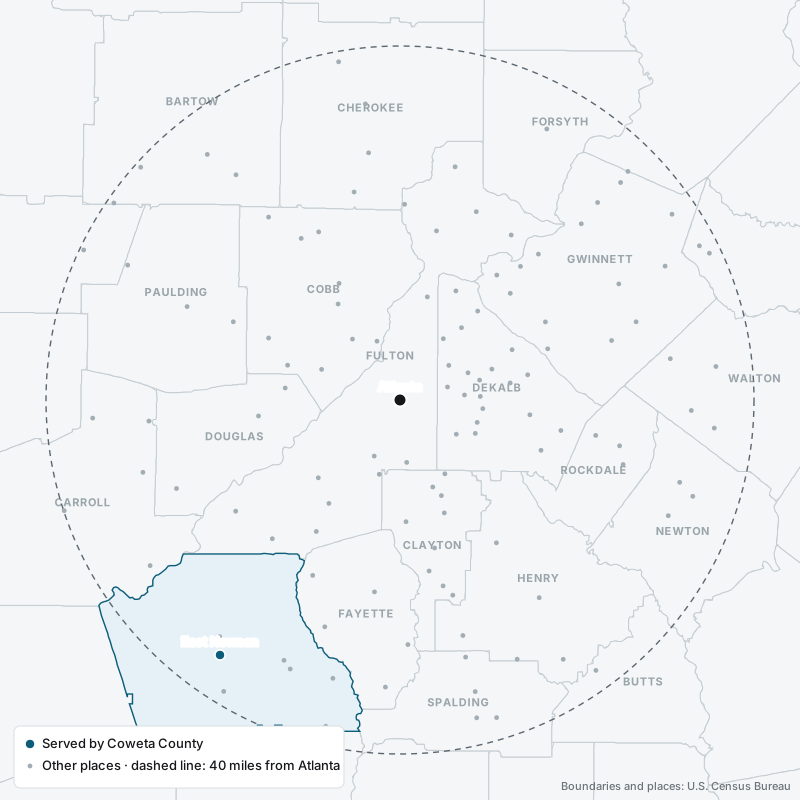
Who provides sewer service here
The Coweta County Water and Sewerage Authority (CCWSA) was created by the Georgia General Assembly in 2001 and took over ownership and operation of the county's water and sewer systems on June 6, 2007. It treats wastewater at three plants, Arnco, Sargent and Shenandoah, and makes drinking water at the B.T. Brown plant. Its About page counts its sewer customers in the low thousands and its water customers near 30,000, which means most of the authority's water customers are not on its sewer.
To confirm, look for a sewer charge on your CCWSA bill, or check your address on the authority's online water and sewer map (Mapping & Engineering). New service can be requested online or at the main office on Corinth Road in Newnan (FAQs). Inside Newnan city limits, sewer usually comes from Newnan Utilities, and Senoia runs its own system.
Where your responsibility ends
CCWSA's sewer use ordinance puts all costs of installing and connecting the building sewer on the owner and requires a separate building sewer for every building. Where a rear building is allowed to share the front building's line, the ordinance adds that the county takes no responsibility for damage caused by that single connection.
The authority's development standards show where public pipe typically ends in a subdivision: mains usually run along the center of the street, with an individual service stub extending to the edge of the right-of-way for each lot, and services reaching the property line, normally within 10 feet of the lot's lower corner. The standards also call for a manhole or cleanout wherever a customer's facility connects to the authority's system. CCWSA staff may enter private property where the county holds a sewer easement to inspect or maintain public facilities inside it (ordinance, Section 8.2). Ask CCWSA where its maintenance ends at your address before paying for digging near the street; the ownership guide explains the questions. Treat this as general information, not legal advice; CCWSA or a licensed plumber can say how it applies to your lot.
If sewage backs up
CCWSA's contact page lists its main office line and weekday hours but no separate after-hours sewer number, and its FAQ's emergency advice is written for water leaks: shut off the meter and call the office (FAQs). For a sewage spill or a manhole overflow, call the main office and ask how to reach on-call staff. If the problem is only inside your home, start with a licensed plumber, and follow the sewer backup procedure for safety steps.
Repairs, permits and inspections
Coweta County's Building Permits and Inspections department issues permits for plumbing, electrical, heating and air, housing and other work, and inspects construction against the adopted codes; applications and inspection requests can be made online. Several cities, including Newnan and Senoia, run their own building departments.
The sewer connection itself needs a separate building sewer permit. Under the ordinance, no one may uncover, connect to or alter a public sewer without a written permit; owners apply on a CCWSA form and pay the permit and inspection fee from the authority's fee schedule, and the applicant must notify the authority when the building sewer is ready for inspection. An old building sewer may serve a new building only after it is examined and tested. Whoever digs should first contact Georgia 811, which asks for a locate request at least three business days ahead (Georgia 811); state law makes the request mandatory before digging with machines (dig law).
Grease, wipes and rainwater
CCWSA's FOG program explains that grease washed down a drain sticks to pipes on your property and in the street, that garbage disposals only shred it into smaller pieces, and that detergents claiming to dissolve grease may just pass it down the line. Its advice: scrape food and grease into the trash, wipe pans with a dry paper towel before washing, pour cooled grease into a lidded can for the garbage, never use hot water to flush grease away, and never pour grease into a storm drain or onto the ground.
Rainwater is barred by ordinance. Roof downspouts, foundation drains, areaway drains and other surface runoff or groundwater may not be connected to a building sewer unless approved for polluted surface drainage, and no one may discharge stormwater, roof runoff, subsurface drainage, swimming pool drainage or condensation into the sewer unless the authority's chief executive authorizes it (ordinance). What not to flush or pour covers wipes and other bathroom items.
Septic homes in this area
Because so many homes are off the sewer, the ordinance's septic section matters. Septic tanks must be built, repaired and maintained under plans approved by the health officer and kept in sanitary working order. For an existing single-family home, sewer counts as available when the main floor can drain by gravity to a sewer line in a public right-of-way or easement passing the property, and an owner abutting a public sewer within 100 feet of the property line must connect within 30 days of official notice (ordinance).
Septic permits and records are kept by the Coweta County environmental health office, which the Department of Public Health lists at 28 East Washington Street in Newnan (DPH). See septic or sewer: how to tell if you are not sure which you have.
Cities and communities served
CCWSA is the public sewer utility for unincorporated Coweta County, which includes the East Newnan area; whether a given street there has sewer is something your bill or the authority's map will show. Several small towns nearby, including Sharpsburg, Turin, Moreland and Haralson, are listed in the directory with what their own sites say.
| City or community | Sewer service | Plumbing permits | Local note |
|---|---|---|---|
| East Newnan | Part of the area | Coweta County Building Permits & Inspections | Unincorporated; CCWSA is the county's public sewer utility but serves far more water than sewer customers, so check your bill for a sewer charge. |
Next step
Check your CCWSA bill for a sewer charge. If there is none, contact the Coweta County environmental health office for your septic permit record before you hire anyone to pump or repair a system.
Provider rules change. Every statement above links to the provider's own page or ordinance as checked in October 2026 — if a source and this page disagree, the source wins. All places within 40 miles of Atlanta and their providers are listed in the metro Atlanta sewer directory.
Sources
- Coweta County Water and Sewerage Authority: About Us
- Coweta County Water and Sewerage Authority: FAQs
- Coweta County Water and Sewerage Authority: Contact Us
- Coweta County Water and Sewerage Authority: FOG Program
- Coweta County Water and Sewerage Authority: Mapping & Engineering
- Coweta County Water and Sewerage Authority: Sewer Use Ordinance, Coweta County, Georgia (2019 revision)
- Coweta County Water and Sewerage Authority: CCWSA Development Standards
- Coweta County Community Development: Building Permits & Inspections
- Georgia Department of Public Health: County Environmental Health Offices
- Georgia 811: The 811 Process