Flowery Branch, GA Sewer Line and Drain Guide for Homeowners
Sewer provider: City of Flowery Branch Public Utilities · Hall County
At a glance
The City of Flowery Branch runs its own sewer and Water Quality Reclamation Facility. City crews make every sewer tap, running it from the main to the street curbline, and the code makes the property owner pay for clearing sewer chokes beyond the curbline, with the city doing the repair and billing the owner. Use the city's water and sewer emergency page for after-hours help.
On this page
Flowery Branch, in Hall County, runs its own water and sewer utility. That matters when a drain backs up, because the city code says exactly how far the city's sewer tap reaches and who pays when the line clogs past that point.
This page explains what Flowery Branch publishes for homeowners and renters: the utility, the curbline rule, who to call after hours, permits and inspections, the grease program and septic.
Who provides sewer service here
Flowery Branch Public Utilities operates the city's Water Quality Reclamation Facility and maintains the collection system that carries sewage to the plant; its office is on Atlanta Highway (Public Utilities). The city's subdivision rules require every lot in a subdivision and every development to connect to the city's public sewer unless the City Engineer and the Hall County Environmental Health Department approve on-site disposal (Subdivision Ordinance, Sec. 710).
Your water and sewer bill comes from the city, and billing questions go to the utility office during weekday business hours from 8 a.m. to 4:30 p.m. (Emergency Contact).
Where your responsibility ends
Flowery Branch's code answers the boundary question more precisely than most. Sewer taps made by the city to lines laid in a street run from the sewer line to the street's curbline; on outfall or interceptor lines, or any line not in a street, the tap extends no more than 10 feet from the line (Flowery Branch code, Sec. 50-52(a)).
Beyond that point the choke is yours. The property owner or person using the service is responsible for repairs due to sewer chokes beyond the curbline or more than 20 feet from the tapped line, whichever is closer to the sewer line, and the code says the city will make the repairs and charge the cost to the owner or user (Sec. 50-52(b)). Ask for the city's assessment in writing before work starts, so you know which side of the curbline the blockage is on.
Every building sewer also needs a 6-inch cleanout with a plug, placed as close as possible to the point where city maintenance begins: the curbline, right-of-way line, property line or easement line, whichever applies. The owner or developer pays for it at the time of development (Sec. 50-47). Other Georgia providers draw that line in different places; who is responsible for the sewer line compares them.
If sewage backs up
The city's "Water/Sewer Emergency" link leads to an after-hours contact page that names the Public Works foreman and inspector as the first call and the Public Works director as the second. The page notes that the after-hours contacts cannot see account information, discuss accounts or take payments (Emergency Contact).
During business hours, the utility office invites questions by phone or through the city's citizen feedback form (Public Utilities). If the blockage turns out to be beyond the curbline, Sec. 50-52 makes it the owner's cost. Inside the house, follow what to do in a sewer backup.
Repairs, permits and inspections
The Building Department in Community Development takes permit submittals and inspection requests through the city's online permitting software, which requires an account. Inspections run Monday through Friday from 8:30 a.m. to 4 p.m. and must be scheduled at least 24 hours ahead (Inspections).
The utility code adds sewer-specific rules. All sewer connections or taps are made only by city personnel, unless the mayor or an authorized city representative allows an owner to connect through a properly qualified person; the connection and its testing are supervised by the chief building inspector; and roof downspouts, foundation drains and other runoff connections to the sewer need city approval (Secs. 50-45, 50-48 and 50-50).
A trench for a new building sewer starts with Georgia 811: the free ticket should go in at least three business days before digging (Georgia 811), and state law requires it before mechanized excavation. Under that law, a sewer system owner's job is limited to helping mark laterals as far as the public right-of-way (Georgia dig law).
Grease, wipes and rainwater
The utility's F.O.G. Control Program calls grease washed down sinks one of the biggest problems in its sewer lines, causing blockages, backups and overflows. It asks residents not to pour cooking oil or grease down drains, to wipe pans, to use sink strainers and to throw grease out in sealed containers; businesses with a grease trap or interceptor must register with the program (F.O.G. Control Program).
The code backs that up. It allows the city to bar waste with more than 100 milligrams per liter of fats, oils or grease or substances that turn viscous between 32 and 150 degrees Fahrenheit, and garbage that isn't properly shredded; a garbage grinder of three-quarters horsepower or more needs the chief building inspector's review (Sec. 50-61). Roof and yard drainage stays out of the sanitary sewer unless the city approves it (Sec. 50-45). Wipes, paper towels and other items that clog a lateral are covered in what not to flush or pour.
Septic homes in this area
On-site sewage disposal in a Flowery Branch subdivision or development needs approval from both the City Engineer and Hall County Environmental Health (Sec. 710). Hall County Environmental Health moved back to its original office at 2875 Browns Bridge Road, third floor, in Gainesville on July 13, 2026, and is open weekdays from 8 a.m. to 5 p.m. (District 2 Public Health).
If you are buying an older home, septic or sewer: how to tell explains how to check which system it uses.
Cities and communities served
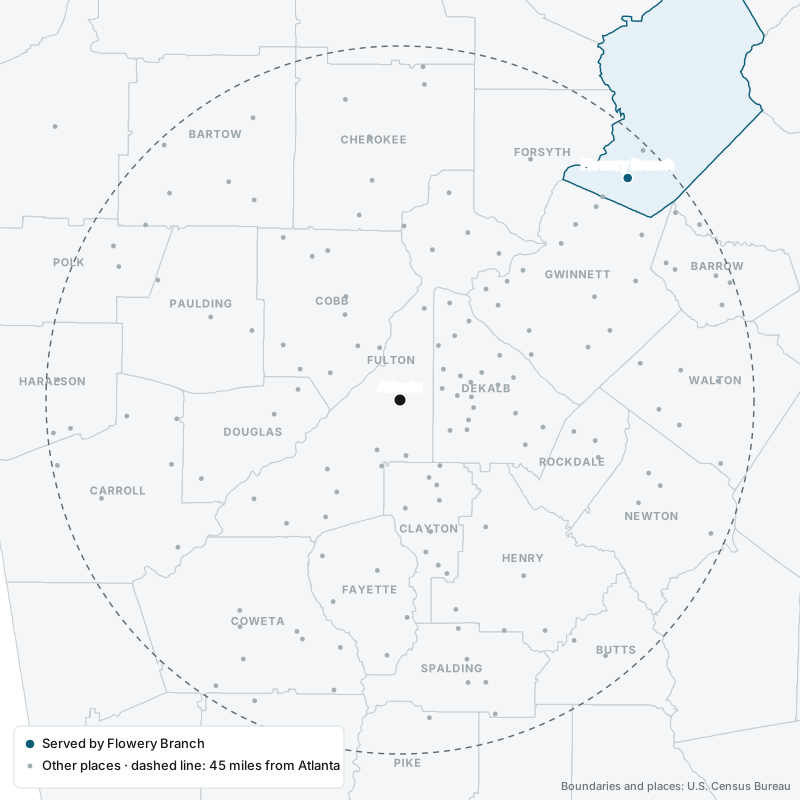
Flowery Branch is the city in this directory with Flowery Branch sewer. The City of Oakwood's 2026 fee schedule lists a Flowery Branch system among the three sewer systems its customers use, with both a Flowery Branch charge and an Oakwood charge (Oakwood fee schedule); Oakwood residents should read their bill and the local directory entry.
| City or community | Sewer service | Plumbing permits | Local note |
|---|---|---|---|
| Flowery Branch | Yes | City of Flowery Branch Community Development (Building Department) | City crews make all sewer taps, and the code charges owners for sewer chokes beyond the street curbline. |
Next step
Ask a plumber to locate your 6-inch cleanout near the curb or property line. If a choke ever occurs, that cleanout is where the city and your plumber will decide whether the blockage is on the city's side of the curbline.
Provider rules change. Every statement above links to the provider's own page or ordinance as checked in October 2026 — if a source and this page disagree, the source wins. All places within 45 miles of Atlanta, plus Rome and their providers are listed in the metro Atlanta sewer directory.
Sources
- City of Flowery Branch: Public Utilities
- City of Flowery Branch Public Utilities: Emergency Contact
- City of Flowery Branch Public Utilities: F.O.G. (Fats, Oils, Grease) Control Program
- City of Flowery Branch (Municode): Code of Ordinances, Chapter 50, Article I: Utilities in General
- City of Flowery Branch (Municode): Subdivision Ordinance, Sec. 710: Sanitary Sewerage
- City of Flowery Branch Community Development: Inspections
- District 2 Public Health, Georgia Department of Public Health: Hall County Health Department and Environmental Health
- City of Oakwood: Adopted 2026 Fee Schedule
- Georgia 811: The 811 Process
- Georgia 811: Georgia Dig Law (O.C.G.A. Title 25, Chapter 9)