Fayetteville Sewer and Drain Guide for Homeowners
Sewer provider: City of Fayetteville Water and Sewer Department · Fayette County
At a glance
The City of Fayetteville's Water and Sewer Department provides sewer service inside the city limits and runs its own treatment plant. Report a backup to its customer service line, which has an after-hours number; crews jet the main, but a plumber repairs the service line between the house and the right-of-way.
On this page
The Fayette County Water System sells water but not sewer service, so in Fayetteville the city handles sewage itself. The City of Fayetteville treats its wastewater at a city plant, maintains the mains and lift stations, and takes backup calls through its Water and Sewer Customer Service office.
Its published answers are practical: who to call when a toilet backs up, what the city crew will try first, and where the city's help stops and a plumber's starts.
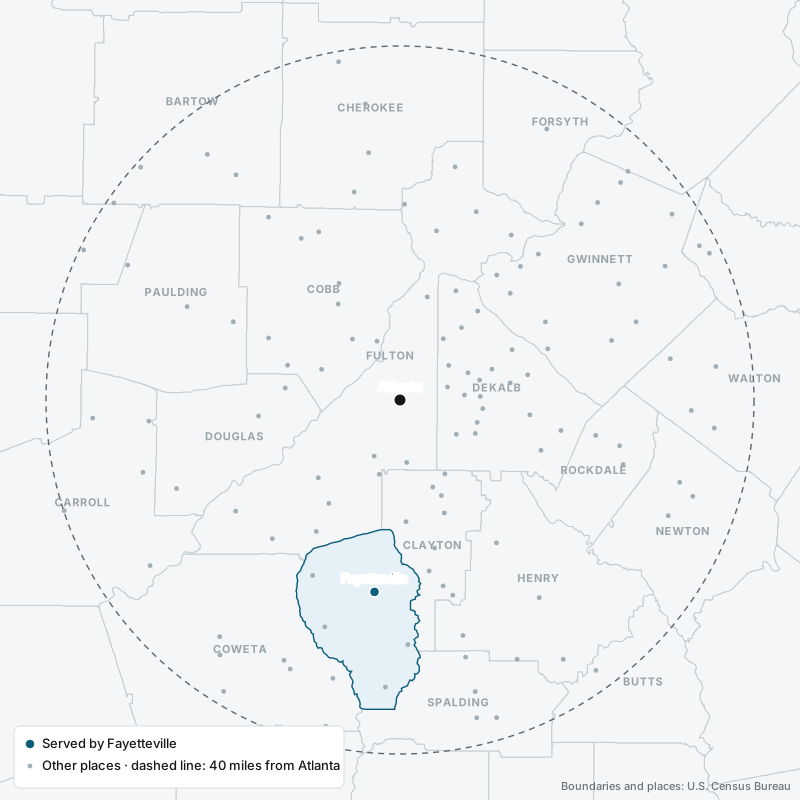
Who provides sewer service here
The Fayette County Water System says it does not provide sewer service; it lists four sewer providers in the county, including the City of Fayetteville, and issues sewer bills on their behalf (Fayette County Water System). The city itself provides water, sewer, sanitation and stormwater service to residents and businesses inside the city limits (Water Customer Service).
The city's Water and Sewer Department has four parts: water treatment, wastewater treatment, distribution and collections, and technical services. The wastewater plant treats incoming flow to state and federal standards before discharging it to Whitewater Creek, and the distribution and collections crew operates the sewer mains and lift stations. Roughly half of the city's drinking water comes from two deep wells and the rest from the county water system (FAQ).
New service is set up in person at City Hall's Water and Sewer Customer Service office, with a deed, tax bill, closing papers or lease plus two forms of identification (FAQ).
Where your responsibility ends
The city's FAQ describes the split on the sewer side through its backup procedure: if the problem is on the service line between the house and the right-of-way, city crews will try to clear it, but a plumber has to repair the line; if the problem is inside the house, a plumber handles it (FAQ). The city code points the same way: when a developer's new sewer lines are accepted, everything except the building sewer becomes city property (Sec. 86-97), and the owner pays all costs of installing and connecting the building sewer (Sec. 86-98).
The city's development standards explain where to look for the dividing point on newer lots. Service lines get a cleanout at the property right-of-way line or within the easement, cut off and capped with a threaded cap at least four inches above final grade, and the cap carries a brass or metal plate so it can be located. No driveway may be built over a sewer lateral, and laterals go in the side-yard setback or the middle of the lot line. Finding your sewer cleanout covers older homes. This is general information; the city or a licensed plumber can confirm the boundary at your address.
If sewage backs up
Call the city's Water and Sewer Customer Service as soon as possible and give your name, location and phone number; outside business hours, the department keeps an after-hours office open 24 hours a day, seven days a week, to send the right crew (FAQ). The city says it first assesses the problem to see whether a plumber is needed, and uses a sewer jet machine to get the line flowing.
The FAQ also covers odors: a sewer-like smell in your area is logged on a work order and investigated, though the city warns that odor sources are the hardest to find. While you wait for help, follow the sewer backup procedure inside the house.
Repairs, permits and inspections
Inside the city limits, the city's Building Department reviews plans, issues permits and inspects residential construction. Applications can be filed online or at the Building Department in City Hall, and inspection requests received before 3 p.m. are scheduled for the next business day.
Sewer connections also need the Water and Sewer Department. The code puts the city's sewers under the department's control and bars anyone from uncovering, connecting to or altering a public sewer except under the department's inspection and direction and after a written permit; every building needs its own building sewer (Sec. 86-98). The standards add that all repairs on water service lines are inspected by the building inspector or a representative of that office. Georgia 811 asks homeowners and contractors alike to submit a locate request three business days before any digging (Georgia 811), and state law requires one before mechanized digging (dig law).
Grease, wipes and rainwater
Fayetteville's code keeps rainwater out of the sewer unless the director gives written permission: no stormwater, surface water, groundwater, roof runoff, subsurface drainage or impounded water may be discharged to a sanitary sewer (Sec. 86-133). The same section bars liquids colder than 32 or hotter than 150 degrees Fahrenheit and wastewater carrying more than a small amount of fats, oils or grease, and it lets the director require grease, oil and sand traps where wastes call for them, to be maintained by the owner.
For a household, that means cooling and trashing cooking grease rather than rinsing it away, and keeping wipes and paper towels out of the toilet; what not to flush or pour has the full list.
Septic homes in this area
Septic systems are allowed only where public sewer is not available. Permits for systems with soil absorption fields come from the county health department, no permit is issued for a new lot smaller than 43,560 square feet (one acre), and once public sewer becomes available the owner must connect within 60 days of notice and clean out and fill the old tank (Sec. 86-97). The Fayette County environmental health office, which the Department of Public Health lists at 140 Stonewall Avenue West in Fayetteville, holds septic permits and records (DPH).
Cities and communities served
The city's system serves Fayetteville inside the city limits. Peachtree City, Tyrone and Brooks have their own sewer providers, all billed through the county water system.
| City or community | Sewer service | Plumbing permits | Local note |
|---|---|---|---|
| Fayetteville | Yes | City of Fayetteville Building Department | Sewer backups go to the city's Water and Sewer Customer Service, which keeps a 24-hour after-hours line. |
Next step
Save the Water and Sewer Department's after-hours number from the city's FAQ in your phone now, so a weekend backup does not start with a search.
Provider rules change. Every statement above links to the provider's own page or ordinance as checked in October 2026 — if a source and this page disagree, the source wins. All places within 40 miles of Atlanta and their providers are listed in the metro Atlanta sewer directory.
Sources
- City of Fayetteville: Water & Sewer
- City of Fayetteville: Frequently Asked Questions (Water & Sewer)
- City of Fayetteville: Water Customer Service
- City of Fayetteville: Water and Sewer Development Standards
- City of Fayetteville: Building & Inspections
- Fayetteville Code of Ordinances (Municode): Sec. 86-98. Building sewers and connections and grant of permit for sewer use
- Fayetteville Code of Ordinances (Municode): Sec. 86-97. Private sewage disposal
- Fayetteville Code of Ordinances (Municode): Sec. 86-133. Use of public sewers for the discharge of nondomestic wastes
- Fayette County Water System: Sewer Providers
- Georgia Department of Public Health: County Environmental Health Offices
- Georgia 811: The 811 Process