Collapsed Sewer Pipe: Warning Signs and What Happens Next
What are the warning signs of a collapsed sewer pipe, and what happens once it collapses?
Short answer
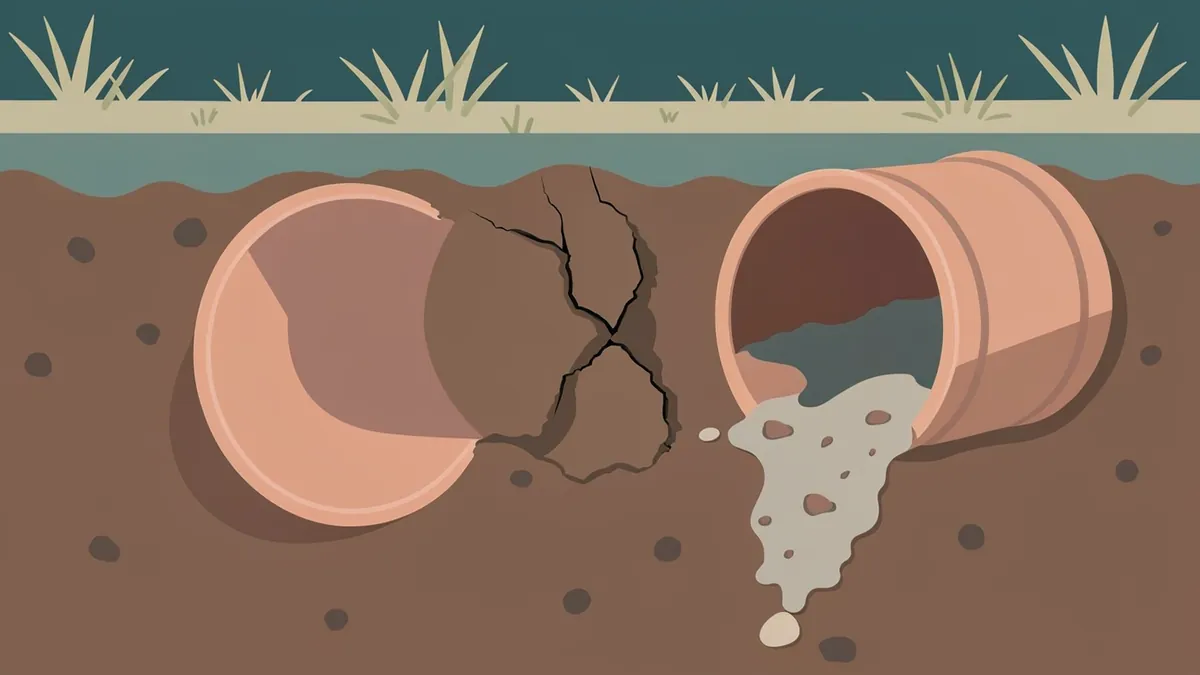
Sewer pipes usually collapse after years of cracks, loose joints, roots or soil washing away around them, and the warnings are clogs that return to the same spot, a line no machine can clear, and sinking ground over the pipe. Once a section caves in, it can't be cleaned or lined back into shape: it is located on camera, checked for crossing gas lines, and usually dug up.
On this page
- What a collapsed sewer pipe is
- How a sewer pipe gets to the point of collapse
- Warning signs of a collapsed sewer line
- What happens when a sewer pipe collapses underground
- First steps, and when it's an emergency
- Finding the collapse: camera, locate and a gas-line check
- Why a collapse usually means digging
- Frequently asked questions
- Next step
A collapsed sewer pipe is the last chapter of a long story. Cracks, loose joints, roots or soil washing away weaken a section of the line until its wall gives way, partly or completely closing the pipe. From that point on, the problem is no longer one a drain machine can clear.
This guide explains how a sewer pipe gets to that point, the warning signs, what a collapse does underground and inside the house, what to do first, and why the repair usually means digging.
What a collapsed sewer pipe is
A collapse means a section of pipe has lost its shape: the top has caved in, the pipe has been crushed, or a weakened wall has flattened under the weight of the soil around it. A partial collapse narrows the opening and snags paper and solids. A full collapse stops the flow.
How a pipe gives way depends partly on what it's made of. Ann Arbor, Michigan's building department describes bituminized fiber pipe, often called Orangeburg, flattening under earth pressure and losing the round bottom that carries the flow. In laminated fiber pipe weakened by solvents, the bottom can bow upward, and the city's inspectors have found pipe that still looked round outside while its inner layers were failing (City of Ann Arbor). Old sewer pipe materials covers how clay, cast iron, fiber and plastic pipe tend to fail.
How a sewer pipe gets to the point of collapse
NASSCO, the trenchless-industry association behind the Pipeline Assessment and Certification Program (PACP) for coding sewer defects, divides the road to collapse into three stages: a defect that forms during or after construction, deterioration that grows from it, and finally the collapse of the weakened pipe (NASSCO). Most of that deterioration, it says, comes not from the pipe material breaking down but from loss of the ground around the pipe. Water moving in and out through defects carries soil away, the pipe loses the side support that holds its shape, and the load on it becomes lopsided.
Cracking is a typical early stage. Once a crack runs through the whole wall and becomes a fracture, soil can move through it. NASSCO notes that rigid clay and concrete sewers are routinely stable with 5 to 10 percent deformation, but past 10 percent they become more and more likely to fail from a single random event, such as a rainstorm or digging nearby. It rates soil loss as most likely with large defects, groundwater above the pipe, lines that often surcharge (fill and back up under pressure) and fine sands or non-plastic silts, and least likely in medium- to high-plasticity clays.
Roots can break a pipe from the inside, too; see the questions at the end.
Warning signs of a collapsed sewer line
Most collapses give some warning, but the signs look like an ordinary clog at first:
- Clogs that return to the same spot, sooner each time. Ask how far into the line the cable or jetter stopped. The same distance visit after visit points to a problem with the pipe itself at that spot.
- Pieces of pipe on the cutter. Ann Arbor's building department notes that a cable machine with a cutting head may bring back bits of pipe material, which helps identify the pipe but can damage fragile pipe further.
- A line no tool can clear. The same department says cutting may not work at all where a long stretch of fiber pipe has failed.
- Every drain backing up together, starting with the lowest drains in the house.
- Ground sinking over the line, from a soft spot in the lawn to a dip in a driveway or a hole that keeps growing.
Earlier and subtler clues, such as wet ground, outdoor sewage odors and rats, are covered in signs of a broken sewer line.
What happens when a sewer pipe collapses underground
Three things follow once the pipe caves in:
- Flow stops or slows at the collapse. Everything upstream backs up toward the house and comes out of the lowest drains first.
- Sewage leaks into the ground at the break instead of reaching the public sewer.
- The ground keeps moving. Soil washes into the opening and is carried off, the ground loss NASSCO describes, and the cavity it leaves can eventually show at the surface as a dip or a sinkhole.
Inside the house, a full collapse takes all of the plumbing out of service, because every sink, tub, toilet and appliance drains through that one line. Water use has to stop until the line is opened up or repaired.
First steps, and when it's an emergency
- Stop using water. If sewage is already coming up indoors, follow what to do in a sewer backup for the first minutes and a safe cleanup.
- Keep people, pets and vehicles off sinking ground, and don't probe a sinkhole or climb into an open hole to look at the pipe. Atlanta's Department of Watershed Management, for one, wants sinkholes and ruptured sewer lines reported to it immediately as sewer emergencies, plus a 911 call when conditions are a safety hazard (Atlanta DWM). Other providers post their emergency numbers on their websites and bills.
- Call your sewer provider first if the trouble may be near the street or neighbors are affected. In Gwinnett County, an investigator checks the main and the cleanout at the right-of-way. If the county's short stub to the main is backed up and a jetter can't clear it, a county pipe repair crew digs up the stub to remove the defective section, and plumbers hired by owners may not cut or dig into the right-of-way (Gwinnett County DWR). Rules differ by provider; check yours with the help of who is responsible for the sewer line in Georgia.
- Treat a rotten-egg smell, or a hissing or bubbling sound in standing water, as a possible gas leak. Atlanta Gas Light's instructions: get everyone out and away from the area, steer clear of ignition sources such as cell phones, light switches and vehicles, and phone 911 and the gas company once you're at a safe location (Atlanta Gas Light). Don't go looking for the source.
Finding the collapse: camera, locate and a gas-line check
A camera run to the collapse confirms it, records how far it sits from the access point, and lets the technician mark the spot and estimate its depth from above. If the line has a cleanout near the street, ask whether the camera can also go in from that end, since seeing both sides of the failure helps show how long the damaged stretch is.
Before anyone tries to cut through, consider that the obstruction could be a gas line. Atlanta Gas Light's rule of thumb for homeowners and plumbers is to treat every sewer obstruction outside the building as if it were a cross bore, a gas line bored straight through the sewer pipe. Its sequence: contact 811 so buried lines are marked before work starts on any sewer pipe, inspect the blockage with an in-line camera, then clear it with minimally invasive tools. If a cross bore is suspected, work stops and the find is reported to the gas company as an emergency.
The rest of the video matters too, because the number of defects shapes the repair. In NASSCO's guidance on rating public sewer pipes, one or two structural defects may suggest a localized repair, while four or more may suggest the whole length needs attention (NASSCO).
Why a collapse usually means digging
Cleaning can't rebuild a pipe wall. Ann Arbor's building department warns that cutting through failed fiber pipe may clear it only temporarily, since the failure tends to resume, and that in many of those cases replacing the pipe is the only workable option.
The trenchless methods have limits, too:
- Lining. The 2024 International Plumbing Code rules out relining when the camera survey made before the work shows a pipe wall that has completely deteriorated or a pipe that has completely separated, for example from roots or poor support; that stretch has to be uncovered and rebuilt with new pipe and fittings (2024 IPC, Section 717.5). Georgia has adopted that edition with state amendments, but because DCA's December 2025 announcement sets January 1, 2027 as its start date and an earlier DCA memo said January 1, 2026, check with your city or county building department before counting on it (Georgia DCA).
- Pipe bursting. EPA lists obstructions along the pipe among the conditions where bursting isn't favorable, because they add friction or can block the bursting head and the new pipe behind it (EPA).
So the collapsed section is usually dug up: a spot repair if the rest of the video looks sound, or a new line if it doesn't. Sewer line repair options compares the methods, and sewer line excavation walks through permits, trench safety and the inspection before backfill.
Emergency digging follows its own rule. Ordinarily, Georgia's dig law makes anyone using motorized digging equipment submit a locate request and wait out a notice period first (O.C.G.A. § 25-9-6). The exception is an emergency, which the law defines as a sudden or unforeseen occurrence calling for immediate action because of a clear and imminent danger to life, health or property, or an interruption of underground services. An emergency excavator may skip the notice period but must take all reasonable precautions and notify Georgia 811 as soon as practical, describing the dangerous condition; if the dig later turns out not to qualify, the law treats it as if no notice had been given (§§ 25-9-3, 25-9-12). Ask your contractor whether the job will go through a normal locate request or as an emergency, and why. This guide is general information, not legal, insurance or plumbing advice; your contractor, your sewer provider, your insurer and, for legal questions, an attorney can advise on your situation.
Frequently asked questions
Can tree roots collapse a sewer pipe?
They can. Traverse City, Michigan's sewer department explains that roots grow in through cracks and loose joints, keep expanding, and press on the opening until the pipe breaks, which may end in a total collapse (City of Traverse City).
Does homeowners insurance cover a collapsed sewer line?
Often not the pipe itself. The 2000 edition of the standard homeowners form, posted as a sample by the Insurance Information Institute, excludes wear and tear, deterioration, latent defects and corrosion. Its added coverage for collapses caused by things like hidden decay or defective construction doesn't reach underground pipes or drains unless the loss results directly from a building's collapse (Triple-I sample form). Policies and endorsements differ, so ask your agent what yours says about the line itself. Damage from sewage backing up into the house is a separate question, covered in sewer backup insurance in Georgia.
Is a collapsed sewer pipe the homeowner's responsibility?
It depends on where the collapsed section lies and on your sewer provider's rules. Gwinnett County, for example, maintains the short stub between the edge of the right-of-way and the main, while the owner is responsible for the rest of the lateral, including the joint where the two pipes meet if it lies outside the right-of-way. Other Georgia providers set the boundary in other places, so call yours before you pay for any digging near the street.
Next step
If you suspect a collapse, stop using water, keep everyone off sinking ground, and call your sewer provider before anyone digs near the street; then get a camera video with locate marks showing where the failed section is and how long it runs, and base the repair on that.
Sources
- NASSCO: PACP and Remaining Useful Life (RUL) Part 2: Understanding the Ground Around the Pipe (Tech Tips, August 2020)
- NASSCO: PACP Condition Grading System (Tech Tips, July 2023)
- City of Ann Arbor, Building, Rental and Inspection Services: Orangeburg Sewer Piping
- City of Atlanta Department of Watershed Management: Prepare for Emergencies
- Gwinnett County Department of Water Resources: Standard Procedure for Clearing Sanitary Sewer Back-ups and Overflows
- Atlanta Gas Light: Call 811 Before You Clear (Sewer Safety)
- International Code Council: 2024 International Plumbing Code, Chapter 7: Sanitary Drainage
- Georgia Department of Community Affairs: New Georgia Codes and Amendments - Effective January 1, 2027
- U.S. Environmental Protection Agency: Water Technology Fact Sheet: Pipe Bursting (EPA 832-F-06-030)
- Georgia 811: Georgia Dig Law (Georgia Underground Facility Protection Act, O.C.G.A. Title 25, Chapter 9)
- City of Traverse City, Sewer and Water: Tree Root FAQ
- Insurance Information Institute (Triple-I): Homeowners 3 - Special Form (HO 00 03 10 00), sample policy
Guides that pick up where this one stops.
Sewer Line Excavation in North Metro Atlanta: What to Expect
How sewer line excavation works in Alpharetta, Marietta and Cumming: 811 locates, permits, trench safety, inspection before backfill and street-cut rules.
Sewer Line Repair: Spot Repair, Lining, Bursting or Replacement
How spot repair, cured-in-place lining, pipe bursting and open-trench replacement compare for a Georgia sewer line, plus permits, 811 and safety.
Who Is Responsible for Your Sewer Line in Georgia?
How Georgia sewer providers split the line between homeowner and utility, with a provider-by-provider table and steps to confirm the rule for your address.