Sewer Line Excavation in North Metro Atlanta: What to Expect
What happens when a sewer line has to be dug up in north metro Atlanta, and which permits and safety rules apply?
Short answer
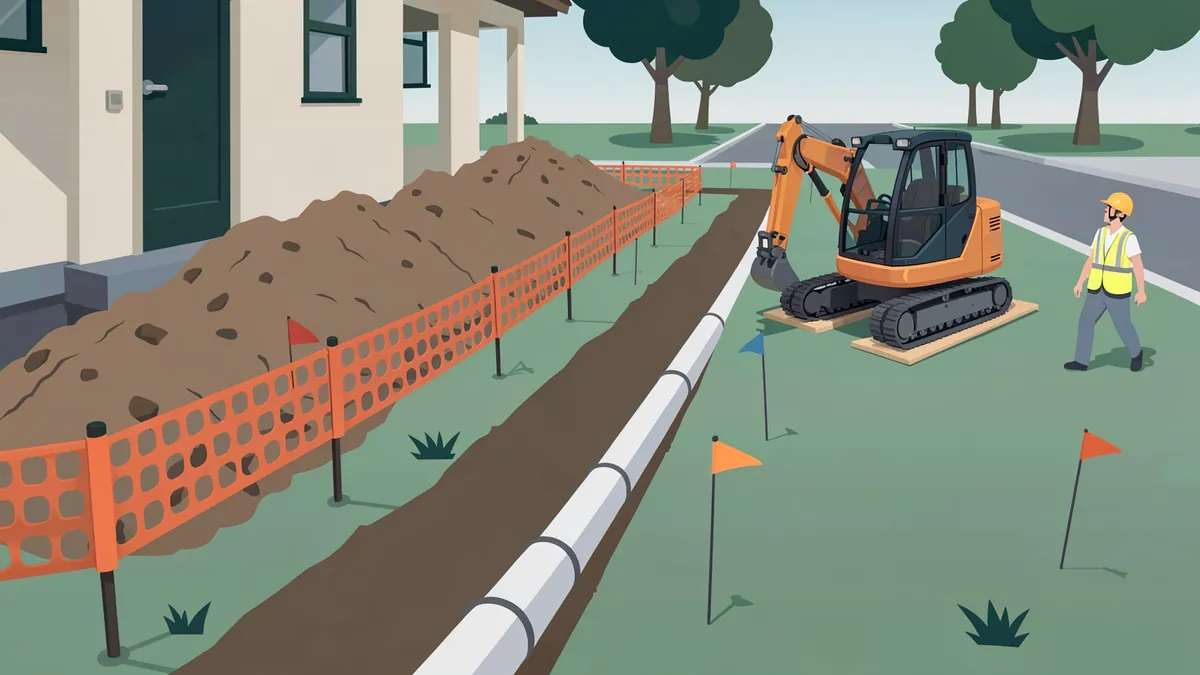
A sewer line excavation starts with a camera finding and a check of who may dig at that spot, then a plumbing permit, a Georgia 811 ticket plus a private locate for your own pipe, and a city permit if a street, curb or sidewalk will be opened. OSHA requires employers to protect trenches 5 feet or deeper against cave-ins, the trench stays open until an inspector approves the new pipe, and your permits set how public property is put back.
On this page
- When digging up the sewer line is the right repair
- How a sewer line excavation unfolds, step by step
- Finding buried lines: Georgia 811 and a private locator
- Permits and the inspection before backfill
- Trench safety: OSHA's cave-in rules
- Right-of-way work and street cuts
- Permit offices and digging rules in north metro Atlanta cities
- Restoration, timeline and cost drivers
- Next step
The camera inspection found the problem: a collapsed section, a sag that holds sewage, or a joint that has pulled apart. Now the quote says the line has to be dug up, maybe across the lawn, through the driveway or out under the street. Much of what happens next is set by your city, your sewer provider and federal safety rules, not by the contractor alone.
This guide follows a sewer line excavation from the homeowner's side, from the first locate to restoration, and ends with each north metro Atlanta city's permit office and digging rules.
When digging up the sewer line is the right repair
Excavation, whether for a spot repair or a full sewer pipe replacement, is for damage that no cleaning tool or liner can fix, so the decision should rest on recorded video. Before you accept a quote for a trench, get the full sewer camera inspection video and a written note of each defect's distance and depth.
Trenchless methods are the alternative to weigh first: lining and pipe bursting can replace much of a trench when the pipe's condition allows, and sewer line repair options compares them and the limits Georgia's plumbing code sets.
Also find out whose pipe the damaged spot is. Under the street or in a utility easement, your sewer provider may do the repair itself or limit who digs there, and who is responsible for the sewer line in Georgia explains the ownership rules.
How a sewer line excavation unfolds, step by step
A typical repair runs in this order; your city or sewer provider may add steps.
- Mark the target. Have the camera technician mark the defect, the pipe's route and its depth on the ground.
- Ask who may dig there. If the defect is in the right-of-way or an easement, call your sewer provider first; some keep that work for their own crews or approved contractors.
- Get the permits. Expect a plumbing permit, a city right-of-way or street-cut permit if public property will be opened, and sometimes a provider permit to uncover or connect to its pipe.
- Request locates. The contractor files a Georgia 811 ticket, and a private locator marks the lines utilities don't, including yours.
- Dig and protect the trench. Expect hand digging near marked lines and cave-in protection once the trench reaches 5 feet (OSHA).
- Repair or replace the pipe. Georgia's plumbing amendments call for a cleanout within 10 feet of the public right-of-way (Section 708.1.2), so ask whether the job adds one; see where to find your sewer cleanout.
- Pass the inspection. The trench stays open until the inspector approves the new pipe.
- Backfill and restore. Soil goes back in compacted layers, and public property is restored to the permit's standard.
- Close it out. Keep the final inspection record, the video and the written warranty.
Finding buried lines: Georgia 811 and a private locator
Georgia 811 asks everyone to submit a dig ticket at least three business days ahead, and state law requires one before anyone, homeowners included, digs with mechanized equipment (Georgia 811; O.C.G.A. §§ 25-9-3, 25-9-6). Member utilities then have at least two full business days after the day of the request to mark their lines, and digging under a ticket must happen within 30 calendar days of its effective date. Ask for the ticket number and check the responses before digging starts.
Those marks cover public lines only. Georgia 811 lists the sewer line between your house and the public system as a private line and tells homeowners to hire a private locator for such lines (Georgia 811). Your sewer provider must help mark a lateral only up to the edge of the public right-of-way, without becoming its owner, and if it marks the ground but can't find the lateral, the law has it paint a green triangle at the main pointing toward your address (§ 25-9-7). A plastic or clay lateral with no tracer wire or location record can count as unlocatable (§ 25-9-3), so keep the camera crew's ground marks.
Within 18 inches of either side of a marked line, the law calls for careful methods such as hand digging or vacuum excavation. If a machine strikes a line, the excavator must stop, notify Georgia 811 and the line's owner, and call 911 if the line carries gas or a hazardous liquid (§§ 25-9-3, 25-9-8).
Permits and the inspection before backfill
Georgia's plumbing amendments delete the model code's administration chapter and leave permit procedures to local governments (Georgia DCA), so permit offices, fees and inspection scheduling vary. Who may do the work depends on where the trench runs: Georgia's rewritten licensing law lets a licensed master plumber or licensed utility contractor work from the property line up to 5 feet from the house, but only licensed plumbers may work within those 5 feet (SB 553, new § 43-14-13). How to hire a drain cleaning company in Georgia explains how to check a license.
The inspection decides how long the trench stays open. Georgia's amendments keep building sewer trenches open until the pipe has been inspected, tested and approved, then call for rock-free backfill in 6-inch layers, tamped until the pipe has at least 6 inches of cover (Sections 306.5 and 306.3). Georgia has adopted the 2024 International Plumbing Code with these amendments. DCA's latest announcement, from December 2025, sets January 1, 2027 as the effective date, though an earlier DCA memo gave January 1, 2026; your building department can tell you which edition it enforces (DCA).
City codes echo the rule: Milton and Dunwoody require an underground plumbing inspection after the pipe is laid and before any backfill (Milton § 10-93; Dunwoody § 8-27). Some providers inspect the connection too; in Fulton County, the plumber must call the county inspector at least three days before installing a lateral (Fulton County). This guide is general information, not legal advice; your building department, sewer provider or a licensed master plumber can say what applies to your property.
Trench safety: OSHA's cave-in rules
OSHA calls trench collapses the greatest risk to workers' lives in excavation work and warns that burial under thousands of pounds of soil takes only seconds (OSHA fact sheet; OSHA alert). Its rules for employers include these:
- A trench 5 feet deep or more needs a protective system unless it is dug entirely in stable rock; in a shallower trench, a competent person decides (29 CFR 1926.652).
- The options are sloping or benching the walls, shoring them, or a trench box, and a trench 20 feet or deeper needs a system designed by a registered professional engineer (OSHA fact sheet).
- A competent person inspects the trench daily before work, after every rainstorm and as conditions change; spoil and equipment stay at least 2 feet from the edge; and a trench 4 feet or deeper needs a ladder, stairway or ramp within 25 feet of lateral travel (29 CFR 1926.651).
Alpharetta has written these employer rules into city law: its code adopts OSHA's excavation standards and sends city inspectors to check trench sites for a permit and OSHA compliance (Alpharetta Code, ch. 8, art. IV). Your part is simpler: keep children and pets away, don't climb into the trench to look at the pipe, and ask how a trench 5 feet or deeper will be protected and how it will be barricaded or covered overnight.
Right-of-way work and street cuts
Between the property line and the main, a lateral often runs under public right-of-way: a grass strip, a sidewalk or the street. There the sewer provider decides who may touch the pipe, and the city or state decides who may open public property.
- Fulton County: only the county or a county-approved contractor may repair a lateral or install a cleanout in the right-of-way or a county easement; the owner pays, and the county's fee is due first (Fulton County flyer).
- Gwinnett County: Water Resources maintains the stub from the right-of-way to the main and bars owner-hired plumbers from digging into the right-of-way. To seek reimbursement, its staff must see the excavated lateral before the repair; allow two to three hours for them to arrive (Gwinnett DWR).
- DeKalb County: the county maintains building sewer connections in county street rights-of-way and sewer easements (§ 25-220), and uncovering its sewer takes a written permit from its watershed department (§ 25-252).
A provider's approval doesn't replace the permit to open public property, as Fulton County's lateral connection requirements point out (Fulton County). On a state route, the Georgia Department of Transportation issues that permit; Milton's code sends such permits to GDOT's District Seven (Milton § 48-558). Some cities would rather see a bore than a trench across pavement. Johns Creek allows an open pavement cut only by special permission of its community development director, never when boring is reasonably practical, and requires backfill and repaving under the city's direction at the applicant's expense (Johns Creek § 113-147). Marietta also bars removing or injuring a shade tree in the right-of-way without a city permit (Marietta § 5-4-090).
Permit offices and digging rules in north metro Atlanta cities
Each row names the plumbing permit office and a published rule for digging, right-of-way work or inspections; confirm details with the office before work starts.
| City | Plumbing permit | Right-of-way, street-cut or inspection rule |
|---|---|---|
| Cumming | City Planning & Zoning; inspections requested by the day before | Written city permit to uncover a public sewer, no backfill before inspection, and streets and sidewalks restored to the city's satisfaction (Sec. 111-133) |
| Unincorporated Forsyth County | County Building & Licensing | County construction notes: lateral cleanouts 1 foot behind the right-of-way, and backfill in the right-of-way compacted to 95 percent Proctor density |
| Alpharetta | City Construction & Inspections | City trenching permit, posted on site and issued after the applicant acknowledges the safety rules (art. IV); an encroachment permit before digging in city right-of-way |
| Milton | Community Development; owners only for homes they occupy (§ 10-86) | Encroachment permit for street work (§ 48-558); bores unless the city accepts a hardship, and steel plates over an open cut only before a weekend or holiday, for 72 hours at most (§ 48-560) |
| Johns Creek | City Building Division: state-licensed trade contractors, or owners who sign an affidavit in person | Encroachment permit for any digging in a street, sidewalk or right-of-way (§ 46-23); a broken curb, sidewalk or driveway section is replaced whole (§ 113-147) |
| Roswell | Building Division; owners only if they live there | Roswell Utility Right of Way Encroachment Permit; private lines cross the right-of-way only with city consent (art. 21.5) |
| Sandy Springs | Community Development, usually over the counter | Utility permit for right-of-way work, sewer lines included, with a plan to restore disturbed areas to equal or better condition |
| Dunwoody | Community Development: one trade permit for a stand-alone plumbing repair | Excavations for utility installations must meet OSHA's construction standards (art. II) |
| Marietta | City Building Division: a permit for all plumbing work, sewer lines included | Public works permit to dig in a street or sidewalk (§ 5-4-020); Marietta Water helps clear a right-of-way blockage only once the line is exposed and the plumber is there (FAQ) |
| Kennesaw | City Building Services; online inspection requests by 7 p.m. for the next business day | Major street crossings should be bored and cased; a street cut needs a public works permit (UDC 6.12.02) |
| Acworth | City Development Department; fees double if work starts first | Encroachment permit: asphalt patches curb to curb and at least 10 feet wide, concrete patches joint to joint, work 9 a.m. to 4 p.m. |
| Woodstock | City Building & Safety Division; trade permits the same day | Street excavation permit with a surety bond (ch. 38, art. II); building sewer trenches stay open until inspected (§ 44-126) |
| Canton | City Building & Safety Services; inspections booked online | Building inspector witnesses the sewer connection and test; right-of-way work needs Engineering Department permission and three days' notice (110.03.03) |
| Holly Springs | City Community Development; underground plumbing inspected before backfill (§ 18-98) | On CCWSA sewer, plumbers connect only to the end of the lot's stub, and CCWSA maintains laterals to the right-of-way (S317) |
| Suwanee | City Planning Services, Inspections & Zoning | Readiness policy: work must be finished before an inspection is requested |
| Sugar Hill | City Building Services | Inspection requests emailed by 2 p.m. are scheduled for the next business day |
| Buford | City Planning Department and Inspection Department, which takes requests by 4 p.m. for next-day service; contractors file a license affidavit before work | City sewer: written permit, no backfill before inspection, and where a main of 12 inches or less has no wye, the city cuts the opening at the owner's expense (§ 40-45) |
| Duluth | City Community Development & Engineering | Gwinnett County inspects water and sewer work, per the city's FAQ |
| Lawrenceville | City Planning & Development | Encroachment permit through the City Clerk for work that disturbs city right-of-way, sidewalk, curb or road (§ 32-83) |
| Cartersville | City Building Department; plumbers show state and business licenses | Public works permit, applied for two business days ahead, to cut or bore a street; trenches backfilled and compacted the same day (§ 7.5-69) |
| Rome | Rome-Floyd County Building Inspection Department | Public works permission to dig in a street, refilled under its supervision at the excavator's expense (§ 20-11); building sewer permit, with work done to OSHA rules (div. 4) |
The local directory covers every other city and community within 45 miles of Atlanta, with its sewer provider and plumbing permit office.
Restoration, timeline and cost drivers
Some cities check how public property is restored. Milton requires the street, sidewalk and landscaping to end up as good as or better than before and confirms it in a final punch-list inspection (§ 48-560). Woodstock makes a street excavation permittee keep the restoration in repair for 24 months and treats settling in that time as proof of defective backfill (ch. 38, art. II).
Your yard is a contract question. Providers restore little: when Gwinnett DWR digs to add a right-of-way cleanout, it puts back only seed and mulch or sod, not landscaping, trees or shrubs (Gwinnett DWR). Woodstock's rule for street excavators, cutting and rolling the sod and relaying it after backfill, is a fair standard for your contract, along with a promise to return if the trench settles.
Notices and inspections, not digging, set the pace. After Georgia 811's wait, street work can add notice periods: Sandy Springs wants 30 days' notice for a lane closure, plus five business days after approval for resident outreach (Sandy Springs). Then the trench waits for the inspector, and since OSHA requires a fresh inspection after every rainstorm, wet weather can stop work.
Cost follows depth, length and what sits on top. A trench 5 feet or deeper needs shoring, a trench box or sloped walls, meaning more equipment or a wider hole, and a driveway or street adds saw cutting, patching and traffic control. Public property adds fees and conditions: as of October 2026, Sandy Springs lists a $425 flat utility-permit fee for water or sewer installation in the right-of-way (Sandy Springs), and the table shows bond and patching rules elsewhere. What drives drain and sewer cleaning costs explains how to compare quotes.
Next step
Before you sign a quote that includes a trench, ask the contractor for a written dig plan: where the trench runs relative to your property line and the right-of-way, which permits they will pull and from which offices, how the 811 ticket and private locate will be handled, how a trench 5 feet or deeper will be protected, and what restoration is included. Then check that list against your city's row in the table, or with your county if you live outside city limits.
Sources
- Georgia 811: Georgia Dig Law (Georgia Underground Facility Protection Act, O.C.G.A. Title 25, Chapter 9)
- Georgia 811: The 811 Process
- Georgia 811: Have my lines been marked?
- Occupational Safety and Health Administration: Trenching and Excavation Safety (Fact Sheet)
- Occupational Safety and Health Administration: 29 CFR 1926.651, Specific excavation requirements
- Occupational Safety and Health Administration: 29 CFR 1926.652, Requirements for protective systems
- Georgia Department of Community Affairs: Georgia State Amendments to the International Plumbing Code (2024 Edition)
- Georgia Department of Community Affairs: New Georgia Codes and Amendments - Effective January 1, 2027
- Office of the Governor of Georgia: Senate Bill 553 (As Passed), 2026 session: repeal and reenactment of O.C.G.A. Title 43, Chapter 14
- Gwinnett County Department of Water Resources: Standard Procedure for Clearing Sanitary Sewer Back-ups and Overflows
- Fulton County Department of Public Works: Water and Sewer Service Laterals (flyer)
- City of Alpharetta (Municode): Code of Ordinances, Chapter 8, Article IV: Excavating and Trenching
Guides that pick up where this one stops.
Sewer Line Repair: Spot Repair, Lining, Bursting or Replacement
How spot repair, cured-in-place lining, pipe bursting and open-trench replacement compare for a Georgia sewer line, plus permits, 811 and safety.

How to Hire a Drain Cleaning Company in Georgia
How to check a Georgia plumber's license, compare estimates, spot red flags and storm chasers, and where to complain if a drain or sewer job goes wrong.

Who Is Responsible for Your Sewer Line in Georgia?
How Georgia sewer providers split the line between homeowner and utility, with a provider-by-provider table and steps to confirm the rule for your address.