Garbage Disposal Clogs and Jams: Safe Step-by-Step Fixes
How do I safely fix a garbage disposal that hums, won't start or won't drain?
Short answer
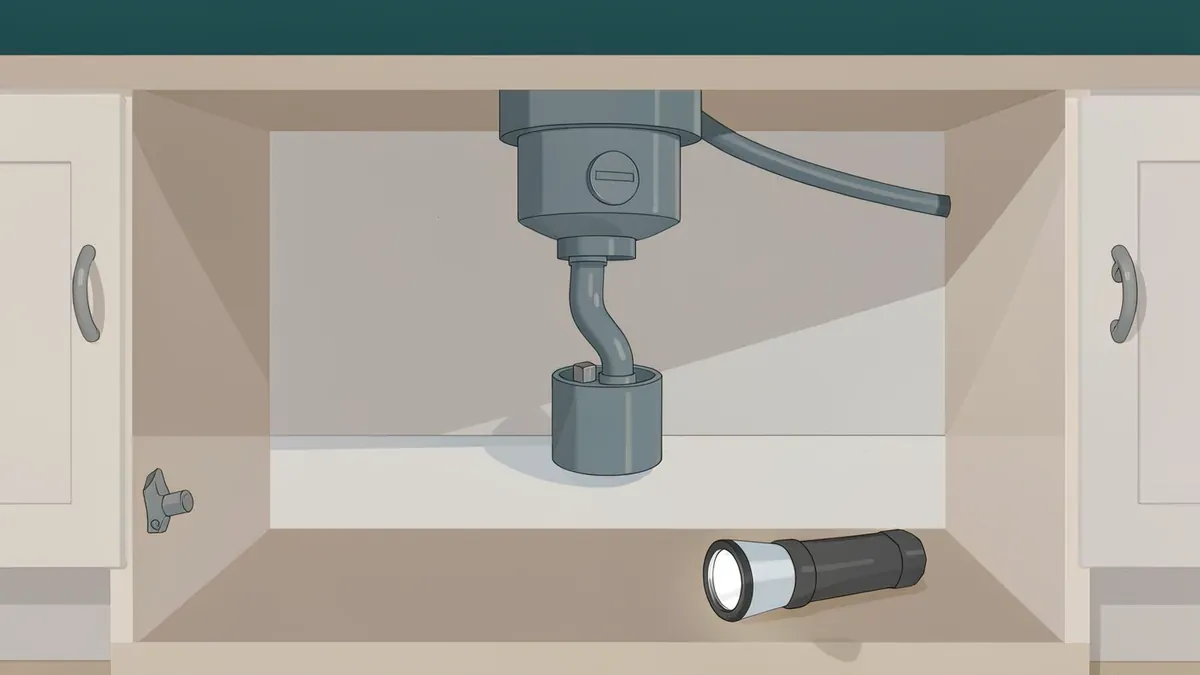
Cut the power and keep your hands out of the unit. A disposal that hums but won't turn is usually jammed: free it with the wrench in the socket underneath or a wooden spoon from above, lift the object out with tongs, then press the reset button. If it runs but the sink still won't drain, the clog is likely in the trap or drain line below.
On this page
A garbage disposal that hums without grinding, stays silent, or leaves the sink full of gray water is a common kitchen problem, and many fixes need only simple tools. The risk lies in shortcuts: reaching into the unit, working on it with the power still on, or pouring a drain chemical into it.
The steps below follow disposal makers' own instructions, from the simplest fix to the more involved ones. They are for one kitchen sink. If other drains in the house are slow or backing up too, the problem is probably farther down the line, and the last part of the drain section explains what to do.
Safety first: power off, hands out
InSinkErator's instructions start by making sure the disposal's switch is off and say never to put your hand in the disposal at any time (InSinkErator). Moen's safety instructions say the same about fingers and hands, and add three rules: unplug the power cord before clearing a jam or removing an object, loosen a jam with a long wooden object such as a wooden spoon, and lift objects out with long-handled tongs or pliers (Moen).
Moen's troubleshooting steps cut power by unplugging the cord or turning off the wall switch or breaker, depending on how the unit is wired. Before any tool goes into the unit, unplugging it or switching off its breaker is a surer choice than the wall switch alone. If the sink is full, InSinkErator says to wait for it to drain or bail the water out with a bucket or pot. Have a flashlight and a pair of tongs or pliers ready.
Match the symptom to the fix
| What happens | Likely cause | Where to start |
|---|---|---|
| Hums but doesn't grind | The grinding plate can't turn, often because something is wedged in it | Unjam it, then reset |
| No sound at all | The overload protector tripped, or the breaker, fuse or switch is off | Reset it |
| Runs, but water stays in the sink | A clog in the drain line below the disposal | Clear the drain below |
| Sudden rattling or clanking | A spoon, bottle cap or other object inside | Power off, then remove it with tongs |
Moen's troubleshooting links humming without grinding to a turntable that isn't rotating, and odd noises to things like a spoon or bottle cap that fell in. A silent disposal may only need its reset button pressed, which both makers cover in the steps below.
Unjam and reset, step by step
- Cut the power and turn off the water.
- Free the grinding plate. Many InSinkErator models have a socket in the center of the bottom, facing the floor. The company ships a small wrench for it and says a standard 1/4-inch Allen wrench also fits. Work it back and forth in both directions until it turns full circles freely; InSinkErator says some force is fine because the wrench is designed to bend before the disposal is damaged. Moen's instructions for its models instead say to rotate the turntable in either direction with a wooden spoon, a method InSinkErator also gives for some of its units.
- Find and remove the object. Shine a flashlight into the grinding chamber, paying special attention to the outer edge of the shredding disk, and lift out anything you see with tongs or pliers.
- Press the reset button. On InSinkErator units it is a small red square button on the bottom of the disposal. When tripped, it sits about a quarter inch lower than normal; press it gently, and if it won't stay up, wait 10 minutes and try again. Some InSinkErator models reset automatically and need up to 20 minutes to cool before they restart. On the Moen units its guide covers, the red button sits near the bottom opposite the discharge elbow; push it until it clicks and stays in.
- Restore power, turn on the water, then the disposal. If it jams again, repeat the steps.
- Still dead? Check the breaker or fuse. Moen says that if the wiring and electrical parts are intact, the unit may have an internal problem that needs service or replacement, and to call a qualified electrician if you aren't familiar with electrical work.
When the sink won't drain
InSinkErator's troubleshooting begins with a simple test. Turn the disposal on and look at the water: if you see a whirlpool, the disposal is spinning, and you may have a clogged drain line (InSinkErator). Its fix is a plunger. Switch the disposal off first, then:
- With a double sink, put a stopper in the other bowl's drain.
- Fill the sink with about 4 inches of water.
- Set the plunger over the disposal opening, press down slowly and gently, then pull up quickly. Repeat several times.
- Once the clog breaks loose, run water and the disposal for a minute or two.
If plunging doesn't work, the next stop is the trap under the sink. How to unclog a drain yourself walks through cleaning a P-trap and using a hand auger. Moen's guide suggests running a drain auger or plumber's snake through the trap and drain lines whenever a disposal is replaced in anything but a new home.
Two dishwasher details matter here. The International Plumbing Code allows a home dishwasher to drain directly into a disposal's dishwasher connection (IPC Section 409.4), and Moen says to make sure the disposal is empty before running the dishwasher so it can drain. If a new disposal was just installed and the dishwasher won't drain, check that the plug in the disposal's dishwasher inlet was knocked out; Moen's instructions say to knock it out with a blunt tool and remove it from the disposal with tongs.
Skip chemical drain openers. Moen says never to put lye or chemical drain cleaners into a disposal, because they badly corrode its metal parts and void its warranties. If one is already in the drain, read chemical drain cleaner safety before you plunge or open the trap.
If other fixtures are slow too, or water backs up somewhere else when the kitchen sink drains, the blockage is probably in a line the kitchen shares with the rest of the house; see signs of a main sewer line clog. A kitchen drain that clogs again soon after you clear it is another reason to call a licensed plumber.
What not to grind, and what Georgia utilities say
The makers' rules come first. InSinkErator says never to pour grease or fat into a disposal or drain, to grind with a moderate flow of cold water and keep the water running a few seconds after grinding stops, and to avoid hot water while grinding. Moen's guide says its disposals won't grind plastic, tin cans, bottle caps, glass, china, leather, cloth, rubber, string, clam and oyster shells, aluminum foil or feathers, and that large bones and fibrous husks are easier to throw away with the trash. Its safety list also rules out caustic drain cleaners, metal utensils, hot grease and other hot liquids, and whole corn husks. Lists vary by model, so check your own manual.
Several Georgia utilities go further. The City of Atlanta's Department of Watershed Management tells residents not to put food scraps down the disposal, because it only shreds solids into smaller pieces and won't keep grease from going down the drain (Atlanta DWM). The Henry County Water Authority says disposals often lead to more sewer clogs, from the added grease and from food particles that catch on grease already in the pipes (HCWA). The City of Senoia's code bars garbage disposals in new residential developments, to cut the organic load (BOD) entering its sewer system and keep its plant's discharge within state guidelines (Senoia Code § 70-101). Rules differ by provider, so check yours in the metro Atlanta directory. What not to flush or pour explains how to get rid of grease.
On septic, a disposal adds to the load. Georgia's rules call for a 50 percent larger septic tank when a garbage grinder will be used, and the Department of Public Health's manual says pumping is needed more often with a disposal. Its troubleshooting advice for mound systems is blunter: don't use in-sink garbage grinders, because they add too many solids to the septic tank (DPH manual). Septic tank pumping in Georgia covers schedules.
Bottom line
Cut the power, keep your hands out, and work in order: the wrench, the reset button, the plunger, then the trap. If the disposal still won't run after a reset and a breaker check, or the drain stays blocked after you've cleared the trap, call a licensed plumber and say what you tried and anything you poured. This guide is general information, not professional advice; your disposal's manual, a licensed plumber or an electrician can address your specific unit and wiring.
Sources
- InSinkErator: Fixing a Jammed Garbage Disposal
- InSinkErator: Fixing a Clogged Garbage Disposal
- Moen: Garbage Disposal Installation Guide (INS10477A)
- International Code Council: 2024 International Plumbing Code, Chapter 4: Fixtures, Faucets and Fixture Fittings (Section 409.4)
- City of Atlanta Department of Watershed Management: Grease Management
- Henry County Water Authority: Frequently Asked Questions
- City of Senoia, Georgia (via Municode): Code of Ordinances, Sec. 70-101. Fats, oils and grease/BOD ordinance
- Georgia Department of Public Health: Manual for On-Site Sewage Management Systems (March 2026)
Guides that pick up where this one stops.
How to Unclog a Drain Yourself: A Safe, Step-by-Step Guide
Step by step: choose the right plunger, pull hair from tub drains, clean a P-trap, use a hand or toilet auger, skip boiling water, and know when to stop.
What Not to Flush or Pour Down the Drain
A prevention checklist for Georgia homes: what stays out of toilets and sinks, and how to get rid of grease, wipes, medicines and chemicals instead.
Chemical Drain Cleaners: Types, Hazards and Safer Options
How caustic, acid, bleach-based and enzyme drain openers differ, why they burn and give off gas, why never to mix or plunge after pouring, and safer fixes.