Hampton Sewer and Drain Guide for Homeowners
Sewer provider: City of Hampton Utilities Department · Henry County
At a glance
The City of Hampton's Utilities Department provides sewer service and runs the Bear Creek water pollution control plant. City code has the owner pay for the building sewer from the house to the city property line, and the city itself makes the connection from that line into the main.
On this page
Hampton runs its own electric utility, and the same city department handles water and wastewater service (Hampton Utilities). For homeowners that means a city utility bill and city rules for the sewer under the yard.
Those rules are short and specific. Hampton's code draws the owner's share of a sewer connection at the city property line and reserves the final tie-in to the main for city crews.
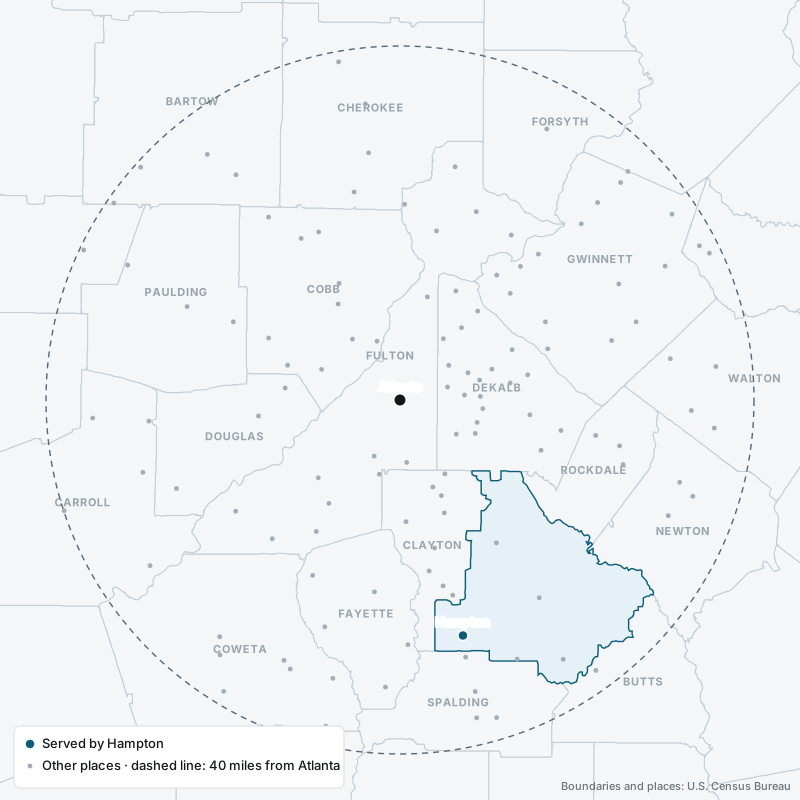
Who provides sewer service here
The Hampton Utilities Department covers water and electric operations, system maintenance and customer service, and its staff includes a wastewater superintendent. The department's water section lists the Bear Creek water pollution control plant, which began operating in 1958 as a trickling filter plant. Customers apply for water and sewer service in person at City Hall and pay a cash security deposit for sewer service set by the mayor and council (Sec. 86-81).
If your sewer bill comes from someone else, use that provider's rules; the Henry County Water Authority is the county-wide sewer utility.
Where your responsibility ends
Under Sec. 86-84, the owner bears all costs of connecting the building sewer from the building to the city property line, and any connection from the city property line into the public sewer is made by the city. Where the main does not reach your lot, the owner also pays to build the sewer from the property line to the nearest existing sewer line unless the mayor and council approve otherwise. The code does not separately describe who maintains each stretch after installation, so ask the Utilities Department before paying for digging near the street.
The construction rules in Sec. 86-87 matter when a line is replaced. The building sewer must be at least 4 inches across with a slope of at least one-eighth inch per foot. Any part within 10 feet of a water service pipe must be cast iron soil pipe or ductile iron with bolted mechanical joints, and the city may require the same where tree roots could damage the line. Drains too low for gravity flow must be lifted by an approved pump. The guide to tree roots in sewer lines explains why joints matter. This is general information; the city or a licensed plumber can confirm how the rules apply to your lot.
If sewage backs up
The Utilities page does not set out a sewer-backup procedure. It lists the department's staff, including the wastewater superintendent, and separate numbers for leaks and outages during and after business hours (Hampton Utilities). If only your home is affected, start with a licensed plumber; if neighbors have the same problem or a manhole is overflowing, call the Utilities Department. The sewer backup procedure covers safety steps inside the house.
Repairs, permits and inspections
Building permits and inspections in Hampton are handled by the city's Community Development department through its online public portal, not by the county; Henry County's building department confirms that each city has its own (Henry County).
Sewer work also needs the city's sign-off. No one may uncover, connect to or alter a public sewer without a written city permit; owners apply on the city's form, with plans if requested, and pay a permit and inspection fee set by the mayor and council (Sec. 86-83). Building sewers are laid in open trenches unless the city approves another method, and no backfill may be placed until the work is inspected (Sec. 86-87). Ask before scheduling trenchless work, since that requires the city's approval. Georgia 811 asks anyone planning to dig to request a free locate at least three business days ahead (Georgia 811), and Georgia's dig law requires that request before digging with machines (dig law).
Grease, wipes and rainwater
Hampton keeps rainwater out of the sanitary sewer by ordinance. Stormwater and other clean drainage must go to storm sewers or an approved natural outlet, and no one may discharge stormwater, surface water, groundwater, roof runoff or subsurface drainage into a sanitary sewer (Sec. 86-88).
The list of banned discharges in Sec. 86-89 reads like a homeowner's checklist once the industrial items are set aside: no liquid hotter than 150 degrees Fahrenheit, no waste carrying grease or other substances that harden between 32 and 150 degrees, no garbage that has not been properly shredded, and no rags, plastics or other solids that can block the flow. Restaurants fall under a separate grease management program run by the public works director. What not to flush or pour has household disposal tips.
Septic homes in this area
Hampton's code treats unconnected homes near a sewer as "nonconforming." A home within two miles of a public sewer line that could drain to it by gravity, but is not connected, must connect within 60 days of official notice when it is destroyed and replaced or when its septic system fails and cannot be properly repaired. The city or the Henry County Health Department decides whether a system has failed, new construction within two miles must connect, and an owner who claims undue hardship can appeal in writing to the mayor and council within five days of the notice (Sec. 86-82).
Septic permits and records are kept by the Henry County environmental health office, which the Department of Public Health lists at 137 Henry Parkway in McDonough (DPH). If you are unsure which system serves your home, see septic or sewer: how to tell.
Cities and communities served
The city system serves Hampton. Homes in the surrounding unincorporated county are covered by the Henry County Water Authority's page.
| City or community | Sewer service | Plumbing permits | Local note |
|---|---|---|---|
| Hampton | Yes | City of Hampton Community Development (Building Inspections) | City code can require homes within two miles of a gravity sewer line to connect when rebuilt or when a septic system fails beyond repair. |
Next step
If your septic system is failing or you are rebuilding, call Hampton's Utilities Department before you call a septic contractor: city code may require a sewer connection instead of a repair.
Provider rules change. Every statement above links to the provider's own page or ordinance as checked in October 2026 — if a source and this page disagree, the source wins. All places within 40 miles of Atlanta and their providers are listed in the metro Atlanta sewer directory.
Sources
- City of Hampton: Utilities
- City of Hampton: Building Inspections
- Hampton Code of Ordinances (Municode): Sec. 86-84. Connection fees and expense
- Hampton Code of Ordinances (Municode): Sec. 86-82. Connection to public sewer required
- Hampton Code of Ordinances (Municode): Sec. 86-83. Building sewers and connections; permit required
- Hampton Code of Ordinances (Municode): Sec. 86-87. Construction specifications and requirements
- Hampton Code of Ordinances (Municode): Sec. 86-88. Stormwater and other unpolluted drainage
- Hampton Code of Ordinances (Municode): Sec. 86-89. Objectionable and harmful items
- Hampton Code of Ordinances (Municode): Sec. 86-81. Sewer service; application requirement, security deposit
- Henry County: Building & Plan Review Department
- Georgia Department of Public Health: County Environmental Health Offices
- Georgia 811: The 811 Process