Locust Grove Sewer and Drain Guide for Homeowners
Sewer provider: City of Locust Grove Public Works (Water and Sewer) · Henry County
At a glance
Locust Grove's Public Works Department manages the city's water and sewer system and its Indian Creek wastewater plant, with one consolidated monthly bill. Sewer connections need a written city permit and city inspection, and the city's standards define the lateral as the pipe from the main to the right-of-way or easement.
On this page
Locust Grove keeps its own water and sewer utility, as do several other Henry County cities. One city department handles the pipes, the treatment plant and the monthly bill, and the city code sets the rules for connecting to the system.
The city-page details below come from archived copies of the city's website made in spring 2026, and the rules come from the city code on Municode. Confirm anything time-sensitive with City Hall.
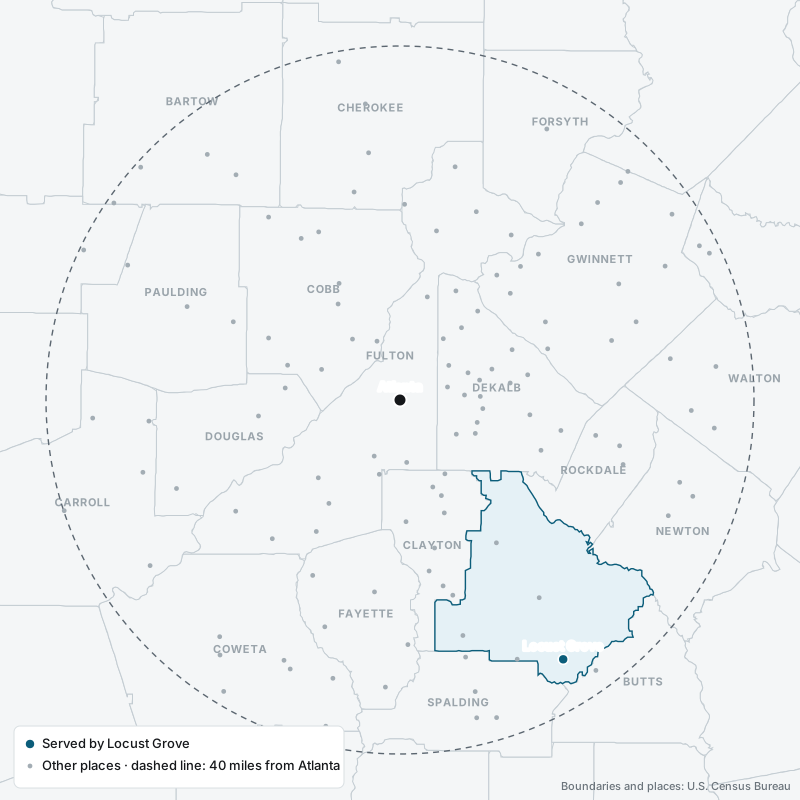
Who provides sewer service here
The city's Public Works Department manages all water and sewage activities, along with city facilities and trash collection, and residents get a single consolidated bill each month. Its utility functions include water treatment and distribution, sanitary sewer treatment, and stormwater maintenance. The same page describes the city's Indian Creek Water Pollution Control Plant, opened December 1, 2005, with capacity to treat 1.5 million gallons of wastewater a day, and lists the Henry County Water Authority as a backup water source.
Capacity is not unlimited. The city's standards say Locust Grove provides water and sewer service where capacity is available, on a first-come, first-served basis. If the city does not bill you for sewer, check whether the Henry County Water Authority does, or whether your home is on septic.
Where your responsibility ends
The city code does not state the maintenance boundary in one sentence, so start with the standards. They define a sanitary sewer lateral as the pipe running from a sewer main to the public street right-of-way or an easement, at least 6 inches in diameter, and they place city-owned sewer appurtenances that are not in a street right-of-way inside permanent easements or on property deeded to the city (Standards). Cleanout boxes built to the standards are round plastic valve boxes with "SEWER" embossed on the lid, a useful clue when you search the front yard.
The building sewer between that point and the house must be at least 4 inches in diameter with a slope of at least one-eighth inch per foot. Any part within 10 feet of a water service must be cast-iron soil pipe, and the superintendent can require cast iron where tree roots threaten the line (13.12.110). Before paying for excavation near the street, ask Public Works where the city's responsibility begins at your address; the ownership guide explains why that answer matters. The summary here is general information, not legal advice; Public Works or a licensed plumber can confirm the specifics.
Repairs, permits and inspections
Plumbing permits in Locust Grove come from the city's Community Development department, which issues building permits, reviews plans and inspects construction from its office in the municipal complex. Its permit list includes separate plumbing, electrical and mechanical applications, and Henry County's building department points Locust Grove residents to that city office rather than handling permits itself (Henry County).
Touching the public sewer takes a separate approval. No unauthorized person may uncover, connect to or alter a public sewer without a written permit from the superintendent, applied for on the city's own form (13.12.070). The city has also opted out of the state law that lets master plumbers or utility contractors self-inspect water and sewer projects, so self-inspection is not an option inside the city (13.04.030). Each building generally needs its own building sewer, and an old building sewer can serve a new building only after the superintendent tests it. For any excavation, Georgia 811 asks for a locate request at least three business days ahead (Georgia 811); under state law, the request is required before digging with machines (dig law). For choosing a repair method, see sewer line repair options.
Grease, wipes and rainwater
Locust Grove runs a fats, oils and grease (FOG) program aimed at restaurants and the service companies that pump their grease traps, with reporting handled through an online portal and questions going to the city's water and wastewater operator (City of Locust Grove).
At home, the code sets the limits. Among the discharges barred from the public sewer are liquids hotter than 150 degrees Fahrenheit, wastewater heavy with fat, oil or grease, garbage that has not been properly shredded, and solids such as rags, plastics, sand or glass that can block the flow (13.12.130). Rainwater belongs in storm sewers or an approved natural outlet: no one may send stormwater, surface water, groundwater, roof runoff or subsurface drainage into a sanitary sewer (13.12.120). What not to flush or pour turns those rules into kitchen and bathroom habits.
Septic homes in this area
Where public sewer is not available, the city code allows a private sewage system, with strings attached. The owner must apply to the city, pay an inspection fee and get written consent from the mayor and council, and must sign an agreement to connect and pay tap-on fees once city sewer reaches the property. The superintendent inspects before anything is buried, and no system using a soil absorption field is permitted on a lot smaller than 15,000 square feet (Chapter 13.20). Septic records for Henry County are kept by the county environmental health office, which the Department of Public Health lists at 137 Henry Parkway in McDonough (DPH).
Cities and communities served
The city system serves Locust Grove, subject to available capacity; homes outside it in Henry County fall under the county water authority or septic systems.
| City or community | Sewer service | Plumbing permits | Local note |
|---|---|---|---|
| Locust Grove | Yes | City of Locust Grove Community Development | Public Works runs the city's water and sewer; wastewater goes to the city's Indian Creek plant, opened in 2005. |
Next step
Before any sewer repair, call City Hall to confirm that Locust Grove bills you for sewer and to ask Public Works where its part of the lateral begins at your address.
Provider rules change. Every statement above links to the provider's own page or ordinance as checked in October 2026 — if a source and this page disagree, the source wins. All places within 40 miles of Atlanta and their providers are listed in the metro Atlanta sewer directory.
Sources
- City of Locust Grove (archived May 10, 2026): Public Works
- City of Locust Grove (archived May 10, 2026): Community Development
- City of Locust Grove (archived May 10, 2026): Water, Wastewater, & F.O.G.
- City of Locust Grove (archived April 11, 2026): City of Locust Grove Standards and Specifications
- Locust Grove Municipal Code (Municode): 13.12.070 Building sewers and connections; permit required
- Locust Grove Municipal Code (Municode): 13.04.030 Self-inspection of water and sewer lines
- Locust Grove Municipal Code (Municode): 13.12.110 Construction specifications and requirements
- Locust Grove Municipal Code (Municode): 13.12.120 Discharge of stormwater and other unpolluted drainage
- Locust Grove Municipal Code (Municode): 13.12.130 Discharge of objectionable and harmful items
- Locust Grove Municipal Code (Municode): 13.20.020 Private sewerage disposal systems; permit required
- Georgia 811: The 811 Process