Main Water Line Repair in North Metro Atlanta: Who Fixes What
Water is leaking somewhere between the meter and my house in north metro Atlanta. Who has to fix it, and should the line be repaired or replaced?
Short answer
Every north metro Atlanta water utility in this guide that publishes a rule stops at the meter: a leak in the street or meter box is the utility's to fix, and a leak on the pipe from the meter to your house is yours. Confirm the leak with a meter test and check your address in the utility's service line inventory. A replacement line must meet plumbing code rules on material, depth, valves and pressure, and cities such as Marietta and Sandy Springs require a permit for the work.
On this page
- Water main leak or service line leak: who owns which pipe
- North metro Atlanta water providers and where their part ends
- Signs of a water service line leak
- Pipe materials: polybutylene, galvanized, copper, PEX and lead
- Lead service line inventories
- Main water line repair or water line replacement?
- Permits, pressure-reducing valves and Georgia 811
- Costs, leak credits and hiring a plumber
- Next step
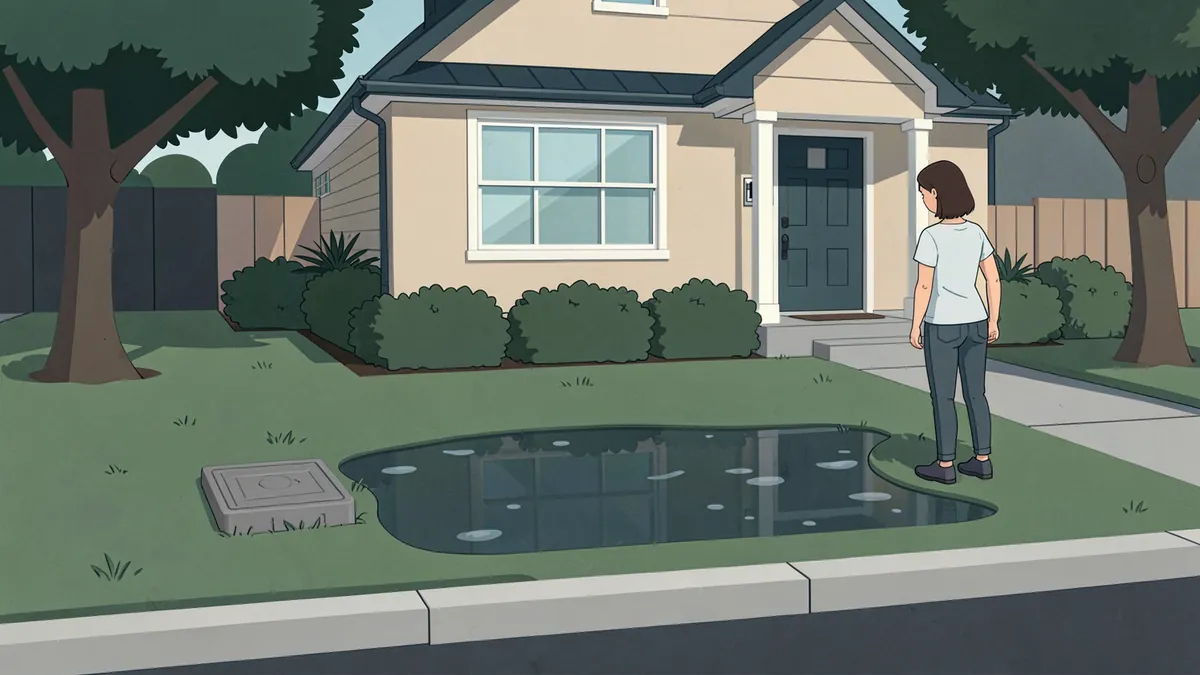
A strip of lawn that stays soggy in dry weather, a meter dial that creeps while every faucet is off, or a bill twice the usual size usually points to one place: the buried pipe that carries water from the meter to your house. In north metro Atlanta that pipe is almost always yours to repair, but who supplies your water, where its duty ends and what a new line must meet depend on the utility, which may not run your sewer.
This guide covers who owns what in each city, confirming a leak, pipe materials, lead line inventories, and the permit, pressure and digging rules. It explains the rules so you can hire a licensed plumber with the facts in hand.
Water main leak or service line leak: who owns which pipe
Every north metro utility in the table below that publishes a rule stops at the meter. Gwinnett County's Department of Water Resources (DWR), for example, maintains the main, the small pipe joining the meter to it, and the meter. Everything on the customer's side, including leaks between the meter and the house, backflow devices and irrigation, is the owner's to maintain, repair or replace (Gwinnett DWR).
That boundary decides your first call. A water main leak in the street or water in the meter box goes to the utility; Gwinnett asks residents to report both to its 24-hour dispatch, and says a leak between the home and the meter needs a plumber because it is on private property (Gwinnett DWR).
The meter isn't always at the property line: Cumming's code lets the city set it on your lot within three feet of the line (Cumming Code, Sec. 111-62). The sewer lateral follows separate rules; see who is responsible for the sewer line.
North metro Atlanta water providers and where their part ends
Your water bill names your provider; each city links to its local sewer guide.
| City | Water provider | Where the utility's part ends; inventory |
|---|---|---|
| Cumming and unincorporated Forsyth | Cumming Utilities in its service area; Forsyth County Water & Sewer elsewhere | Cumming makes piping and leaks past the meter the customer's (Sec. 111-63) and found no lead in 927 pre-1990 lines inspected (Cumming). Forsyth's maintenance stops at the meter (leak policy); inventory portal. |
| Alpharetta | Fulton County Public Works | County owns main to meter; owner, meter to building. A Water Service Lookup tool confirms your provider (Fulton County). |
| Milton | Fulton County; the city runs no water system and says residents get service from the county or privately (Milton) | Same split. Fulton published its inventory in October 2024 and is reducing unknowns (Fulton County). |
| Johns Creek | Fulton County, citywide | The county lays 1-inch Type K copper on its side but sets no specifications for private lines (Fulton County). |
| Roswell | Roswell Water Utility (about 5,900 metered customers in and around downtown) or Fulton County | City maintains the lateral to the meter, the owner the rest; a GIS portal shows each line's classification (Roswell). |
| Sandy Springs | Atlanta's Department of Watershed Management (DWM), which also bills sewer (Sandy Springs) | Ends at the meter. Inventory on Georgia EPD's dashboard; no lead lines found so far (Atlanta DWM). |
| Dunwoody | DeKalb Watershed Management; the city sends water main leaks there (Dunwoody) | County owns the line through the meter, the owner from the meter in (DeKalb); "Check Your Line" map (DeKalb). |
| Marietta | Marietta Water (Marietta Power & Water) | Utility maintains main to meter; owner from the meter on, including indoor piping. Its finished inventory found no lead lines (Marietta). |
| Kennesaw | Cobb County Water System, which must approve all water and sewer systems under city code (Kennesaw) | County maintains main to meter; owner, meter to house (Cobb County). |
| Acworth | Cobb County Water System since a 1987 sale (Acworth charter § 6.30) | Same split; the county's inventory lists no lead or galvanized-requiring-replacement lines in its area, which includes Acworth (Cobb County). |
| Woodstock | City of Woodstock; it and the Cherokee County Water and Sewerage Authority (CCWSA) split service areas on a map first adopted in 2000 (CCWSA) | City maintains mains, meters and lines to the meter; the owner, everything beyond (Woodstock). Inventory linked in the 2025 water quality report. |
| Canton | City of Canton or CCWSA; one 2020 case had CCWSA water and Canton sewer at the same address (CCWSA) | City owns the line through the meter box (§ 114-202). CCWSA stops at the meter too (FAQ); its inventory searches by address (CCWSA). |
| Suwanee | Gwinnett DWR (Suwanee) | Ends at the meter. Address lookup on the county's inventory map; it reports no lead lines (Gwinnett DWR). |
| Sugar Hill | Gwinnett DWR for emergencies; Gwinnett County inspects water and sewer work (Sugar Hill) | Gwinnett's split. City code requires dual check valves at the meter and a thermal-expansion relief valve on new systems (Sec. 74-1). |
| Buford | City of Buford in the areas it serves; part of its water comes from Gwinnett (Buford) | No published meter rule; ask. Its 2025 report says the inventory can be seen at City Hall (report). |
| Duluth | Gwinnett DWR, for new service and emergencies (Duluth) | Gwinnett's split; meter-box leaks go to DWR dispatch (Gwinnett DWR). |
| Lawrenceville | Gwinnett DWR; the city agreed in 2020 to sell its water system to the county, adopting Gwinnett's water ordinances effective December 1, 2020 (§§ 38-220, 38-221) | Gwinnett's split. |
| Cartersville | City Water Department | Owner responsible from the meter box to the house, with a valve beside the box (§ 24-41). The 2024 inventory lists several hundred galvanized-requiring-replacement lines. |
| Rome | City Water & Sewer Division | No published meter rule. Its page links an online inventory and takes leak adjustment requests after repairs (Rome). |
For every other place within 45 miles of Atlanta, the local directory lists its sewer provider and permit office.
Signs of a water service line leak
Cumming Utilities says most leaks occur on privately owned lines between the meter and the building (Cumming Utilities). Watch for:
- a meter that moves while no water is in use (EPA WaterSense);
- soggy patches in the yard (Gwinnett DWR);
- a bill far above normal that isn't a misread; compare the meter with the bill (CCWSA);
- a leak notice from the utility; Cumming gives 30 days to find and fix the leak (Cumming Utilities).
Confirm the leak in six steps
- Stop all water use for two hours; leave appliance supply valves open unless one runs constantly, like some ice makers (Gwinnett DWR).
- Photograph the meter reading and watch its small leak-detection wheel. A changed number or any movement means a probable leak.
- Close the main shutoff where the line enters the house. If the meter still moves, the leak is between the meter and that valve; if it stops, look inside (City of Hemet).
- Walk the route for wet ground. Water in the meter box or street is the utility's to fix.
- Use your own valve, not the utility's. Gwinnett publishes a diagram of its curb stop (Gwinnett DWR), but Cumming lets only people it authorizes turn water on or off at the meter box (Sec. 111-69), and Canton bars work on a meter without written permission (§ 114-202).
- Call a licensed plumber; keep the invoice and photos for a leak credit.
Pipe materials: polybutylene, galvanized, copper, PEX and lead
The pipe often shows where it enters a basement, crawlspace or garage. Forsyth County's guide: plastic is rigid PVC or flexible PEX in many colors; copper is penny-colored, or green or brown with age; galvanized steel is dull silver-gray and usually attracts a magnet; lead is dull gray, soft, scratches easily to a bright surface and doesn't attract a magnet (Forsyth County). EPA's Protect Your Tap guide uses the same test.
Polybutylene. InterNACHI, the home inspectors' association, says this plastic was made from 1978 to mid-1995 and can flake apart anywhere along the pipe where disinfectants attack it. It's most often gray, with blue used mainly outdoors, and usually stamped "PB2110"; the damage can't be seen without taking the pipe apart, and no regulation requires replacing it (InterNACHI). It isn't among the water service materials in the 2024 International Plumbing Code (IPC) Table 605.3.
Galvanized steel. Still listed, but galvanized pipe rusts from the inside. One water utility tells customers that galvanized lines or fittings on their own side can bring periodic episodes of discolored water, especially after a period of non-use (Lincoln Water System, Nebraska).
Copper, PEX and other plastics. Table 605.3 lists copper tubing, PEX, polyethylene, PVC and CPVC. Buried service pipe must meet NSF 61 and a 160 psi rating, and a material not certified for indoor use must stop at or before the main valve at the house (Section 605.3).
Lead. EPA says new lead pipe installation was banned nationally in 1986 (EPA); Fulton County says systems commonly used lead service lines until 1960 (Fulton County). CCWSA says lead wasn't typically used in Cherokee County, and where it was, mostly on pipes over 2 inches (CCWSA).
Lead service line inventories
Under EPA's 2021 rule revisions, water systems had to inventory service line materials by October 16, 2024 (EPA). They must notify anyone served by a lead line, a galvanized line that may carry lead, or a line of unknown material, and the newer Lead and Copper Rule Improvements require most systems to replace lead and those galvanized lines under their control within 10 years, with most requirements starting in late 2027 (EPA). Inventories cover the utility's and the owner's sides (Gwinnett DWR) and use four classes: lead, galvanized requiring replacement (galvanized that is or was downstream of lead, or sits downstream of an unknown line), non-lead and unknown (Cobb County).
Georgia EPD links a statewide Service Line Inventory Public Transparency Dashboard from its drinking water page. Most utilities in the table report no lead lines found; many lines are still unknown, which means no record, not a lead finding. Atlanta mails unknown-status customers a yearly notice until the line is confirmed non-lead or replaced, and may request a right-of-entry form to inspect (Atlanta DWM). Fulton, DeKalb and Cobb also take owners' own pipe reports (Fulton County; DeKalb; Cobb County).
If your line is listed as lead or galvanized requiring replacement, call the utility before paying to replace it. EPA tells owners of lead lines to join the utility's replacement program (EPA), and Atlanta offers funding information to eligible customers (Atlanta DWM). EPA says no level of lead in drinking water is safe; it suggests cold water for drinking and cooking, running the tap first, cleaning aerators and a filter certified for lead, and notes that boiling doesn't remove it. Ask your doctor if you're worried about exposure.
Main water line repair or water line replacement?
If the leak is on your side, the pipe decides most of it. Ask the plumber to show you the failed section and whether the damage stops there. A polybutylene line can fail anywhere, a galvanized line shedding rust is losing metal, and a line your utility lists as lead or galvanized requiring replacement belongs in its program.
Georgia has adopted the 2024 International Plumbing Code with Georgia amendments. DCA's most recent announcement (December 2025) gives January 1, 2027 as its effective date, while an earlier DCA memo said January 1, 2026, so ask your city or county building department which edition it enforces (DCA). Under the 2024 code, a new service line:
- is at least 3/4 inch (Section 603.1), buried at least 12 inches deep and 6 inches below the frost line (Section 305.4);
- stays 5 feet from the building sewer unless the sewer pipe is an approved building-drain material, the water line runs at least 12 inches above it, or it is sleeved at the crossing (Section 603.2), and never runs in, under or above a septic tank or drain field (Section 603.2.1);
- has accessible full-open valves near the curb and where it enters the house (Sections 606.1 and 606.3);
- is pressure-tested (Section 312.6) and, under Georgia's amendment to Section 610.1, flushed and disinfected before use;
- if plastic, can't replace metal pipe that grounds the electrical system until other approved grounding exists (Section 601.3), so ask whether an electrician is needed.
Permits, pressure-reducing valves and Georgia 811
Georgia's amendments delete the code's administration chapter, leaving permit procedures to local governments (DCA). Marietta requires a plumbing permit for any plumbing work, water supply included (Marietta). Sandy Springs requires one except for simple repairs, issues it to licensed contractors or owners working on their own permanent home, and inspects at rough-in and final (Sandy Springs). Johns Creek says to apply before installing, altering, repairing or replacing any plumbing system (Johns Creek), and Suwanee requires permits for plumbing changes (Suwanee). For licensing, see how to hire a drain cleaning company in Georgia.
A pressure-reducing valve (PRV) is required where static pressure in the house exceeds 80 psi, and it must stay open if it fails (Sections 604.8 and 604.8.1). Forsyth County says older homes may lack one, that it usually sits on the house side of the meter, and that keeping it working is the owner's job (Forsyth County). Gwinnett calls a failing home PRV the most common cause of low pressure: strong flow at the front spigot with weak flow inside points to the valve (Gwinnett DWR). Where a PRV, check valve or backflow preventer feeds a storage water heater, Georgia's amendment to Section 607.3 requires a thermal expansion device downstream of it and puts any expansion tank at least 18 inches of pipe from the heater's inlet (DCA); Marietta requires thermal expansion control on retrofits too (Marietta).
Georgia 811 asks everyone to request a locate at least three business days before digging, and state law requires one before digging with mechanized equipment (Georgia 811; dig law). Utilities mark only public lines, which usually end at the meter; the line from the meter to your house is private and needs a private locator (Georgia 811).
Costs, leak credits and hiring a plumber
Price depends on the run's length and depth, obstacles such as trees or patios, trenching versus boring, the pipe and the permit. HomeAdvisor's cost guide, updated June 19, 2026 and checked October 2026, puts the national normal range for main water line replacement at $647 to $2,834 (HomeAdvisor). Georgia quotes vary; get written ones that state length, route, material, method, permit and restoration.
Utilities may credit part of a leak-inflated bill, with proof of repair. Cumming wants a parts receipt or a licensed plumber's paid bill within 90 days of the first high bill (Cumming Utilities); Fulton County asks for the repair bill or material receipts (Fulton County); Marietta can credit up to six months with an invoice (Marietta FAQ). Mailers selling water line coverage are covered in sewer line warranty plans.
Next step
Run the two-hour meter test and look up your address in your utility's inventory, so your plumber starts with the leak's location and your pipe's material. This guide is general information, not legal advice; your water utility, your building department and a licensed plumber can tell you what applies to your property.
Sources
- U.S. Environmental Protection Agency: LCRI Questions and Answers
- U.S. Environmental Protection Agency: Revised Lead and Copper Rule
- Georgia Environmental Protection Division: Drinking Water
- International Code Council: 2024 International Plumbing Code, Chapter 6: Water Supply and Distribution
- Georgia Department of Community Affairs: Georgia State Amendments to the International Plumbing Code (2024 Edition)
- Georgia 811: Have my lines been marked?
- Georgia 811: Georgia Dig Law (Georgia Underground Facility Protection Act, O.C.G.A. Title 25, Chapter 9)
- Gwinnett County Department of Water Resources: Resident Responsibility
- Fulton County Department of Public Works: Lead & Copper
- City of Atlanta Department of Watershed Management: Service Line Information
- Forsyth County Department of Water & Sewer: Water Pressure: How PRVs Help Prevent High Water Pressure
- HomeAdvisor: How Much Does Main Water Line Replacement Cost in 2026?
Guides that pick up where this one stops.

How to Hire a Drain Cleaning Company in Georgia
How to check a Georgia plumber's license, compare estimates, spot red flags and storm chasers, and where to complain if a drain or sewer job goes wrong.

Who Is Responsible for Your Sewer Line in Georgia?
How Georgia sewer providers split the line between homeowner and utility, with a provider-by-provider table and steps to confirm the rule for your address.

Sewer Line Warranty Plans in Georgia: What to Check First
What sewer line warranty plans sold to Georgia homeowners cover and exclude, how they differ from insurance, and how to check a mailer before you pay.