Basement Floor Drain Backing Up: What It Means
Why is my basement floor drain backing up, and what should I do about it?
Short answer
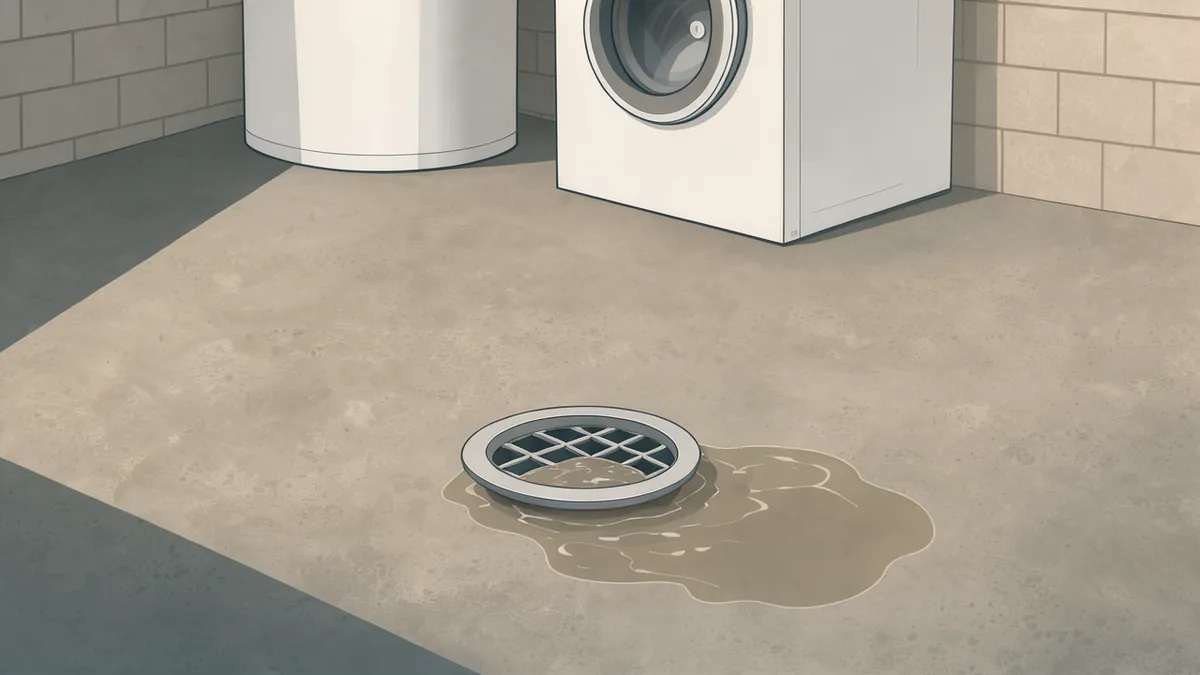
A basement floor drain is usually the lowest opening in the house, so when the main sewer line or the public sewer can't carry water away, it is the first place the water comes back up. Sewage that rises when fixtures upstairs run points to a blockage in the building drain or your sewer line; clear water after heavy rain, a smell with no water, or a drain that is only slow each have other causes. We find out which before we clear anything.
On this page
The grate in the basement or garage floor is easy to forget until the day water comes out of it instead of going in. Sometimes it is a gray puddle that shows up while someone upstairs showers or runs the dishwasher. Sometimes it is clear water after a hard rain, a sewer smell with no water at all, or sewage that keeps rising. All of these get called a floor drain backing up, but they don't share a cause.
When customers call Georgia Sewer about a basement floor drain, we start with three questions: what came up, when it came up, and whether any other drain reacted. The answers usually tell us whether the trouble is the floor drain itself, the main sewer line or the public sewer. Here is what each pattern means and what to do right now.
Why the floor drain is the first to show it
A floor drain has a strainer on top, a trap below that holds water, and a pipe that joins the building drain. Because it sits in the floor of the lowest level, it is usually the lowest opening on the whole system. When water can't get out of the house through the sewer line, it rises in the pipes until it finds a way out, and the floor drain is the first one it reaches.
Atlanta's 311 service lists waste seeping in and around a basement drain among its examples of a sewage backup inside a home (ATL311). So a floor drain that backs up is more often a warning about the line beyond it than a problem with the drain.
What the water tells you
| What you see | What it usually means | What to do first |
|---|---|---|
| Dirty water or sewage rises when a toilet flushes, a shower runs or the washer drains | A blockage in the building drain or your sewer line, downstream of every fixture that reacts | Stop using water and call us |
| Sewage rises with no water running in the house, often during heavy rain, and neighbors have trouble too | The public sewer may be backing up | Call your sewer utility, then us |
| Clear water appears after rain or in wet weeks | Groundwater, a yard or foundation drain, or rainwater getting into the sewer line | Note when it happens and call us |
| Clear water appears near the water heater or air handler on dry days | A relief valve or condensate line discharging there | Check those lines; call us if it doesn't stop |
| A sewer smell, but no water | The trap has dried out | Pour water into the drain |
| Water from mopping or a spill drains slowly | Debris in the floor drain's strainer, trap or pipe | Clean the strainer; call us if it stays slow |
HUD's residential rehabilitation inspection guide lists backed-up floor drains, leaky plumbing and a clogged air conditioner condensate line among the sources of basement water, and notes that a water heater's relief valve pipe may run to a floor drain, depending on local code (HUD).
What causes a floor drain to back up
A blockage in the main line
When the water is dirty, this is the usual cause. Roots, grease, wipes, a sag or a broken section in the building drain or the sewer line hold water back, and every fixture upstream drains toward the floor drain. If a toilet bubbles or a lower-level tub fills at the same time, the main sewer line clog signs page walks through the pattern. Gwinnett County's Department of Water Resources says that historically more than 70 percent of the backups reported to it turned out to be in the privately maintained part of the sewer lateral (Gwinnett DWR).
The floor drain's own trap and pipe
Dirt, sand, lint from a nearby washer and small objects wash into a floor drain and settle in its trap. The plumbing code expects that: the 2024 International Plumbing Code requires floor drains to have removable strainers, to be built so the drain can be cleaned, and to have an outlet at least 2 inches in diameter (2024 IPC, Section 413). A drain that is only slow when you hose the floor, while every other fixture works, usually has a blockage close to the grate.
The public sewer backing up
When a public sewer main fills in a storm or is blocked downstream, sewage can back up into homes whose lowest floor sits below the next upstream manhole. Both Clayton County and Gwinnett County expect homes in that position to have a backflow device on the sewer lateral (CCWA; Gwinnett DWR). How those devices work and when the code requires one is covered in backwater valves explained, and storm-related backups in why drains back up when it rains.
Rainwater and groundwater in the wrong pipe
A floor drain inside the house belongs on the sanitary sewer. The 2024 IPC says floor drains must not be connected to a storm drain, and that storm water must not be drained into sewers meant for sewage only (Sections 1104.2 and 1101.3). Subsoil drains around a foundation are supposed to discharge to a trapped area drain, a sump, a dry well or an approved place above ground, and must have a backwater valve where the building is subject to backwater (Section 1111.1) (2024 IPC, Chapter 11). Older houses don't always follow those rules. If clear water rises only in wet weather, a downspout, sump pump or foundation drain may be tied into the line, and that connection has to come off the sewer.
When the floor drain smells but never backs up
A floor drain that is rarely used can let sewer gas into the room even though nothing is wrong with the pipes. Its trap is meant to hold a plug of water; the 2024 IPC requires a trap seal of 2 to 4 inches, and where a trap seal is subject to evaporation, the code calls for protection such as a trap seal primer valve fed by the water supply, a primer device fed by wastewater, or a barrier-type insert in the drain (Section 1002.4) (2024 IPC, Chapter 10). Georgia's amendments to that edition leave those trap seal sections as written (Georgia DCA).
Wisconsin's health department names the floor drain as one way sewer gas enters a home and says adding water to the drain may stop it (Wisconsin DHS). If a smell comes back within days, the trap may not be holding water, or the odor may be coming from somewhere else; sewer gas smell in the house goes through the other sources.
If the smell could be natural gas, the rotten-egg odor that utilities add to it, treat it as a gas leak. Atlanta Gas Light tells customers to leave right away, avoid anything that could make a spark, and call 911 and the gas company once they are out of the area and somewhere safe (Atlanta Gas Light).
What to do when water or sewage comes up
- Stop running water everywhere in the house: no flushing, laundry, dishwasher or showers. Gwinnett's sewer department recommends stopping high-discharge water use such as washing machines, dishwashers and showers until a backup is cleared.
- Keep away from wet electrical equipment. Ready.gov says not to touch electrical equipment if it is wet or if you are standing in water, and to turn off the electricity only if it is safe to do so (Ready.gov).
- Keep children and pets out of the area, and don't walk through sewage.
- Check whether it's only your house. If neighbors have the same problem, or sewage is coming out of a manhole, call your sewer utility; its number is on your bill. Gwinnett sends an investigator to check the flow in the sewer main and in your lateral at the cleanout, while Clayton County's field staff can inspect only from the cleanout to the main and can't work on private property (CCWA).
- Call us at (404) 482-2527 when the problem is on your side, or when you can't tell.
- Take photos of the water and any damage before cleanup starts, for your insurer or the utility.
What not to do:
- Don't keep testing the drain by running water upstairs.
- Don't pour chemical drain openers into a floor drain that is backing up. When the blockage is out in the main line, they can't reach it. If you already have, tell us before we start.
- Don't open the sewer cleanout on a backed-up line. The pipe can be full of sewage, and it comes out when the cap does.
- Don't clean up sewage without protection. The steps for cleanup, what to throw away and when to bring in a cleanup company are in what to do during a sewer backup.
Code rules and utility policies differ from one city and county to the next, so your building department and your sewer utility have the final word for your address. Georgia has adopted the 2024 International Plumbing Code with Georgia amendments; the Department of Community Affairs' most recent announcement (December 2025) gives January 1, 2027 as its effective date, while an earlier DCA memo said January 1, 2026, so ask your building department which edition it enforces (Georgia DCA).
How we find the cause and fix it
Our technician starts with the questions above, then looks at the floor drain, the cleanouts and the fixtures that share the line.
- The floor drain itself. If only the floor drain is slow, we take off the strainer, clear the trap and run a cable into the pipe it feeds, then tell you what came out and how far in it was.
- The main sewer line. If other fixtures react, we clear the line from a cleanout and, when the cause isn't obvious, run a camera through it. You get the video and our findings and recommendation in writing, and after a repair we run the camera again.
- Grease or heavy buildup. A line coated along its length may need hydro jetting, not just a cable.
- A broken or sagging pipe. If the camera shows damage, we explain the repair options, and whether the job needs a permit, before any work starts.
Backwater valve installation isn't work we do. If your home sits below the next upstream manhole and has no backflow device, we tell you so, so you can have one installed.
Frequently asked questions
Can I just plug the floor drain?
A plug can keep water from coming up through that one opening, but it does nothing about the blockage behind it. Floor drain plugs and standpipes are covered with backwater valves in backwater valves explained. Find out why the drain is backing up first.
Why does the floor drain back up only when the washer runs?
A washer sends a lot of water down the line at once, and a partly blocked main line can't keep up, so the overflow shows at the lowest opening. That is a main line warning, not a laundry problem: stop doing laundry and call us.
Who pays when sewage comes up the floor drain?
It depends on where the blockage is and on your utility's rules. Gwinnett and Clayton County both treat the private part of the lateral as the owner's responsibility. Who owns which part of the line is covered in who is responsible for the sewer line in Georgia. Whether your policy pays for the damage is a question for your insurer.
How Georgia Sewer can help
Before you call, note what came up, when, and which fixtures were running. Then call Georgia Sewer at (404) 482-2527. Sewage rising through a floor drain calls for emergency sewer and drain service; a blocked line under the house or yard is a main sewer line cleaning job; a slow floor drain on its own is drain cleaning; and if backups keep coming back, a sewer camera inspection shows us why.
Sources
- International Code Council: 2024 International Plumbing Code, Chapter 4: Fixtures, Faucets and Fixture Fittings (Section 413)
- International Code Council: 2024 International Plumbing Code, Chapter 10: Traps, Interceptors and Separators (Section 1002.4)
- International Code Council: 2024 International Plumbing Code, Chapter 11: Storm Drainage (Sections 1101.3, 1104.2, 1111.1)
- Georgia Department of Community Affairs: Georgia State Amendments to the International Plumbing Code (2024 Edition)
- Georgia Department of Community Affairs: New Georgia Codes and Amendments - Effective January 1, 2027
- ATL311, City of Atlanta: Customer Reporting a Possible Sewer Backup
- Gwinnett County Department of Water Resources: Sewer Lateral Policy
- Clayton County Water Authority: Preventing Costly Sewer Backups
- U.S. Department of Housing and Urban Development: Residential Rehabilitation Inspection Guide
- Wisconsin Department of Health Services: Air: Sewer Gas
- Atlanta Gas Light: Safety
- Ready.gov (FEMA): Floods
Guides that pick up where this one stops.
Sewer Backup in Your House: What to Do, Step by Step
Sewage backing up into your Georgia home? The first steps, who to call and how to clean up safely. Georgia Sewer clears backups: call (404) 482-2527.

Backwater Valves Explained: When Georgia Homes Need One
Georgia Sewer explains backwater valves, when Georgia's code requires one for low fixtures, and how we check and service the sewer line around one.
Signs Your Main Sewer Line Is Clogged, Not Just One Drain
Georgia Sewer explains the signs of a main sewer line clog, a safe check to run before we arrive, and how we clear the line. Call (404) 482-2527.