Sewer Line Replacement Permits in Metro Atlanta
What permits and inspections does a sewer line replacement need in metro Atlanta, and who issues them?
Short answer
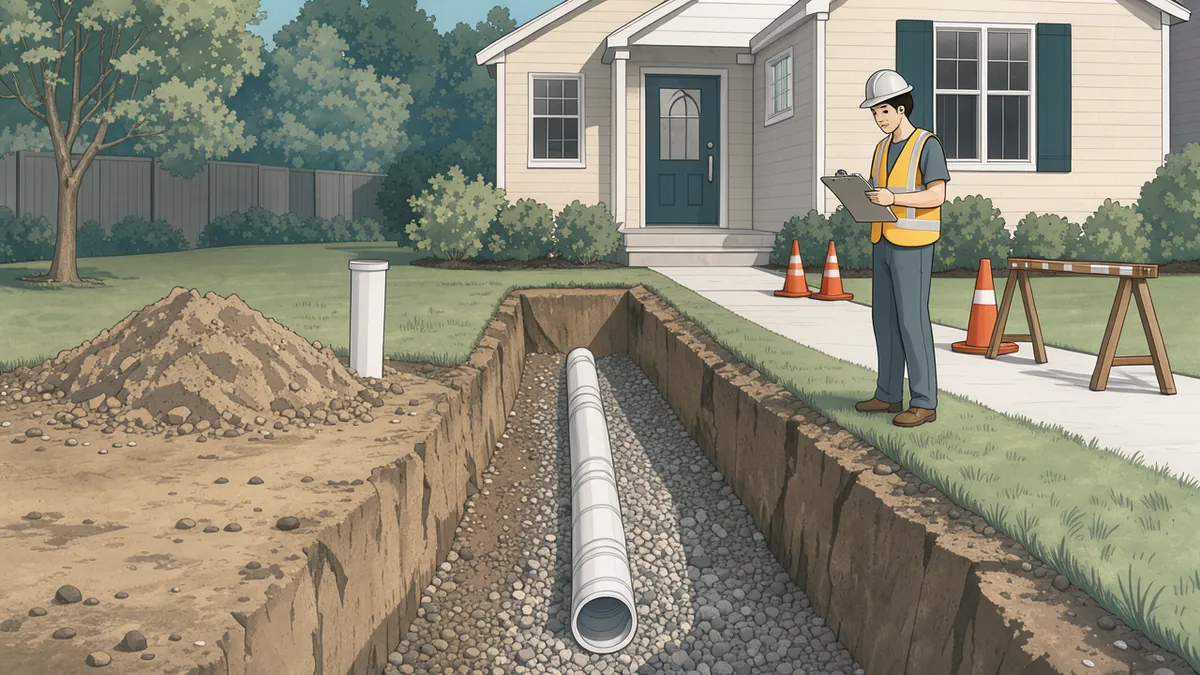
A sewer line replacement usually needs a plumbing permit from the city or county building department that covers your address, and the work has to be seen before the trench is closed. If the pipe runs under a street or sidewalk or ties into the public sewer, the road owner and the sewer provider have their own say. Which office that is, and whether a homeowner may apply, changes from one city to the next.
On this page
- A replacement can need three kinds of approval
- Which office issues the plumbing permit
- Who may apply: homeowner or licensed contractor
- The sewer provider and the right-of-way
- The inspection before backfill, or a sworn affidavit
- Starting without a permit, and other rules worth knowing
- The permit path for a typical replacement
- Frequently asked questions
- How Georgia Sewer can help
A camera inspection has shown that your sewer line has to be replaced, and the next question is paperwork. Who issues the permit? Can you apply for it yourself? Does the city have to see the pipe before the trench is filled? What changes if the line runs under the sidewalk or the street? In metro Atlanta the answers depend on which city or county your house is in and which utility owns the sewer it drains into.
At Georgia Sewer we replace sewer lines across metro Atlanta, and before any digging we sort out which offices the job involves. Below is how the permit side works: the separate approvals a replacement can need, how to find the office for your address, who may apply, and what has to happen before the trench is closed. How we choose between trench and trenchless methods is covered in sewer line repair options, and a day-by-day walk through a dig is in sewer line excavation.
A replacement can need three kinds of approval
Most sewer line replacements touch up to three authorities, and each one approves something different:
| Approval | Who usually grants it | What it covers |
|---|---|---|
| Plumbing permit and inspection | The building department of your city, or of your county if you live outside city limits | The new pipe on your property: material, slope, cleanouts, testing, and the inspection before backfill |
| Right-of-way or street-cut permit | Whoever owns the road: the city, the county, or the Georgia DOT on a state route | Digging in a sidewalk, curb, grass strip or street, traffic control and restoring the pavement |
| Sewer provider approval | The utility that owns the public sewer | Work on its connection, its part of the lateral, and inspection of the tie-in |
A short replacement that stays inside your yard may involve only the first one. A line that has to be dug up out to the main can involve all three. The approvals don't stand in for each other: Fulton County's lateral connection requirements say its permit does not override the approval a city or state agency must give for work in the right-of-way (Fulton County Public Works).
Which office issues the plumbing permit
Georgia's plumbing code is statewide, but its permit rules are local. The Georgia amendments to the International Plumbing Code delete the model code's administration chapter and keep it only as a reference for local governments writing their own procedures (Georgia DCA). Georgia has adopted the 2024 International Plumbing Code with Georgia amendments. The effective date is muddled: an earlier DCA memo said January 1, 2026, but DCA's December 2025 announcement says January 1, 2027, so ask your city or county building department which edition it enforces (DCA). Woodstock, for one, says permits it issues after January 1, 2026 are reviewed under the 2024 edition (City of Woodstock).
The office follows city limits, not your mailing address. A few examples of how that plays out:
- Atlanta: a permit is required to install, repair or replace plumbing, and applications go online through the city's Accela Citizen site (ATL311).
- Marietta and unincorporated Cobb: Marietta's homeowner permit page explains how to check the tax district on a county parcel record. "(4) MARIETTA" means the city handles it; "(9) UNINCORPORATED" means Cobb County does (City of Marietta).
- Mableton: since March 1, 2025, the new City of Mableton takes building permits for its addresses; Cobb County stopped accepting them on February 28, 2025 (Cobb County).
- DeKalb: the county's permit page warns that a project inside an incorporated DeKalb city may have a different permitting authority (DeKalb County). Tucker, one of those cities, lists sewer line replacement among the jobs that need a plumbing permit (City of Tucker).
Our local directory names the sewer provider and plumbing permit office for each city and county we serve.
Who may apply: homeowner or licensed contractor
Cities don't agree on whether you can pull a plumbing permit for your own house:
- Atlanta lets homeowners submit their own permit application (ATL311).
- Sandy Springs issues residential plumbing permits to licensed contractors or to owners for their current permanent residence, usually over the counter (City of Sandy Springs).
- Marietta says homeowners cannot apply for plumbing permits; the professional license holder must apply (City of Marietta).
- Unincorporated DeKalb requires plumbing permits to be submitted by a licensed plumbing contractor (DeKalb County).
A homeowner permit generally covers work you do yourself, so when you hire the work out, the permit usually belongs with the company doing it. If the job needs a permit, we tell you before work starts, along with which office issues it. State licensing rules, and how to look up a license, are in Georgia's plumbing licensing rules.
The sewer provider and the right-of-way
Where the old lateral runs under a sidewalk or street, or the new pipe has to tie into the public sewer, the utility and the road owner come in.
- Atlanta: the city's Department of Transportation issues right-of-way permits for work on city streets and sidewalks, sanitary sewer work included (ATL311).
- Fulton County sewer: the plumber has to contact the county inspector at least three days before installing a lateral connection (Fulton County). Since September 16, 2022, Fulton County has not permitted or inspected sewer projects whose connection point is inside Atlanta, College Park, East Point, Fairburn, Palmetto or Tyrone (Fulton County).
- Gwinnett County sewer: plumbers and contractors hired by the owner may not cut or excavate into the right-of-way, where the county maintains the service stub. If you plan to seek reimbursement for a defect in the county's part, county staff must see the exposed lateral after excavation and before the repair (Gwinnett DWR).
- Douglas County WSA: when a lateral problem sits under the street, WSA decides whether the line will be dug up there and makes that repair itself only in certain circumstances (WSA).
- Sandy Springs: a utility permit is required for construction in the public right-of-way, including sewer lines, and the city lists a flat fee for water or sewer installation on that page as of October 2026 (City of Sandy Springs).
Which part of the lateral is yours to replace in the first place is set by your provider, and who is responsible for the sewer line in Georgia lays out the rules utility by utility. Before anyone digs, Georgia 811 asks for a dig ticket at least three business days ahead (Georgia 811), and state law requires one before digging with mechanized equipment (O.C.G.A. § 25-9-6). Utilities mark only public lines; your own sewer line is a private line (Georgia 811).
The inspection before backfill, or a sworn affidavit
Georgia's amendments require the trench for a building sewer to stay open until the piping has been inspected, tested and approved (Section 306.5). They also call for building sewer cleanouts no more than 100 feet apart, plus one within 10 feet of the public right-of-way (Section 708.1.2) (Georgia DCA). A replacement is the natural time to add a missing one; where to find your sewer cleanout shows what they look like.
State law also offers a second route for underground water and sewer lines outside the house on a private single-family lot. A master plumber or utility contractor may file notice with the local inspector, along with license, trench-safety and bond paperwork, and then submit a sworn certification within five business days of finishing that the line meets the plumbing code. The local government then accepts the work without its own inspection, though it may still inspect at any time and stop work that violates the code (O.C.G.A. § 8-2-26(d)).
Local forms show how that works in practice. Cobb County accepts a notarized sewer approval affidavit or a visual inspection by a county inspector before the pipe is covered. If the visual inspection is chosen, the trench has to stay shored or sloped to OSHA rules until the inspection is done (Cobb County). The City of Dallas requires the affidavit for sewer upgrades and replacements (City of Dallas). Ask your building department which route it accepts. Either way, ask for a copy of whatever closes out the permit.
Starting without a permit, and other rules worth knowing
Skipping the permit tends to cost more, not less. Acworth doubles permit fees when permitted work starts before the permit is issued (City of Acworth), and Jonesboro's application warns that fees are doubled when proper permits aren't obtained before work begins (City of Jonesboro). Permits also lapse: Acworth's expire six months after the last passed inspection, or six months after issue if none has passed.
Two parts of state law help owners keep track (O.C.G.A. § 8-2-26):
- Whoever is issued a permit for work on your property must post a copy where the work is done or deliver a copy to the owner within ten days.
- If an inspector cites a code violation, the permit holder can ask in writing for the code book, section and edition behind it.
Keep the permit, the inspection result or affidavit, and the camera video together: they record what was replaced, when and to what standard.
The permit path for a typical replacement
- Camera and mark the line. We record the pipe, mark its route and depth, and note where it crosses the property line or right-of-way.
- Confirm the jurisdiction. City or county building department for your address, plus the sewer provider.
- Settle who does what in the right-of-way. Some providers keep that work for their own crews; we tell you before work starts if yours does.
- Permits. If the job needs a plumbing, right-of-way or provider permit, we tell you which ones before work starts.
- Locates. A Georgia 811 ticket for public lines and a private locate for your own lines.
- Install, then hold the trench. The new pipe stays exposed until the inspector approves it, or until the jurisdiction's affidavit route is complete.
- Backfill, restore and close out. Keep the paperwork and the video.
Frequently asked questions
Does a sewer line repair need a permit, or only a full replacement?
It depends on the jurisdiction and the work. Sandy Springs, for example, doesn't require a plumbing permit for simple repairs such as unclogging a sink (City of Sandy Springs), while Tucker lists sewer line replacement among jobs that need one (City of Tucker). For anything in between, ask your building department.
Can the trench be filled as soon as the pipe is in?
Only once the inspection is done or, where it's allowed, the affidavit route is followed. Georgia's amendments keep building sewer trenches open until the piping has been inspected, tested and approved, so the inspector's schedule often sets the pace of the job.
My house is in a city, but my sewer bill comes from the county. Who issues the permit?
The plumbing permit usually comes from the city, while the county utility controls its own connection and part of the lateral. Fulton County, for instance, notes that its lateral connection permit doesn't replace the approval needed from the city or state for work in the right-of-way.
How Georgia Sewer can help
Call Georgia Sewer at (404) 482-2527. We start with a sewer camera inspection and give you the video and our findings in writing. If the line has to be replaced, we tell you before work starts which permits and inspections the job needs and which offices are involved. The work itself is our sewer line replacement and sewer excavation service, with a sewer cleanout installation where the code calls for one. After the repair, we run the camera again. Your building department and sewer provider have the final word on what applies at your address.
Sources
- Georgia Department of Community Affairs: Georgia State Amendments to the International Plumbing Code (2024 Edition)
- Georgia Department of Community Affairs: New Georgia Codes and Amendments - Effective January 1, 2027
- FindLaw (O.C.G.A. text, current as of March 28, 2024): Georgia Code Title 8, Section 8-2-26
- Cobb County Community Development Agency: Sewer Approval Affidavit and Procedures for Sewer Approval on Private Property
- ATL311, City of Atlanta: Office of Buildings: Electrical, HVAC or Plumbing Permits
- ATL311, City of Atlanta: Right of Way Permits
- Fulton County Public Works: Development Permitting: Permitting Process
- Fulton County Department of Public Works: Requirements for Lateral Connections to Existing Sewer Lines
- Gwinnett County Department of Water Resources: Sewer Lateral Policy
- City of Marietta: Homeowner's Building Permit
- City of Sandy Springs: Plumbing Permits
- Georgia 811: The 811 Process
Guides that pick up where this one stops.
Sewer Line Excavation in North Metro Atlanta: What to Expect
Georgia Sewer digs up and repairs sewer lines in Alpharetta, Marietta, Cumming and nearby. How we handle 811 locates, permits, trench safety and restoration.
Sewer Line Repair: Spot Repair, Lining, Bursting or Replacement
Georgia Sewer repairs and replaces sewer lines. How we choose between spot repair, lining, bursting and trench replacement, plus permits and 811.
Who Is Responsible for Your Sewer Line in Georgia?
Georgia Sewer works on the homeowner's side of the sewer line. How Georgia providers split the line, provider by provider, and how to confirm yours.