How to Use Your Water Meter to Find a Leak
How do I use my water meter to find out whether I have a leak, and whether it is in the buried water line or inside the house?
Short answer
With every faucet, appliance and sprinkler off, the meter should not move. A turning leak indicator, or a reading that climbs during a one- or two-hour wait, means water is escaping past the meter. Closing the main shutoff at the house then tells you whether it is in the buried service line, which Georgia Sewer repairs, or somewhere inside.
On this page
A water bill that jumps for no clear reason, a utility notice about unusual use, or a faint hiss somewhere in the house all raise the same question: is water leaking, and where? The quickest answer is usually out by the street. Your water meter counts every gallon that passes through it, and when nothing in the house is using water, nothing on the meter should move.
At Georgia Sewer we repair and replace the buried water line between the meter and the house, and a meter test is the first thing we run on a leak call. Here is how to run it yourself and read the result. Your water utility answers for its meter, your bill and any leak credit; for the pipe from the meter to your house, call us.
Finding the water meter and opening the box safely
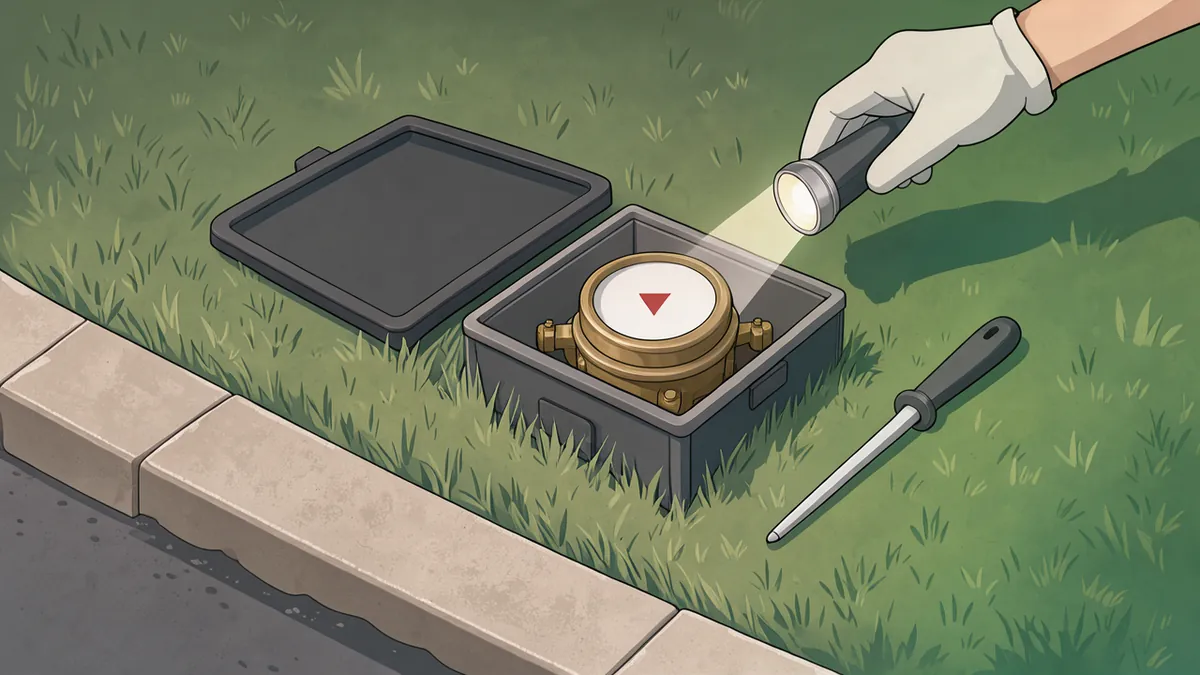
In most metro Atlanta neighborhoods the meter sits in a box in the ground near the street. Cobb County Water System describes a below-ground box with a lid, usually in the front yard near the curb (Cobb County); Henry County Water Authority (HCWA) says it can also be under a metal sidewalk cover marked "water" (HCWA); and Austell notes the box often lines up with the main outside faucet (Austell).
- Lift the lid with a tool. Austell suggests a large screwdriver in the hole in the lid, and HCWA warns that lids can be heavy. Set it back flat when you finish.
- Look before you reach in. HCWA says bugs and small animals sometimes hide in meter boxes. Use a flashlight and work gloves: University of Georgia entomologists call avoidance and gloves the only sure protection from venomous widow spiders, and say anyone bitten should go to the emergency room (UGA CAES).
- Leave the utility's valve alone. The box usually also holds the curb stop shown in Gwinnett County's meter box diagram. Cumming's code bars anyone the city hasn't authorized from operating its curb stops, meters and valves (Cumming Code, Sec. 111-69), and the test doesn't need them.
- Water flowing in the box or the street goes to the utility. Gwinnett's Department of Water Resources (DWR) handles those leaks through its emergency dispatch center (Gwinnett DWR).
How to read your water meter
Lift the meter's protective cap, if it has one, and find these parts:
| Part of the meter | What it shows | How to use it |
|---|---|---|
| Register (odometer-style numbers) | All the water that has passed through the meter | Photograph it; the difference between two readings is the water used in between |
| Sweep hand (large needle) | Water moving through the meter now | Note its position when the test starts |
| Leak indicator (small triangle, arrow or wheel) | Turns with even a small flow | If it turns while no water is in use, water is going somewhere |
| Digital display (some newer meters) | The reading and, on some models, the flow rate | On McDonough's meters, a flashlight on the photo eye wakes the screen, which alternates between reading and rate in gallons per minute |
Table sources: Cobb's water leaks page and meter factsheet, Gwinnett DWR and McDonough.
Check the units before doing any math. Austell's meters measure gallons; Cobb's register counts gallons but the county bills in 1,000-gallon steps, so two bills can match even when use differed slightly; and Atlanta prices sewer use per CCF, which its rate page equates to 748 gallons (Atlanta DWM).
Compare the meter with your bill, too. Cobb and the Cherokee County Water and Sewerage Authority (CCWSA) say the meter should read at least the latest reading on your bill; a lower number means a misread, which is a call to the utility, not a leak (CCWSA).
The meter leak test, step by step
Georgia utilities describe the same basic test with different waiting times. This is the version we ask customers to run before we arrive:
- Stop all water use. Turn off faucets, showers, the washer and the dishwasher, and ask everyone not to flush. Gwinnett says to leave appliance supply valves open unless an appliance runs constantly, as some ice makers do; Georgia's plumbing amendments put the ice maker's shutoff valve within reach on the refrigerator's floor (Georgia DCA).
- Shut off the sprinklers. Austell and McDonough tell irrigation owners to turn off the controller and close the valves on the double check valve assembly.
- Watch the leak indicator for a minute or two. Cobb says a spinning indicator with no water in use may mean a leak; on a digital meter, McDonough says any flow rate with everything off means water is passing through.
- If nothing moves, record the reading and wait. Gwinnett, CCWSA and EPA's WaterSense program use two hours (EPA); Cobb uses one. HCWA adds a check ten minutes after the two hours.
- Read it again. Gwinnett says the number should not have changed; any change, or any movement during the test, means you probably have a leak.
To size the leak, divide the change by the hours. If, hypothetically, the register climbs 12 gallons in two hours, that is 6 gallons an hour, or about 144 a day. For scale, Gwinnett says a constantly running toilet can waste 200 gallons or more a day, and EPA says nine percent of homes have leaks wasting at least 50 gallons a day.
A still meter doesn't rule out every leak. Cobb notes that a leak can be intermittent and suggests a reading, an hour without water use, and a second reading. Its bills also carry a 13-month usage graph, where a spike may mean a leak if nothing at home changed, such as more people, irrigation or filling a pool (Cobb County).
Service line or house? The shutoff test
Once the meter shows a leak, your main shutoff splits the problem in two. The plumbing code calls for a full-open valve on the house side of every water meter and another where the water pipe enters the building (2024 IPC, Section 606.1), and Cumming requires customers to keep a private cutoff valve on their side of the meter (Sec. 111-63). HCWA says the main shutoff is usually near the water heater, in the basement, garage or crawl space.
- Close the main shutoff at the house.
- Prove it closed. Open a faucet inside. Under HCWA's test, if water still flows after several seconds, the valve isn't working and the meter can't tell you whether the leak is inside or outside. Get that valve fixed anyway; it is the one you need in an emergency.
- Go back to the meter. If the leak indicator or dial hand still moves, water is flowing between the meter and the shutoff. HCWA calls that an underground leak, and Cobb says it is most likely in the service line from the meter to the house.
- If the meter stops, the leak is inside the house.
- Reopen the main shutoff when you're done.
One catch: a leak in a sprinkler line that branches off before the main shutoff looks like a service line leak, so close the sprinkler valves first.
What the result means and who fixes it
| What you found | What it usually means | Who handles it |
|---|---|---|
| Water flowing in the meter box or the street | A leak on the utility's side | Your utility; Cobb says a leak before the meter is the county's to repair and shouldn't affect your bill |
| Meter keeps moving with the house valve closed and holding | A leak in the buried service line or a branch ahead of the valve | The owner; this is the pipe we repair |
| Meter stops when the house valve closes | A leak inside: toilet, faucet, water heater, appliance or pipe | The owner; see the next section |
| Meter still, bill high | A misread, an intermittent leak or a change in use | Compare meter and bill; ask the utility about a misread |
For how each north metro utility draws the line at the meter, see our main water line repair article.
Water gushing into the yard or basement, or a house without water, is an emergency: close the main shutoff if you can reach it safely and call us at (404) 482-2527. If your valve won't hold, only the utility can stop the water at the meter; McDonough, for one, lets anyone with a plumbing emergency on private property ask the city to do that (McDonough).
Tracking down a leak inside the house
If the meter stopped when you closed the main valve, start with the toilets. Cobb calls a toilet leak the most common leak inside the home, notes that some are silent, and blames most on a worn or damaged flapper. To test one:
- Put a few drops of food coloring in the tank, not the bowl, and don't flush. EPA says color in the bowl after 10 minutes means a leak; Gwinnett waits 30 minutes and HCWA 15 to 20. Flush afterward so the dye doesn't stain, as EPA advises.
- If tank water runs over the overflow tube, Austell says the fill valve isn't shutting off and may need replacing.
- Gwinnett calls a new flapper a relatively easy do-it-yourself job, and EPA suggests replacing it at least every five years.
Then check faucets and showerheads, the pipes under sinks and in the basement, and around the water heater, as Gwinnett lists. EPA says a faucet dripping once a second wastes more than 3,000 gallons a year. The code puts a shutoff valve on the supply to each fixture except bathtubs and showers, and to every appliance (Section 606.2); close them one at a time while someone watches the leak indicator to see which one stops it.
Check the pressure too: Forsyth County says high pressure can damage pipes, wear out fixtures and waste water, and a failing pressure-reducing valve (PRV) may be behind a sudden rise (Forsyth County). Our water pressure article shows how to read a gauge before and after the PRV.
Frequently asked questions
Will my utility fix a leak between the meter and my house?
In the systems cited here, no. Cobb says a leak after the meter is the property owner's responsibility, Gwinnett says a leak between the home and the meter is on private property, and CCWSA isn't responsible for the service line between the meter and the home. They do take reports of water in the meter box or the street.
Can a smart meter tell me I have a leak?
Some can. HCWA customers with an upgraded smart meter can join its portal to track use and set usage alerts (HCWA), and Cobb lends a flow monitor that straps onto the meter for up to 90 days. An alert still needs the shutoff test to show where the water goes.
Will I get a credit for the water I lost?
Possibly. Cobb gives a partial credit once in a rolling 12 months, for no more than two months, with a repair receipt, a parts receipt or at least a letter explaining the fix (Cobb County); HCWA reviews leak adjustment requests as a courtesy. Our main water line repair article lists other utilities' rules. Keep your meter photos and the repair invoice.
How Georgia Sewer can help
Run the test, note the readings and times, and whether the meter stopped when you closed the main shutoff. Then call Georgia Sewer at (404) 482-2527. If the meter kept moving with the house valve closed, we confirm the leak on the service line, trace the line's route and find the leak before we dig. Our water line repair service fixes a leak in otherwise sound pipe, and water line replacement covers a line failing along its length. If pressure readings point to the PRV, we repair or replace the pressure-reducing valve. We explain what we found before any work starts and give you the invoice your utility asks for with a leak credit request. Water in the meter box or the street goes to your utility first.
Sources
- Gwinnett County Department of Water Resources: Leak Detection
- Cobb County Water System: Water Leaks
- Cobb County Water System: How CCWS Reads Your Water Meter (factsheet)
- Henry County Water Authority: Leak Information
- Henry County Water Authority: AMI Smart Meters
- Cherokee County Water and Sewerage Authority: FAQs
- City of McDonough: How to Detect Water Leaks
- City of Austell: How to Read Your Water Meter
- U.S. Environmental Protection Agency (WaterSense): Fix a Leak Week
- International Code Council: 2024 International Plumbing Code, Chapter 6: Water Supply and Distribution (Sections 606.1 and 606.2)
- Georgia Department of Community Affairs: Georgia State Amendments to the International Plumbing Code (2024 Edition)
- City of Cumming (Cumming Utilities): Cumming Code, Chapter 111: Utilities Ordinance (Sections 111-63 and 111-69)
Guides that pick up where this one stops.
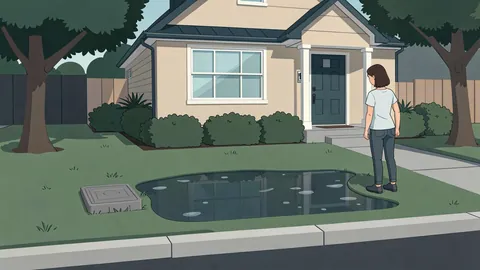
Main Water Line Repair in North Metro Atlanta: Who Fixes What
Georgia Sewer repairs and replaces the water line from the meter to your house in north metro Atlanta. Who owns what, leak signs, permits. (404) 482-2527.
Low Water Pressure: Is Your Water Service Line the Cause?
Weak water at every tap? Georgia Sewer finds whether the utility, the PRV or your buried service line is to blame, and we fix the PRV or the line.
Lead Water Service Lines in Georgia: How to Check Yours
Georgia Sewer replaces water service lines. How to look up your line in your utility's lead inventory, check the pipe yourself and cut lead exposure meanwhile.