Sewer Smell Outside the House: Where It Comes From
Why does it smell like sewer outside my house, and who should fix it?
Short answer
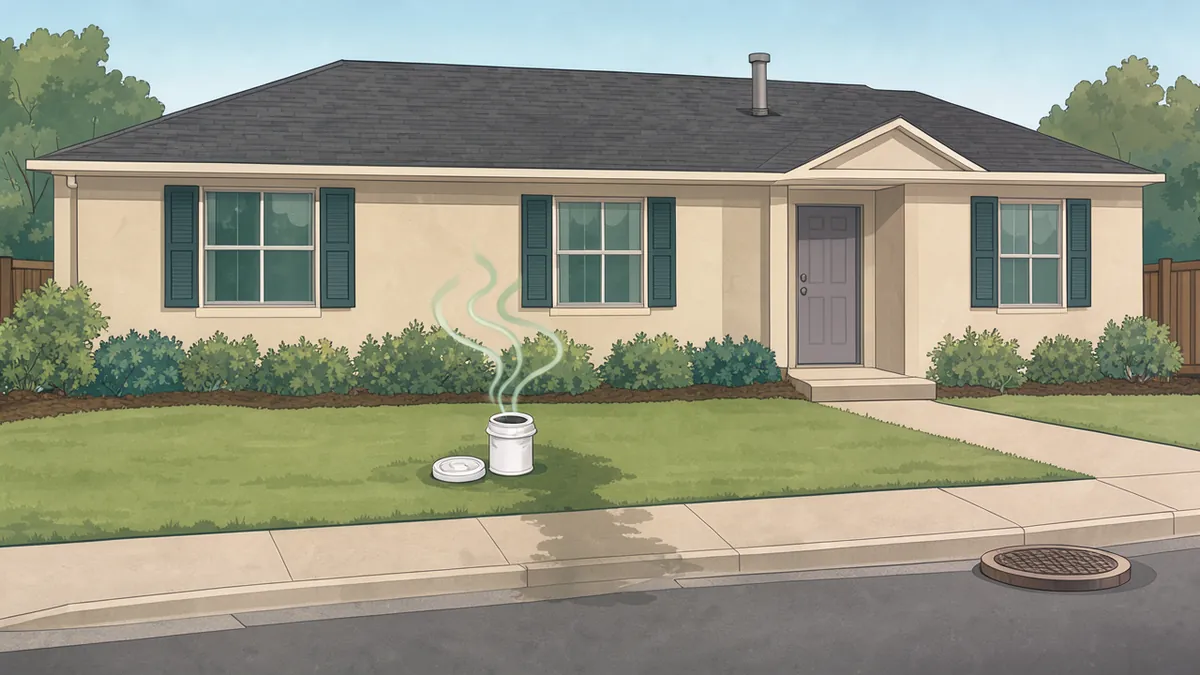
Outdoors, a sewer smell usually comes from the plumbing vent on the roof, an open or broken cleanout, a leak in the buried sewer line, a septic tank or drain field, or the public sewer. If it could be natural gas, leave and call 911 or the gas company from a safe place first. After that, where and when you notice the smell points to the source: on your property it's ours to find, and public manholes and pump stations are your sewer provider's.
On this page
A sewer smell that meets you in the driveway or drifts across the patio is harder to pin down than one inside. The wind moves it, it comes and goes, and the source may be on your roof, under your lawn, in a septic tank or in a manhole down the street. Some of those are normal, some are yours to fix, and some belong to your sewer provider.
At Georgia Sewer, we track down outdoor sewer odors across metro Atlanta, and here is how we sort them out, starting with gas. If the smell is inside, start with sewer gas smell in the house; to have us find the source outside, call (404) 482-2527.
First, make sure it isn't natural gas
"Rotten eggs" describes both. OSHA lists sewers among the places hydrogen sulfide occurs naturally and notes its rotten-egg odor (OSHA), and Atlanta Gas Light describes the same odor for natural gas. Outdoors, it lists more signs of a leak: blowing dirt, discolored vegetation, continued bubbling in standing water, and a hissing or roaring noise near a gas line. It asks customers to act on even a small amount of the odor and not to rely on smell alone. If you notice any of these, or can't tell what you're smelling near a gas meter or line, follow its steps (Atlanta Gas Light):
- leave the area; don't try to find the source or stop the leak;
- avoid anything that could make a spark or flame, including phones, lights, electronics and vehicles;
- call 911 or the gas company from a safe location away from the leak;
- stay away until the gas company or emergency crews say it's safe.
If another company supplies your gas, its website and bill list its emergency steps. Everything below assumes gas has been ruled out.
Where you smell it tells you a lot
Start with where the smell is strongest and when it shows up.
| Where and when you notice it | Likely source | Who handles it |
|---|---|---|
| Near the roofline or an upstairs window, coming and going with the wind | The plumbing vent | Often normal; we check a vent that is blocked, cracked or too close to a window |
| At a short capped pipe in the yard | A missing or cracked cleanout cap | You can replace a cap; we repair a broken cleanout |
| Along the route to the street, with a wet spot when it hasn't rained | A leak in your sewer line | Us: camera inspection, then repair |
| Over the septic tank or drain field | The septic system | A septic contractor; we clear the line from the house to the tank |
| At a manhole cover, a pump station or the street | The public sewer | Your sewer provider |
| At a storm drain in dry weather | Sewage reaching the storm system | Your city or county |
| With blowing dirt, dead grass, bubbling or hissing | A possible gas leak | Leave; call 911 or the gas company |
The usual sources, from the roof to the street
The plumbing vent on your roof
Your drains need air. The plumbing code requires a vent system that lets air into and out of the drains so the water seals in the traps hold (2024 IPC, Section 901.2), and that air comes from the same pipes that carry sewage. Georgia's amendments require a vent through a roof to end at least 6 inches above it (Georgia amendments, Section 903.1.1). The code also keeps vent openings from sitting directly beneath a door, an openable window or an air intake, or within 10 feet of one horizontally unless the vent ends at least 3 feet above its top (Section 903.5). Georgia has adopted the 2024 IPC with these amendments; DCA's latest announcement sets January 1, 2027 as the effective date and an earlier memo said January 1, 2026, so ask your building department which edition it enforces (DCA).
So a faint whiff near the roof can be normal. EPA says the same of septic systems: a roof vent is a normal source of odor, it can clog with leaves or debris, and a downdraft can carry the smell down; such a vent may need to be cleaned or raised, and charcoal filters for roof vents are available (EPA). If the smell is strong, constant or reaches a window or deck, call us rather than climbing onto the roof.
An open or broken cleanout
A cleanout is a capped pipe that opens into your sewer line. Georgia's amendments call for one near the point where the building drain meets the building sewer, brought up to ground level, and another within 10 feet of the public right-of-way (Sections 708.1.2 and 708.1.3). With the cap missing or cracked, your sewer line vents right where you walk; the City of Valdosta lists eliminating sewer odors around the home among the reasons to keep cleanouts capped (City of Valdosta). Broken or missing cleanout cap covers the fixes and who looks after the cleanout near the street.
A leak in the buried sewer line
A cracked pipe or a joint that has pulled apart lets sewage seep into the soil. The St. Louis sewer district lists a sewage smell outside the building, wastewater leaking from cleanouts and wet ground in the yard among the signs of a blocked or damaged lateral (MSD).
Atlanta's Department of Watershed Management gives a quick way to tell leaks apart: one that is cloudy and smells like sewage or stormwater is likely in the sewer system, including the pipes from the house to the main, and one that runs clear and smells of chlorine is likely in the water system (Atlanta DWM). For a wet spot with no smell, run the water meter leak test first; signs of a broken sewer line covers the other clues.
A septic tank or drain field
On septic, the tank and drain field are the first suspects. The Georgia Department of Public Health's manual lists a sewage odor outside the house, where the drain field isn't saturated and nothing is backing up, among the signs of a failing system, along with effluent surfacing or ponding on the ground (DPH manual). EPA adds damp spots and bright green, spongy grass over the tank or field, even in dry weather (EPA). We don't pump septic tanks, but we clear and camera the line from the house to the tank; septic drain field failure covers what comes next for the field.
Manholes, pump stations and storm drains
Some odors come from the public system. OSHA notes that hydrogen sulfide is heavier than air and collects in low-lying and enclosed spaces such as manholes and sewers (OSHA). Pump stations, also called lift stations, move sewage where it can't flow downhill.
A smell around a manhole cover, a pump station or the street is the provider's to investigate, and so is sewage coming out of a manhole:
- Atlanta's watershed department takes reports of sewer odor through ATL311 (Atlanta DWM).
- Gwinnett's Department of Water Resources asks residents to call its dispatch center immediately about sewer spills and overflowing manholes (Gwinnett DWR).
- Marietta asks anyone who sees or smells a sewer spill to report it immediately (City of Marietta).
- Cobb County's water system has an online sewage overflow report form (Cobb County).
A storm drain is meant for rain, so a sewage smell from one is worth reporting too. DeKalb County lists sewage overflows, and unexplained water flowing in storm drains during dry weather, among the problems to report (DeKalb County).
How we track down an outdoor sewer smell
On the phone, we ask where and when you notice the smell and whether drains inside are slow. On site, we work from the house outward:
- We check that the roof vents are open and intact and how close they end to windows, doors, decks and air intakes.
- We walk the sewer line's route, checking each cleanout and looking for wet, sunken or unusually green ground.
- If a leak or break is likely, we run a sewer camera inspection from a cleanout; the camera's transmitter lets us mark the spot and its depth from above ground.
- We put our findings and recommendation in writing, give you the video, and explain it before any work starts.
Gwinnett's Department of Water Resources also smoke-tests and cameras its sewers and notifies owners when a defect turns up on their property (Gwinnett DWR); a notice like that is a good reason to have us camera your line.
Safe checks before you call, and what not to do
Safe checks that save time on the visit:
- Keep notes: when and where the smell is strongest, the wind, and whether rain or heavy water use changes it.
- Look at each cleanout while the drains are working normally. Is the cap there, whole and snug?
- Walk the line's route on a dry day and note wet spots, sinking ground or a strip of greener grass.
- Check inside. Slow or gurgling drains along with an outdoor smell point to the sewer line.
What not to do:
- Don't lift a manhole cover, a pump station hatch or a septic tank lid. DPH's manual warns never to enter a septic tank without special equipment: people have died in them, and they hold toxic gases and little or no oxygen (DPH manual). OSHA warns that hydrogen sulfide can almost immediately overcome unprepared workers, including rescuers.
- Don't open a cleanout while drains are backing up. A blocked line can fill the cleanout pipe with sewage.
- Don't dig to find a leak. Georgia 811 asks for a free locate ticket at least 3 business days before any digging (Georgia 811).
- Don't mask it. Bleach or fragrance can't seal a crack, and a masked smell can't lead us to the source.
- Keep children and pets off wet, smelly ground. EPA says raw sewage carries bacteria, viruses, protozoa and intestinal worms, and that people can be exposed through direct contact in places such as lawns (EPA).
When the smell is a health concern
Don't judge the danger by how strong the smell seems. OSHA explains that after a while at low concentrations, or quickly at high ones, people can no longer smell hydrogen sulfide (OSHA), and that prolonged exposure at low levels may cause nausea, tearing of the eyes, headaches or loss of sleep (OSHA health effects). See a doctor if you feel ill after exposure: health questions are your doctor's, the public sewer is your provider's, and your own pipes are ours to inspect.
Sewage on the ground or coming out of a manhole is urgent: keep people and pets away and report it to your sewer provider, and call us too if it's coming from your cleanout. If sewage comes up inside, stop using water and call us for emergency sewer and drain service.
Frequently asked questions
Is it normal to smell sewer gas from the roof vent?
A faint, occasional whiff can be, since the vent lets the drain system breathe. A strong or constant smell, or one that reaches a window or deck, is worth having us check.
Who fixes a smelly manhole on my street?
Your sewer provider, which owns the public manholes and pump stations. Atlanta, Gwinnett, Marietta and Cobb all take such reports.
Who pays to fix a leaking sewer line under my yard?
It depends on your sewer provider, which sets where your part of the line ends. Who is responsible for the sewer line in Georgia shows how to check.
How Georgia Sewer can help
Rule out gas first, check your cleanout caps and walk the line's route, then call Georgia Sewer at (404) 482-2527 if the smell stays. We find the source with a sewer camera inspection, fix a cracked or separated pipe with sewer line repair, and replace broken cleanouts through sewer cleanout installation and repair. When the smell comes with slow drains throughout the house, main sewer line cleaning clears the line.
Sources
- Atlanta Gas Light: Sewer Blockage Safety for Customers
- Occupational Safety and Health Administration: Hydrogen Sulfide - Overview
- International Code Council: 2024 International Plumbing Code, Chapter 9: Vents (Sections 901 and 903)
- Georgia Department of Community Affairs: Georgia State Amendments to the International Plumbing Code (2024 Edition)
- U.S. Environmental Protection Agency: Resolving Septic System Malfunctions
- Georgia Department of Public Health: Manual for On-Site Sewage Management Systems (June 2026)
- City of Atlanta Department of Watershed Management: Report a Problem
- Gwinnett County Department of Water Resources: Report a Problem
- Gwinnett County Department of Water Resources: Sewer Lateral
- Metropolitan St. Louis Sewer District: Lateral Line: A Guide to Your Private Sewer Line
- City of Valdosta Utilities Department: 'Cap The Cleanout' Program
- U.S. Environmental Protection Agency: Sanitary Sewer Overflow (SSO) Frequent Questions
Guides that pick up where this one stops.
Sewer Gas Smell in the House: Causes and What to Do
Sewer smell in the house? Rule out a gas leak first, then check the likely causes. Georgia Sewer finds and fixes drain and sewer odors: (404) 482-2527.
Signs of a Broken Sewer Line: Inside, Outside and Under the Yard
Georgia Sewer finds and fixes broken sewer lines. The signs inside, in the yard and on our camera, how to rule out gas or water leaks, and what we do next.

Broken or Missing Sewer Cleanout Cap: Risks and Repairs
A cracked or missing cleanout cap lets rain, debris and pests in and odors out. Georgia Sewer repairs cleanouts; here is what we check and who fixes what.